About Ramaria rasilispora Marr & D.E.Stuntz
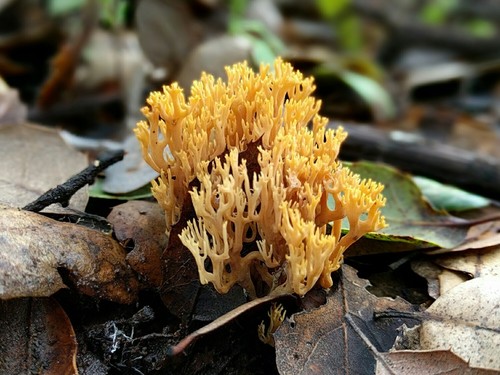
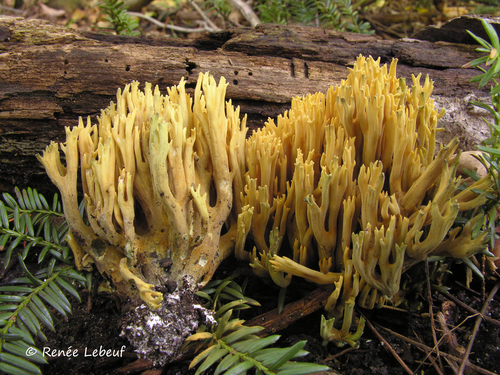
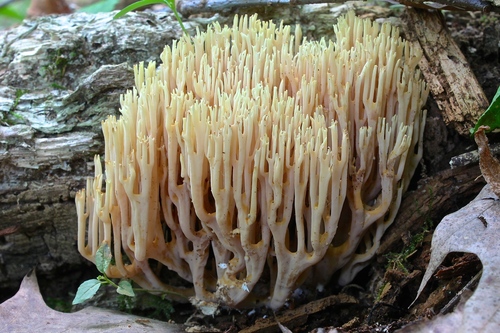
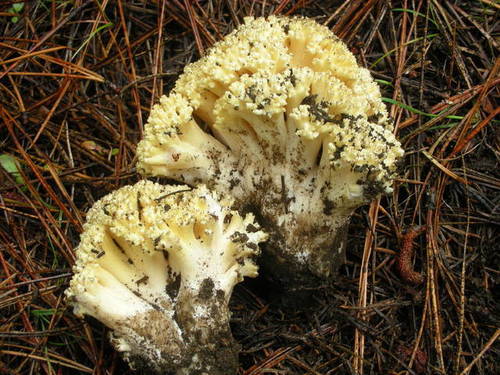
Ramaria rasilispora Marr & D.E.Stuntz produces large, broad fruit bodies that measure 5–30 cm (2–12 in) or more in both height and width. Fruit bodies grow from a single thick, conical stem that is 3–8 cm (1+1⁄8–3+1⁄8 in) long and 2.5–7 cm (1–2+3⁄4 in) wide. The base gives rise to multiple smooth branches, which branch two or more additional times. When young, both the stem and lower branches are whitish, while the upper branches are yellow to apricot-yellow. Branch tips are initially yellow or match the color of the branch, but darken to brown as the fungus reaches maturity. Primary branches are thick, between 2 and 4 cm (3⁄4 to 1+5⁄8 in) in diameter, and upper branches are typically 0.2 to 1.5 cm (1⁄8 to 5⁄8 in) thick. The internal context of the fruit body is fleshy to fibrous, and when dry it has a consistency similar to bendable chalk. Ramaria rasilispora fruit bodies have no distinctive taste or odor. The spore print of this species is orangish yellow to ochraceous. Spores are cylindrical, with a surface texture that ranges from smooth to finely warted, and measure 8–11 by 3–4 μm. The spore-bearing basidia are club-shaped, produce two to four spores (most often four), and measure 47–60 by 8–10 μm. The variety Ramaria rasilispora var. scatesina differs from the main variety in the color of its fruit bodies: the branches of both young and mature specimens range from yellowish-white to light yellow. Fruit bodies of Ramaria rasilispora grow on the ground in coniferous forests, and fruiting occurs in spring and summer. The species is common in western North America, with a range extending south to Mexico and north to Alaska. The nominate variety R. rasilispora var. rasilispora is found in the Pacific Northwest. Variety scatesina was originally collected from coniferous forests of Idaho, and has since been reported growing in a deciduous forest in the eastern Himalayas.