About Ramalina peruviana Ach.
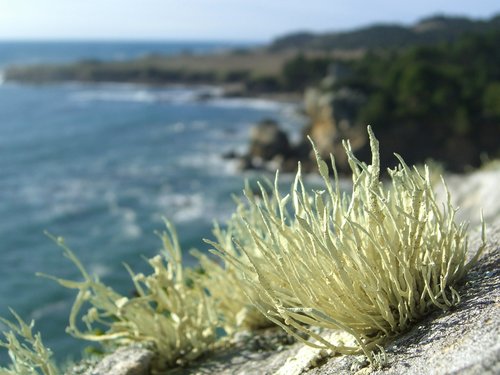
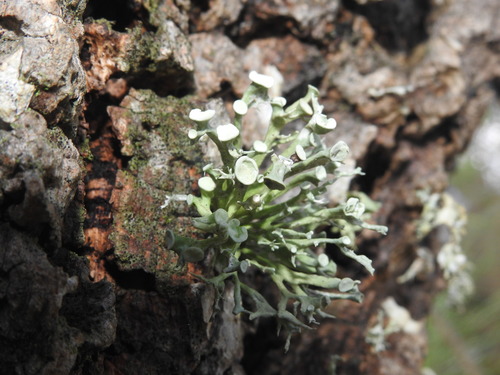
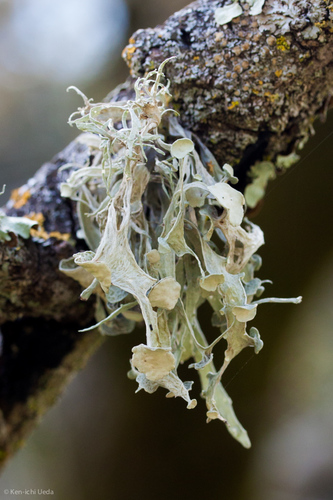
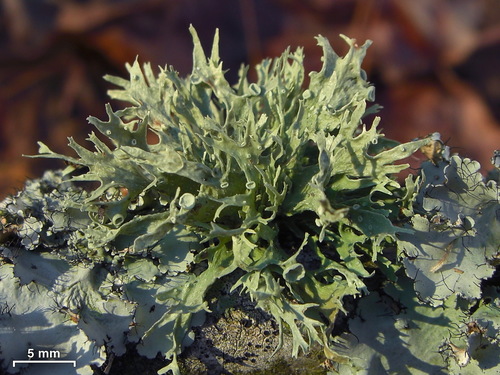
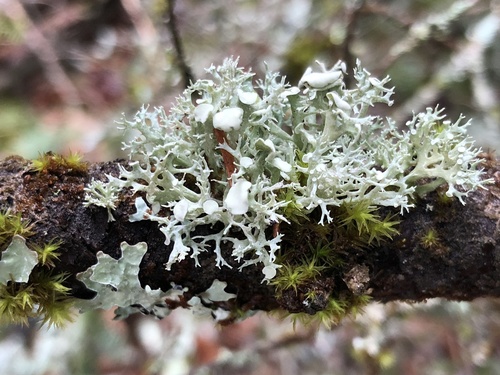
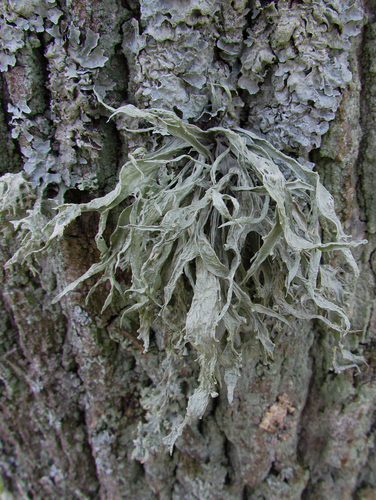
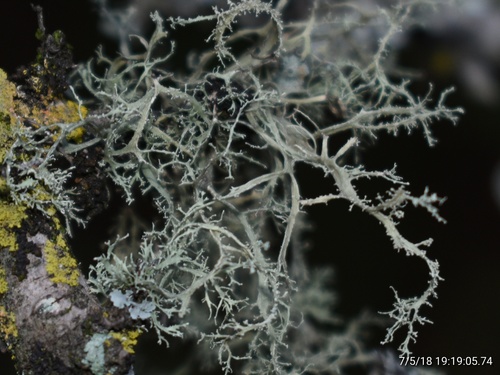
Ramalina peruviana Ach. is a species of lichen with a thallus that ranges in color from grey-green to yellow-green. It forms tufted, erect to slightly hanging clusters that grow 2 to 6 cm long, and reach up to about 3 cm high. This lichen has intricate branching, which varies from nearly symmetrical subdichotomous divisions to more irregular branching patterns. Its branches measure 0.15 to 1.3 mm wide; in cross-section, branches may be flat, subterete (nearly round), or terete (round), and sometimes twist slightly, ending in sharp tips. The chondroid cartilage-like tissue in the central core of its branches has no cracks. The lichen’s cortex is 15–20 μm thick. The thallus surface can be either matt or shiny, and ranges from smooth to rugose (wrinkled); small gas-exchanging porous areas called pseudocyphellae are occasionally present. The lichen’s basal attachment structure (holdfast) may be clearly defined or spread out, particularly in denser colonies. A key distinguishing feature of this species is the presence of soralia, small structures that produce powdery reproductive particles. These soralia are punctiform (dot-like), located along branch edges or at branch tips, and often produce tiny fibrils. The granular reproductive particles (soredia) are 35–50 μm in diameter. Sexual reproductive structures called apothecia are rarely observed in Ramalina peruviana; when present, they grow on the margins or sides of the thallus. If apothecia occur, their discs are 0.4 to 2.7 mm in diameter, and range from concave to flat, sometimes with notches. The ascospores are slender, fusiform (spindle-shaped), typically measuring 14.5–17 by 3–6 μm, and may be straight or slightly curved. Ramalina peruviana’s photosynthetic partner (photobiont) is a green alga from the genus Trebouxia, specifically belonging to clade IV, a group of Trebouxia found in tropical Ramalina species. Ramalina peruviana occurs in subtropical and warm temperate locations. It is typically corticolous (bark-dwelling), but occasionally grows as a saxicolous (rock-dwelling) species, and has been recorded once growing on a wooden fence post. Originally described from Peru, it has also been recorded in other South American countries including Brazil, Chile, Ecuador, and Uruguay. Beyond South America, it is found in Africa, including Morocco, East African nations Kenya, Tanzania, and Uganda, and multiple islands in Cape Verde. In North America its distribution extends north to the southern United States, where it occurs in central Texas, Georgia, and Florida. It is present in Iran’s Hyrcanian forests along the Caspian coast, where it was originally described under the name Ramalina hyrcana, growing on tree trunks and showing good shade tolerance. In Asia it is found in Japan, South Korea, Taiwan, and China. In southern Taiwan it is locally abundant, particularly growing on the trunks of Cocos nucifera (coconut palm). In Chinese habitats it grows at elevations ranging from 2,000 to 3,450 m, usually found on the bark of Camellia or Rhododendron. It occurs in Australia, several Pacific Islands, Tristan da Cunha, Saint Helena, New Zealand (where it is relatively uncommon), and nearby Pacific locations including Chatham Islands, Manawatāwhi / Three Kings Islands, Kermadec Islands, and Cook Islands. In Australia, Ramalina peruviana grows exclusively as a corticolous species, and is most commonly found on the mangrove species Ceriops tagal and Rhizophora stylosa. The high temperatures, high light intensity, and low humidity of these mangrove communities are thought to be ideal for the lichen’s growth. In Morocco, it was previously documented under the name Ramalina crispans.