About Ramalina menziesii Taylor
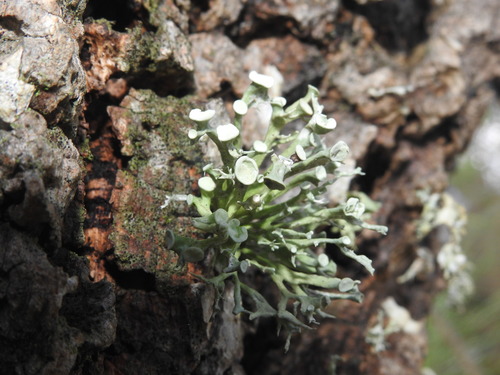
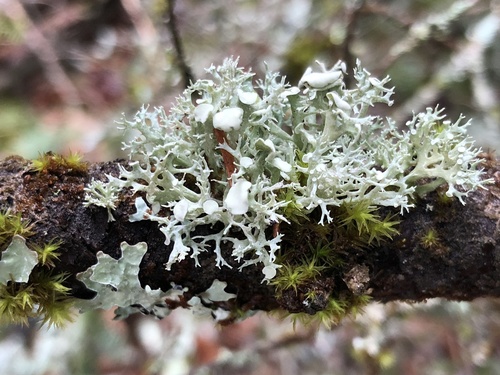
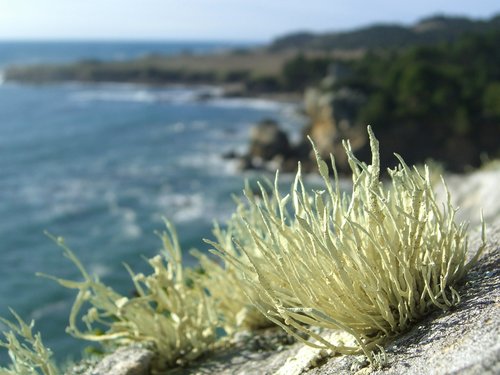
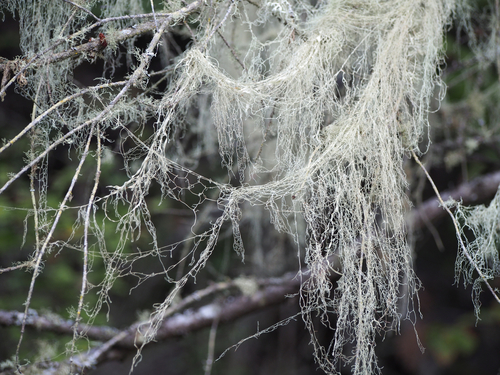
Ramalina menziesii Taylor is a fruticose epiphytic lichen that grows in the coastal regions of North America, and forms large, conspicuous thalli. Its net-like morphology forms as perforated tissue expands from the apex of the thallus. This morphology varies: it forms thick nets in sunny regions and thin filaments in foggy regions. Studies suggest this morphological variation comes from both genetic differences between populations and phenotypic plasticity within the species. Lichen spot tests on the cortex of this species return K−, C−, P− and KC+ (dark yellow).
Ramalina menziesii, commonly called lace lichen, ranges from Baja California, Mexico, north through six distinct ecoregions to the temperate rainforests of Alaska. The habitat it occupies varies with distance from the coast across this range. In Baja California, it is most common on shrubs in coastal fog deserts, and on cacti, shrubs and trees in inland chaparral habitats. In coastal California, it occurs in habitats dominated by coast live oak, tanoak, California laurel, red alder, and willow. In inland California, it grows in oak savannas dominated by valley oak, blue oak, and coast live oak. Northern and southern California populations of this lichen are geographically separated by the Coast Ranges. Moving north into the Pacific Northwest, lace lichen grows in temperate mixed coniferous forests of Sitka spruce, western hemlock, and some broad-leaved species, and disappears quickly when moving further inland in this northern part of its range. Its range continues north along the Pacific coast of British Columbia, all the way to Alaska.
In the deciduous blue oak (Quercus douglasii) woodlands of central coastal California, Ramalina menziesii plays an important role in annual biomass turnover. The total standing biomass of this lichen and other co-occurring epiphytic lichens in this area measures 515 grams per tree, which equals 706 kilograms per hectare. 94% of this standing biomass belongs to R. menziesii. Even though this area is much drier than the study sites examined in similar research, R. menziesii contributes just as much to biomass and nutrient turnover here as epiphytic lichens do in wetter locations.
One study of Ramalina menziesii across its full range, from northern Baja California to the Queen Charlotte Islands, identified morphological variation patterns shaped by environmental factors. Key findings include a correlation between the number of perforations in the lichen's net buds, and both proximity to the coast and latitude. Coastal samples have fewer perforations, and the number of perforations decreases as latitude increases. This pattern is particularly noticeable north of central Oregon, where all samples are exclusively coastal. The study also found significant relationships between morphological variation and environmental factors including NaCl concentration and annual temperature variation. While the distribution of different R. menziesii forms aligns somewhat with patterns of annual precipitation, the presence and form of R. menziesii does not correlate with the distribution of the eight tree species that act as its substrate.
California indigenous tribes first documented historical uses of Ramalina menziesii. The Kawaiisu people are reported to have used it for magical properties: it was placed in water to bring rain, or placed in fire to repel thunder and lightning. The Kashaya Pomo people of Northern California used it as sanitary material.