About Ramalina dilacerata (Hoffm.) Hoffm.
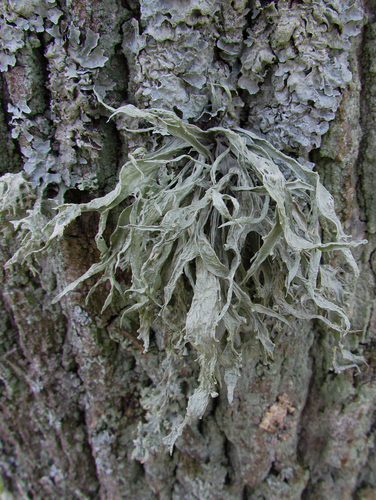
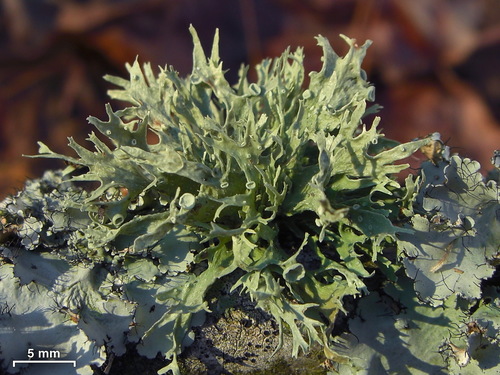
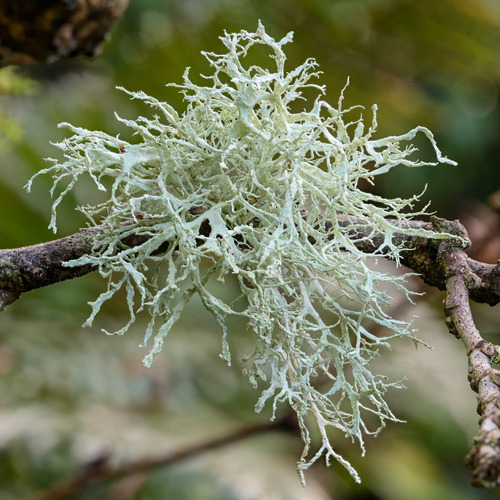
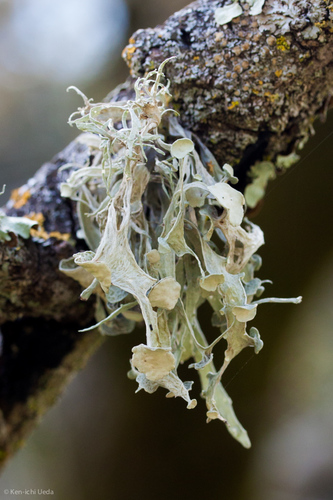
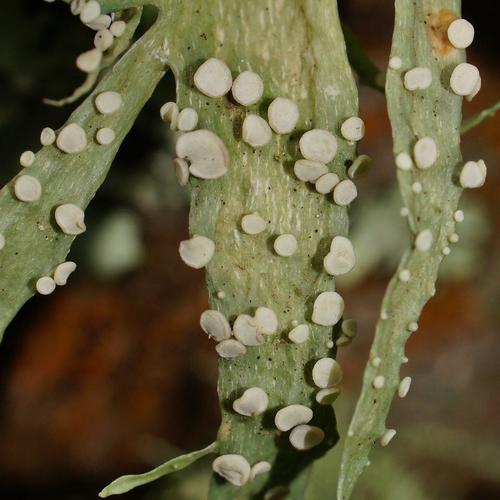
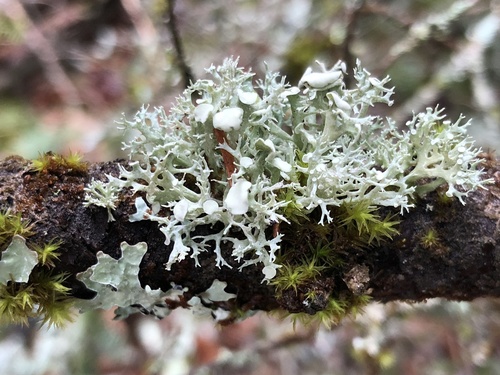
Ramalina dilacerata (Hoffm.) Hoffm. has a fruticose growth form, with a pale yellowish-green thallus that grows up to 1.5 (exceptionally 2) cm tall. The thallus is erect to ascending, abundantly branched, and firmly attached to its substrate by a basal holdfast, forming shrubby tufts that reach up to 2 cm broad. Its branches are less than 1 mm wide, inflated and hollow (fistulose), and pellucid when wet. They have between a few and many small, elongated or rounded openings called fenestrations. The cortex is thin, while the medulla is white, very lax (especially beneath apothecia), and has sparse hyphae that form discontinuous bundles of chondroid tissue. Apothecia, the species' reproductive structures, are common; they are lecanorine, with a greenish disc and a thin, smooth thalline margin. They are mostly located subterminally on smaller branches, and each is subtended by a short, pointed spur. The asci are 8-spored, clavate, and belong to the Bacidia-type. Ascospores are 1-septate, hyaline, and shortly fusiform, measuring 12-15 x 4-6 μm. The photobiont partner of R. dilacerata is a chlorococcoid green alga. In terms of distribution and ecology, R. dilacerata ranges across North America from Alaska south to California, occurring west of the Cascade Mountain range, and extends inland as far as western Montana. It grows primarily in low-elevation riparian forests and shrublands, though it may occasionally occur in areas with strong oceanic influences east of the Cascades. In Europe, R. dilacerata has been recorded from a small number of sites across northern and central Italy, including the regions of Veneto, Trentino-Alto Adige, Abruzzo, Molise, Campania, and Basilicata. It is considered extremely rare in the montane and subalpine belts of the Italian peninsula. Ramalina dilacerata most commonly colonizes the bark and twigs of acid-barked trees, especially conifers. More rarely, it can also grow on lignum (woody material) in highly humid environments.