About Rallus semiplumbeus P.L.Sclater, 1856
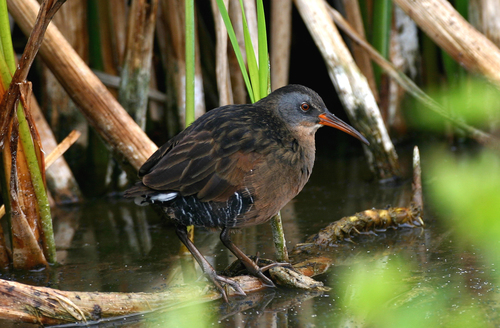
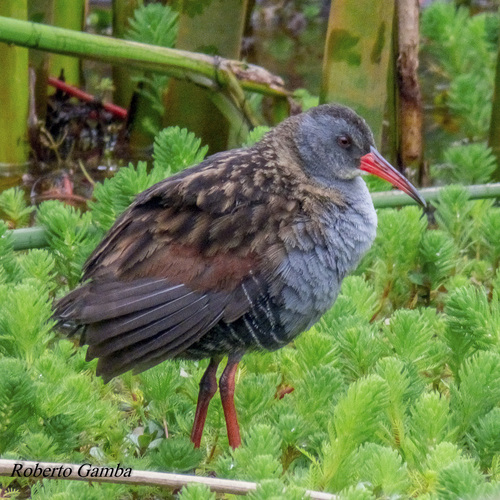
The Bogotá rail (scientific name Rallus semiplumbeus P.L.Sclater, 1856) is a typical member of the genus Rallus, with a long, slightly decurved bill, a plump body, and a short tail. It measures 25 to 30 cm (9.8 to 12 in) in length. Its bill is dull red, fading to dusky black along the culmen and at the tip. It has red eyes with black pupils, and dull coral red legs. The sexes have identical plumage. Adult Bogotá rails have sepia brown crowns and napes, and plumbeous gray faces, breasts, and bellies. Their backs, tertials, secondaries, and the upper side of the tail are dull brown, with black streaks on the back. Their primaries are black with chestnut fringing, and a rufous patch is usually visible on the wing coverts. The rear sections of their flanks are black with fine white vertical barring, and their undertail coverts are white. A small white patch sits on the throat just below the bill. Juveniles resemble adults, but have sooty tips on their breast feathers and a whitish throat. The Bogotá rail is a scarce species endemic to the departments of Cundinamarca and Boyacá in the Eastern Andes of Colombia. It lives in wetlands, ponds, and wet meadows on montane slopes and in páramo, at elevations between 2,000 and 4,100 m (6,600 to 13,500 ft). The species is most commonly found in dense reedbeds dominated by the sedge Schoenoplectus californicus, which also contain emergent vegetation including Juncus effusus, Polygonum punctatum, Rumex obtusifolius, Bidens laevis, Hydrocotyle ranunculoides, and Carex acutata. Reedbeds bordered by dwarf Chusquea bamboo or other dense vegetation appear to be the favored habitat. A study of Bogotá rails at La Conejera wetland found that the birds spent an average of 84% of their time in this habitat type. They were also observed in wet grasslands, but seem to mainly enter this more open, predator-friendly habitat when moving between patches of wetland. They were only seen on floating vegetation occasionally.