About Rallus obsoletus Ridgway, 1874
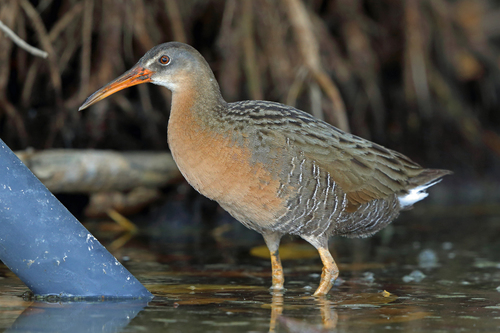
Ridgway's rail (Rallus obsoletus) is a bird species in the rail family Rallidae. It is principally found along the Pacific coast of North America, ranging from the San Francisco Bay Area to southern Baja California, and also occurs in some regions of the Gulf of California. It is a chicken-sized bird that inhabits brackish tidal marshes, and rarely flies. Its common name honors American ornithologist Robert Ridgway. This species is closely related to the clapper rail, and was classified as a subspecies of clapper rail until recently. It has a long, downward-curving bill, and is grayish brown overall, with a pale chestnut breast and a conspicuous whitish rump patch. It is most active at night and during twilight. Ridgway's rail forages along the ecotone between mudflats and higher vegetated zones, and in tidal sloughs. Its preferred foods are mussels, clams, arthropods, snails, worms, and small fish, which it obtains by probing substrate and scavenging the surface while walking. The bird only forages on mudflats or in very shallow water that is near taller plant material, which provides protection during high tide. During high tide, it may also prey on mice, and has been recorded scavenging dead fish. One of the largest populations of Ridgway's rails resides in San Francisco Bay, where around 1,100 individuals are resident. Historically, its geographic range spanned more than 90% of the total area of San Francisco Bay. Other common locations for sightings of this species around San Francisco Bay include the Napa Sonoma Marsh, Bothin Marsh in Mill Valley, Gallinas Creek in San Rafael, Arrowhead Marsh and Damon Marsh in Oakland, the Palo Alto baylands, Charleston Slough in Mountain View, Seal Slough in San Mateo, and Belmont Slough. For cover, Ridgway's rail seeks out emergent wetlands dominated by pickleweed and cordgrass, or brackish emergent wetlands that contain these two plants plus bulrush. It remains unclear whether the species requires any source of fresh water. Although the species is not migratory in coastal wetlands, it disperses juvenile individuals into freshwater wetlands between late August and October. Ridgway's rail has been observed foraging in and near relatively disturbed areas, which demonstrates the importance of protecting even small marsh areas; for example, the species was seen foraging on a small mudflat area within Seal Slough in San Mateo, three miles from the nearest known breeding area in Belmont. As an omnivore, Ridgway's rail eats a wide range of foods, including clams, crabs, mussels, and occasionally small rodents and birds.