About Rallus longirostris Boddaert, 1783
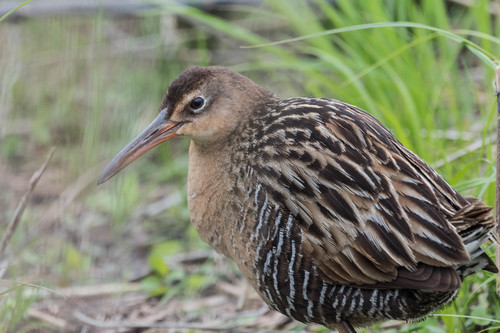
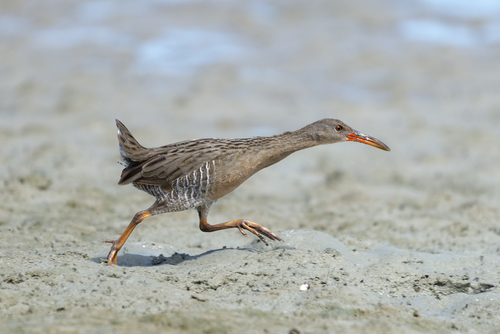
The mangrove rail (Rallus longirostris Boddaert, 1783) measures approximately 33 cm (13 in) in length and weighs between 260 and 310 g (9.2 to 11 oz). It has a long, slender, slightly curved downward bill: the upper mandible (maxilla) is brownish, and the lower mandible is orange-yellow. Its legs are light orange-red, and both sexes share identical plumage patterns.
For the nominate subspecies R. l. longirostris, adult upperparts are dull gray-brown, with darker feather centers. They have a white streak through the loral area on a pale gray face, a whitish throat, tawny buff neck and breast, a white-centered belly, and black-and-white bars on the flanks. Juveniles match the adult pattern but are darker and duller overall. The described subspecies differ in the following traits: R. l. phelpsi has a darker crown and upperparts, and paler underparts than the nominate; R. l. margaritae is the darkest subspecies, smaller than the nominate, and has bolder barring on the flanks; R. l. pelodramus is similar in size to R. l. margaritae but paler in overall color; R. l. cypereti has lighter dark markings on the upperparts and lighter dark flank bars than the nominate.
The mangrove rail occurs discontinuously along the Pacific coast of Central America, and along the Pacific, Caribbean, and Atlantic coasts of South America. It inhabits coastal mangrove swamps, as well as brackish and salt marshes. The accepted subspecies have the following distributions: R. l. phelpsi Wetmore, 1941 ranges from La Guajira Department in northeastern Colombia northwestern Venezuela as far as Miranda state; R. l. dillonripleyi Phelps Jr & Aveledo, 1987 occurs in Sucre state, northeastern Venezuela; R. l. margaritae Zimmer, JT & Phelps, 1944 is found on Margarita Island off the Venezuelan coast; R. l. pelodramus Oberholser, 1937 occurs on Trinidad; R. l. longirostris Boddaert, 1783 is found in Guyana, Suriname, and French Guiana; R. l. crassirostris Lawrence, 1871 occurs in Brazil from the Amazon estuary south to Santa Catarina state; R. l. cypereti Taczanowski, 1878 ranges from Nariño Department in southwestern Colombia through Ecuador to Peru's Department of Tumbes; R. l. berryorum Maley et al., 2016 occurs in El Salvador, Honduras, and Nicaragua, and the population in northwestern Costa Rica is believed to also belong to this subspecies.