About Rallus limicola Vieillot, 1819
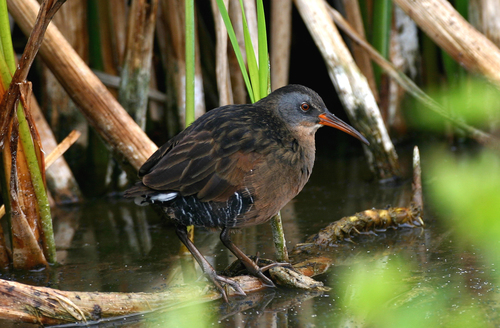
Adult Virginia rails (Rallus limicola) are primarily brown, with darker coloring on the back and crown, and orange-brown legs. To move through dense vegetation, they have a laterally compressed body and stiff forehead feathers that resist wear from pushing through plants. Among all birds, Virginia rails have the highest ratio of leg muscle to flight muscle: leg muscle makes up 25% of their body weight, while flight muscle accounts for 15%. They have long toes that let them walk on floating vegetation, a short tail, and a long, slender reddish bill. Their cheeks are grey, with a light stripe above the eye and a whitish throat. Chicks are solid black. Juveniles have blackish brown upperparts with rufous edges on their feathers, and brownish bills and legs; their underparts are dark brown to black, and their faces are grayish brown. Males and females are very similar in appearance, though females are slightly smaller. Adult Virginia rails measure 20–27 cm in length, have a 32–38 cm wingspan, and typically weigh 65–95 g. The Virginia rail inhabits freshwater and brackish marshes, and sometimes uses salt marshes during winter. Northern populations migrate to the southern United States and Central America, while some populations on the Pacific coast are permanent residents. Their breeding range covers marshes from Nova Scotia to southern British Columbia, California, North Carolina, and extends into Central America. They often live alongside soras, another species of wetland rail. Courtship for Virginia rails begins around May. The male raises his wings and runs back and forth next to the female; both birds bow, and the male feeds the female. Before copulation, the male approaches the female while grunting. Virginia rails are monogamous. Both parents build the nest and care for the young, and only the male defends the breeding territory. Nest construction starts when the first egg is laid, and the nest is a woven basket made from vegetation such as cattails, reeds, and grasses. Virginia rails also build dummy nests throughout the marsh. They place their nests near the base of emergent vegetation, in spots where surrounding vegetation forms a canopy over the nest. Females lay a clutch of 4 to 13 white or buff eggs with sparse gray or brown spots. The eggs typically measure 32 by 24 millimetres (1.26 by 0.94 in). Both parents incubate the eggs for 20 to 22 days, and continue adding nesting material to hide the nest during incubation. After the eggs hatch, both parents feed the chicks for two to three weeks, until the chicks become independent. Young Virginia rails can fly less than a month after hatching, and the pair bond between the parents breaks once the young are independent.