About Rallus indicus Blyth, 1849
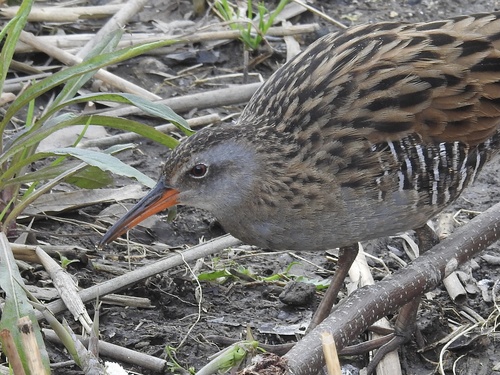
Rallus indicus, the eastern water rail, differs from the slightly smaller nominate form of water rail by having paler upperparts, brown-tinged underparts, and a brown stripe through the eye. When compared to R. a. korejewi, it is darker on the upperparts, has a browner breast, white on the throat, and a more obvious brown eyestripe. This species has different vocalisations from other forms of water rail, and is now typically recognised as a full species. Its behaviour, nest, and eggs are identical to those of other water rail subspecies. R. indicus was considered a separate species in early ornithological works, including the 1898 first edition of Fauna of British India. It was later demoted to a subspecies by E. C. Stuart Baker in the 1929 second edition of the work. In 2005, Pamela Rasmussen, an expert on Asian birds, restored R. indicus to full species status as the eastern water rail in her book Birds of South Asia, and reclassified the other existing forms as western water rail. This treatment has gained widespread acceptance, and was followed in the 2010 publication Birds of Malaysia and Singapore. A 2010 molecular phylogeny study further supported treating R. indicus as a full species, estimating that it diverged from western water rail forms approximately 534,000 years ago. The study also found that differences between the three other water rail races were clinal, and suggested all three should be merged into R. a. aquaticus. The calls of Rallus indicus are quite different from those of the water rail. Its year-round courtship call is a sharp piping kyu, which is longer and clearer than the equivalent call of the European water rail race. Its song is a series of metallic slurred shrink, shrink notes produced at about two notes per second, repeated after a short pause. The eastern water rail does not respond to recorded calls of the nominate subspecies R. a. aquaticus. The average weight of wind-dried R. indicus nests collected in Japan is 95 g (3.4 oz). Rallus indicus is mainly a migratory species. It winters in southern Japan, eastern China, and northern Borneo. It is uncommon in northern Bangladesh, northern Burma, northern Laos, and northern and central Thailand, and does not normally range further south in mainland Southeast Asia. Migrants have been recorded in Sri Lanka in the past. On the Indian mainland, this species is found mainly in northern regions, with only a few records as far south as Mumbai. When newly arrived migrants reach India, they may be so exhausted that they can be caught by hand. Most breeding birds from the Japanese island of Hokkaido migrate far south, including to Korea, but a small number overwinter in the coastal marshes of Honshu.