About Radiola linoides Roth
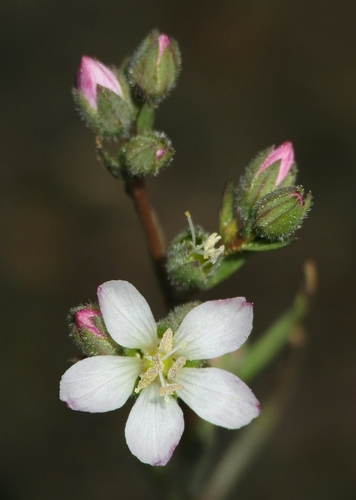
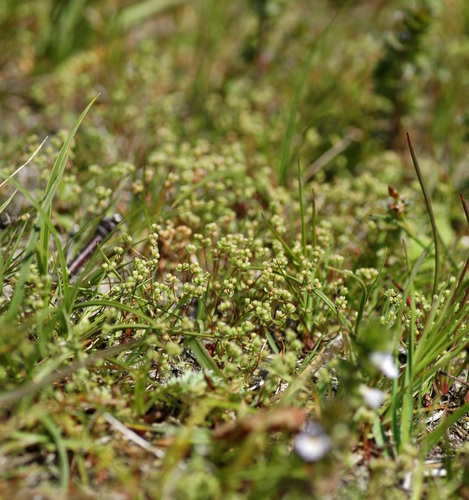
Radiola linoides Roth is a small, herbaceous annual plant. It is often overlooked because of its small size and delicate growth form. It reaches 1.3–7.5 cm (1–3 in) in height and has repeated dichotomous branching, meaning stems divide into two branches at the axils, forming repeated forked subdivisions. The hairless stems are very slender and thread-like, around 0.5 mm in diameter, and are often flushed purple or reddish. Its leaves are arranged oppositely, and are obovate, or ovate to elliptic in shape. They are very small, only 1.5–2 mm long, dull green or slightly glaucous, often tinged purple, and completely hairless. Each leaf has a single vein, and transparent (hyaline) margins that look ragged due to tiny teeth or lobes along the edge. It bears leaf-like bracts. It flowers between July and August, producing numerous tiny flowers at branch tips or at each stem fork. The flowers are white, with 4 equal sepals and 4 petals, and measure 1.0–1.5 mm long. It has 4 stamens 0.5–0.8 mm long, with white anthers. The plant's very small pollen has been analyzed and measured to be around 25μm. After flowering, it produces rounded or globular seed capsules that are generally considered more noticeable than the flowers. Its common name 'allseed' comes from the plant having multiple seed capsules, each holding 8 seeds. The seed capsules are 0.1 mm wide, with 8 cells and 8 valves. Inside the capsules are very small brown seeds, 0.4–0.5 mm long and 0.2–0.3 mm wide, obovoid to ellipsoid in shape, slightly flattened on one side, with a smooth, lustrous surface. Radiola linoides has a wide native range that covers temperate Europe (including Albania, the Balearic Islands, the Baltic States Estonia, Latvia and Lithuania, Belarus, Belgium, Bulgaria, Corsica, Czechoslovakia, Denmark, France, Germany, Great Britain including Northern Ireland, Greece, Hungary, Ireland, Italy, Netherlands, Norway, Poland, Portugal, Romania, Sardinia, Sicily, Spain, Sweden, Ukraine and Yugoslavia), parts of Russia (central European Russia, northwest European Russia and south European Russia), Macaronesia (the Canary Islands, Cape Verde and Madeira), parts of Africa (Algeria, Cameroon, Ethiopia, Madagascar, Malawi, Morocco including the Tingitan Peninsula, Tanzania and Tunisia), and parts of western Asia (Lebanon, Syria and Turkey). It was later introduced to North America, where it occurs in Maine, New Brunswick and Nova Scotia. It was also introduced to New Zealand, where it has been found on the North Island's Kaimaumau Swamp. It is considered extinct in Switzerland, and listed as rare in Lithuania. It is a calcifuge species, meaning it does not tolerate alkaline soils. It grows on acidic, damp soils in grasslands, heaths, and commons, beside ponds, paths, or tracks, in woodland rides, and on roadsides in Scotland. In southern England, it can also be found on the margins of fishponds, in fields or abandoned meadows, and in old sand pits, and grows in moist, boggy places in Devon. On the Iberian Peninsula, it grows in damp forests. It tolerates infertile, peaty or sandy ground. Near the coast, it occurs in dune slacks, sandy grassland, machair, soil-filled rock cracks, and on rocky outcrops. It grows at altitudes between 0 to 100 m (0 to 328 ft) above sea level. In Britain, it is generally found in acidic grasslands and heathlands, on grassy cliff slopes, along the broken, rutted edges of tracks, beside woodland rides and firebreaks, at the edges of ponds, in sandy grassland, machair (low-lying grassy plains) and dune slacks, and in soil-filled rock crevices. In Dorset, it is often found growing with Chaffweed (Anagallis minima). Radiola linoides grows in sparsely vegetated, damp, infertile, moderately acid peaty, gravelly or sandy soils, and is often found in draw-down zones or in areas that have experienced livestock poaching. In 2000, Rodwell included R. linoides as an associate of short open turf belonging to the NVC MC5 maritime therophyte community, but its NVC affinities are likely much broader and include a range of grassland and heathland types. In Ireland, it is found growing with Plantago maritima in dense, exposed conditions. In Poland, it grows alongside other damp-loving plants: Cyperus flavescens, Centunculus minimus and Illecebrum verticillatum. Across Europe, R. linoides is also associated with annual-rich west Mediterranean siliceous grassland, the fumaroles of Pantelleria in Sicily, Juncus bufonius-dominated communities with Centunculus minimus and Centaurium pulchellum, and temporarily inundated small herb communities with associates including Elatine species, Damasonium bourgaei and Samolus valerandi. In the Netherlands, R. linoides has been recorded in fields that are filled with water during winter and frozen for ice skating.