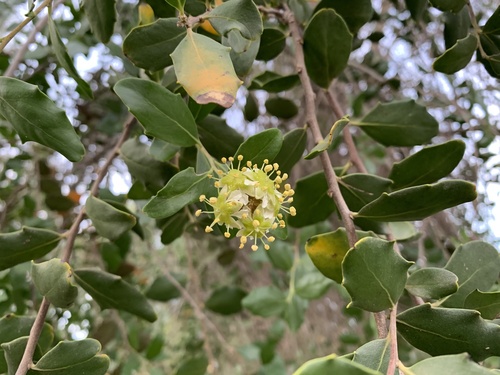
About Quillaja saponaria Molina
Quillaja saponaria Molina, commonly called the soap bark tree or soapbark, is an evergreen tree in the plant family Quillajaceae, native to warm temperate central Chile. In its native range, it grows between approximately 32 and 40° South Latitude, at elevations up to 2000 m (6500 ft) above sea level. Mature trees reach 15–20 m (50–65 ft) in height. It has thick dark bark, smooth, leathery, shiny oval evergreen leaves that are 3–5 cm long, white star-shaped flowers 15 mm in diameter arranged in dense corymbs, and a dry fruit made of five follicles, each holding 10–20 seeds. This species is drought resistant and can tolerate temperatures as low as approximately −12 °C (10 °F) in its natural habitat. Documented specific populations grow in the forests of La Campana National Park and Cerro La Campana in central Chile, where it grows in association with the Chilean wine palm, Jubaea chilensis. It is commonly planted for reforestation on arid soils. It has been introduced as an ornamental plant to California, and has become acclimatized in Spain, though it is rarely cultivated there. This species was first formally described by Edwin John Quekett. Its wood and bark contain raphides, which researcher George Gulliver found are concentrated in the liber and mesophloeum. It has a range of practical and commercial uses. Its wood is used for cabinetry, and scents obtained from the tree are added to perfumes and cosmetics. The inner bark can be ground into powder and used as a soap substitute, because it creates a lather when mixed with water. This lathering property comes from a glycoside saponin in the bark, often called quillaia saponin. Similar saponin substances are found in soapwort (Saponaria officinalis), senega root (Polygala senega), and sarsaparilla, and they are chemically related to digitonin from digitalis. Soap bark tree has a long history of medicinal use among Andean peoples, who used it to treat a variety of chest conditions. The saponin content of the bark stimulates production of thinner mucus in the airways, which helps clear phlegm through coughing. Bark from this tree is the source of quillaia, an extract used as a food additive, as well as an ingredient in pharmaceuticals, pesticides, personal care products, and fire-fighting foam. It is also applied as an agricultural spray adjuvant, used as an additive in photographic films, and employed as a foaming agent for drinks. Saponins from Quillaja saponaria extract act as the active ingredient in commercial pesticides that inhibit the growth of pathogenic fungi and nematodes in ornamental plants, food crops, and turfgrass. These tree saponins also have adjuvant properties for vaccine formulations, and have been used for this purpose since 2017. QS21 adjuvant is a triterpenoid glycoside saponin isolated from Quillaja saponaria extract. This adjuvant is used in the Novavax COVID-19 vaccine, the zoster vaccine Shingrix, and the RSV vaccine Arexvy.

