About Quercus velutina Lam.
Quercus velutina Lam., commonly called black oak, varies in size across its range. In the northern portion of its range, it is a relatively small tree, reaching 20–25 metres (66–82 feet) in height and up to 90 centimetres (35 inches) in diameter. It grows larger in the southern and central parts of its range, where confirmed maximum heights reach 42 m (138 ft).
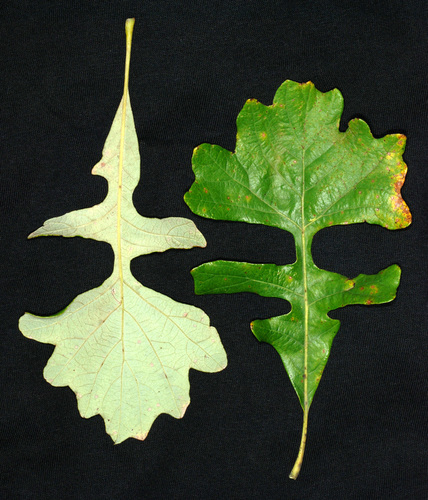
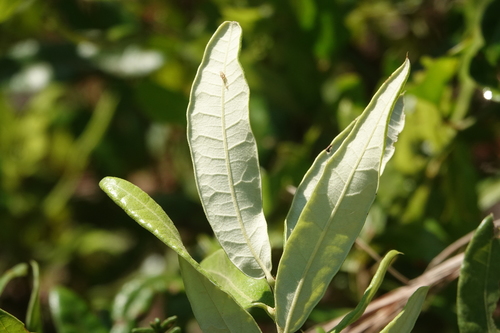
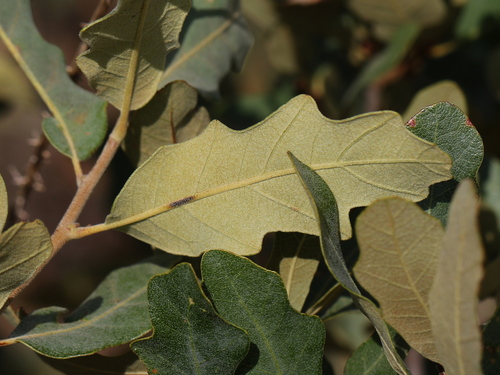
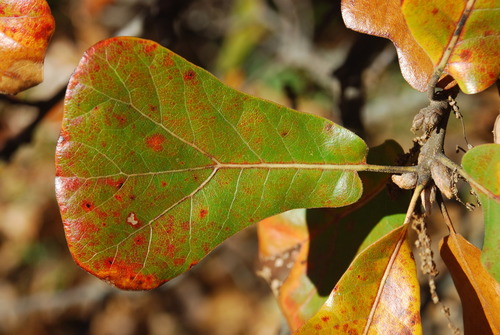
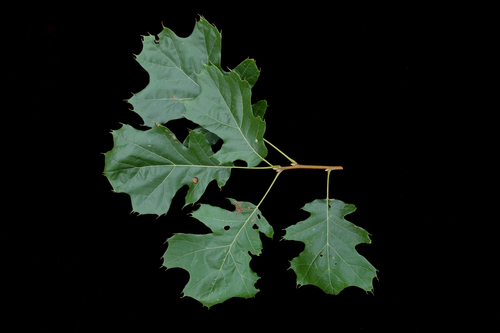
Black oak leaves are alternately arranged on twigs, measuring 10–20 cm (4–8 in) long, with 5–7 bristle-tipped lobes separated by deep U-shaped notches. The upper leaf surface is shiny deep green, while the lower surface is yellowish-brown, and bears clumps of stellate hairs. Key identifying traits include very deep U-shaped sinuses on leaves grown in full sun, and velvety buds covered in white hairs.
This species is monoecious. Staminate flowers develop from leaf axils of the previous year; their catkins emerge before or at the same time as current year leaves, between April and May. Pistillate flowers grow in the axils of current year leaves, and may be solitary or arranged in spikes holding two to many flowers.
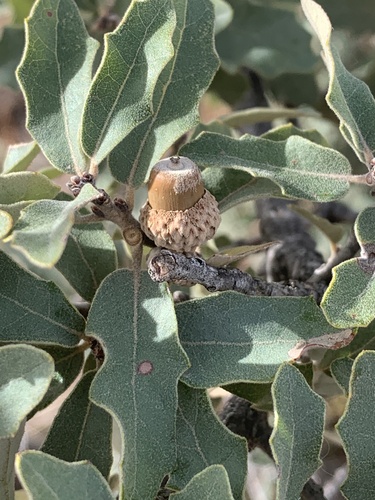
The fruit of Quercus velutina is an acorn, which occurs singly or in clusters of two to five. Roughly one-third to almost half of the acorn is enclosed in a scaly cup. Acorns are medium-sized, broadly rounded, brown when mature, and take two years to ripen. Ripening occurs from late August to late October, varying with geographic location.
Black oak is distributed across all coastal states from Maine to Texas in the United States, and extends inland as far as Michigan, Minnesota, Nebraska, Kansas, Oklahoma, and eastern Texas in the U.S., plus Ontario in Canada. It can grow on all slope positions and aspects, but grows best in coves and on middle and lower slopes with northerly or easterly aspects. In the southern Appalachians, it occurs at elevations up to 1,200 m (3,900 ft). It grows on cool, moist soils in southern New England, and on warm, moist soils elsewhere. The most widespread soil types it grows on are udalfs and udolls, which form from glacial materials, sandstones, shales, and limestone. These soils range from heavy clays to loamy sands, and some have a high content of rock or chert fragments. Black oak grows best on well-drained silty clay to loam soils.
The most important factors that determine site quality for this species are the thickness and texture of the A horizon, texture of the B horizon, aspect, and slope position. Other factors can affect site quality in localized areas: in northwestern West Virginia, site quality increases as precipitation rises to 1,120 millimetres (44 in), but does not improve further with precipitation above this amount. In southern Indiana, site quality decreases as slope steepness increases. Near the edges of its range, topographic factors can restrict distribution. At its western range limits, black oak is often only found on north and east aspects, where moisture conditions are most favorable. In southern Minnesota and Wisconsin, it is usually restricted to ridge tops and the lower two-thirds of south- and west-facing slopes. Black oak is a characteristic species of some types of oak savannas in the United States and Canada, thanks to its tolerance of fire.
The inner bark of black oak contains the yellow-orange pigment quercitron. This pigment was sold commercially in Europe until the 1940s, and the species once had the common name yellow oak because of this distinctive pigment.