About Quercus vacciniifolia Hittell
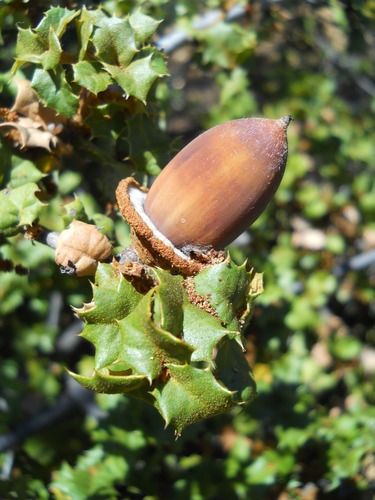
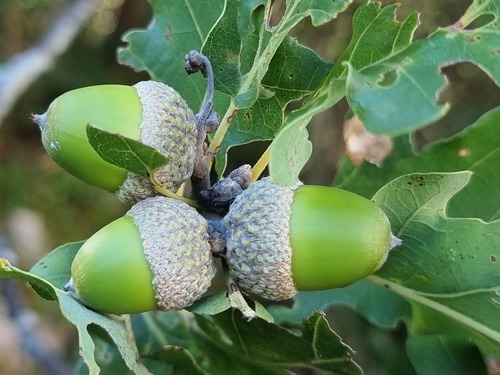
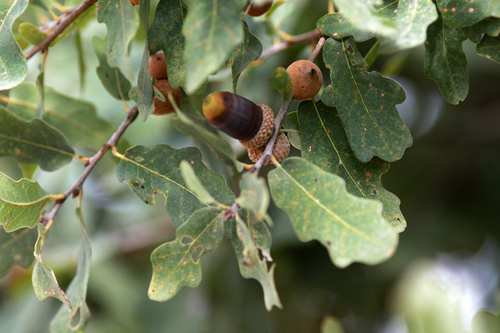
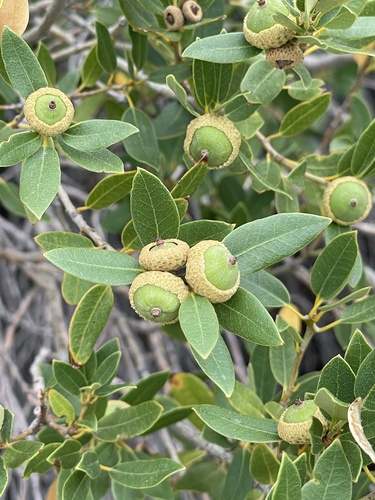
Quercus vacciniifolia is an evergreen shrubby member of the oak family. It typically grows less than 1.5 meters (5 feet) tall, spreads horizontally, and never develops into a tree. In field identification, oaks as a genus are most easily recognized by their clustered terminal buds, while this species is most reliably identified by its acorns. The acorns of Q. vacciniifolia measure 7.5–18 millimeters (5⁄16–11⁄16 inches) long and take 2 years to mature after pollination. Q. vacciniifolia is native to the western United States. Its range includes the Sierra Nevada of California (extending just into Nevada), the Klamath Mountains, and the southern Cascade Range as far north as southern Oregon. It grows in high mountain forests, and also dominates sections of mountain chaparral. This species occurs on steep slopes, ridges, conifer forests, and sub-alpine forest, mostly in high montane areas at altitudes ranging from 150 to 2,930 m (490 to 9,610 ft). While primarily native to California, it can also be found in Oregon and Nevada. Extensive hybridization between Q. vacciniifolia and Q. chrysolepis has been recorded in the Sierra Nevada. Between the early and middle Holocene, 11,000 to 5,000 calibrated years before present, Q. vacciniifolia formed extensive shrub stands on ultramafic soils in the northern California portion of the Klamath Mountains. During this period, Q. vacciniifolia was a major contributor to fire spread due to its abundance, mid-height growth, and resinous leaves. Today, Q. vacciniifolia rarely forms dense, chaparral-like stands, which allows fire-resistant species to grow in intermittent patches throughout its habitat. Many animal species rely on this shrub as a food source: mule deer feed on its leaves, while a wide range of birds and mammals including the American black bear consume its acorns. The acorns of Q. vacciniifolia are edible. This plant is used for habitat restoration, revegetation projects, and garden landscaping. It is particularly effective for erosion control, including use on slopes above Lake Tahoe to slow erosion that contributes to lake pollution.