About Quercus rotundifolia Lam.
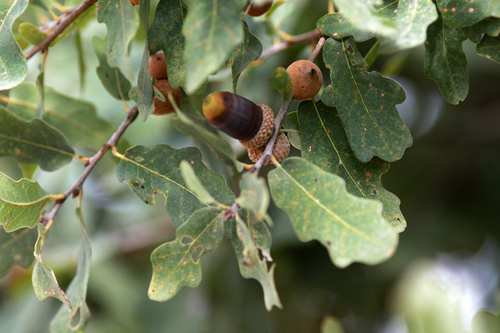
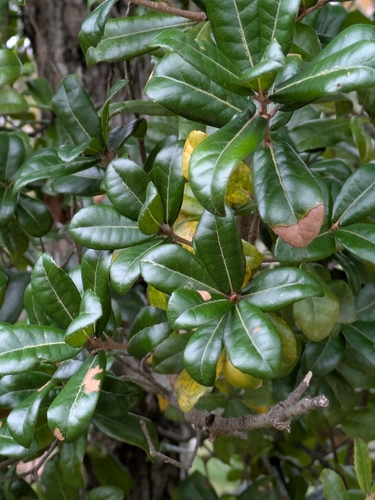
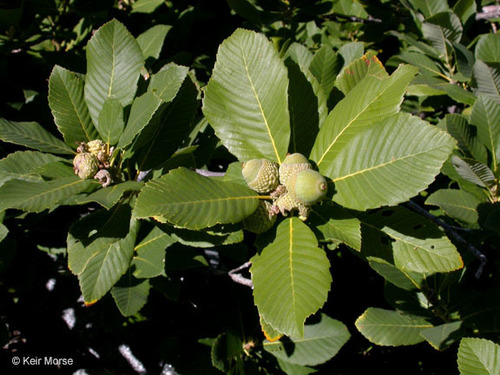
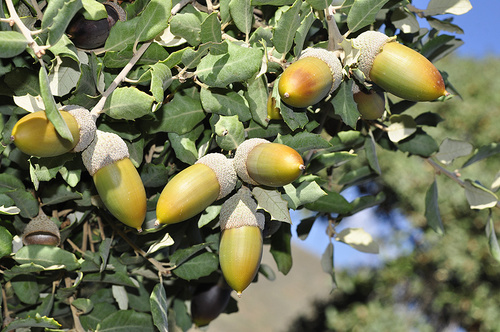
Quercus rotundifolia Lam. is a medium to large tree, typically growing 8–12 m (26–39 ft) tall, and can reach up to 15 m (49 ft). It has a large, dense, rounded canopy. Its leaves are small, leathery, and dark green, with a glaucous, densely hairy underside. Leaves are usually roughly circular to elliptical or lanceolate, and are generally spiny or toothed on younger trees. This species produces a semi-hemispheric cupule. It flowers from February to April. Seedlings begin flowering at around 8 years old, but do not produce acorns until they are 15 to 20 years old; trees growing in humid, high-quality soils can start producing acorns as early as 10 years old. Acorns ripen in autumn, approximately six months after pollination. Quercus rotundifolia is a resilient species that can survive temperatures below −20 °C (−4 °F), and can tolerate occasional temperatures as high as 47 °C (117 °F). Unlike the acorns of Quercus ilex, its acorns have a very low content of bitter tannins, so they are generally sweet and make a good energy source for livestock. Quercus rotundifolia is native to most of the Iberian Peninsula (Portugal and Spain), and also occurs throughout Morocco (especially in the Atlas Mountains), Algeria, Tunisia, southern France (Languedoc-Roussillon), and the Balearic Islands. It grows in continental, sub-continental, or littoral Mediterranean areas, always under climatic conditions that include fairly hot and dry summers. This requirement excludes it from the wet, ocean-influenced climate of Green Spain and northwest Portugal, while the species also requires wet winters, so it is not found in arid climates or regions with no truly wet months such as southeast Spain. It grows in a wide variety of soils and is tolerant of different edaphic conditions, persisting in soils with a pH between 6 and 8. It is found as part of holm oak/Atlas cedar mixed forests in the Atlas Mountains. In Morocco, some of these mixed forests provide habitat for the endangered Barbary macaque. It grows in dense oak forests, open oak forests, and sub-savanna ecosystems, from sea level up to 1,900 m (6,200 ft) above sea level. In Portugal, it can occur at all altitudes, where it replaces Quercus suber. The grasses and herbs growing under Quercus rotundifolia support low-density mixed animal grazing during wetter seasons. When grasses die back in summer, acorns from the oaks (growing at densities of 30 to 50 trees per hectare), along with oak foliage and some retained crops, support grazing animals until grasses grow back. This species can tolerate frost and short periods of light snow. The wood of Quercus rotundifolia is traditionally used to make charcoal. Both humans and animals can consume its acorns. Its bark is rich in tannins, which are used for traditional medicinal purposes. Quercus rotundifolia is also used as a host plant for cultivating black truffles (Tuber melanosporum) and summer truffles (Tuber aestivum var aestivum). Human use of the species' acorns dates back to the Neolithic era. 9,000 years ago, inhabitants of the southern Iberian Peninsula collected Q. rotundifolia acorns in autumn (November), gently toasted them to preserve the acorns, ground them in granite mills, and used the resulting flour in soups or breads.