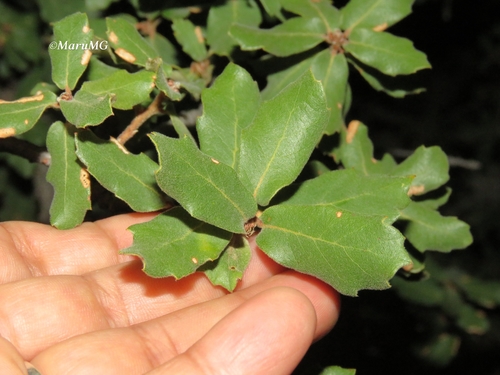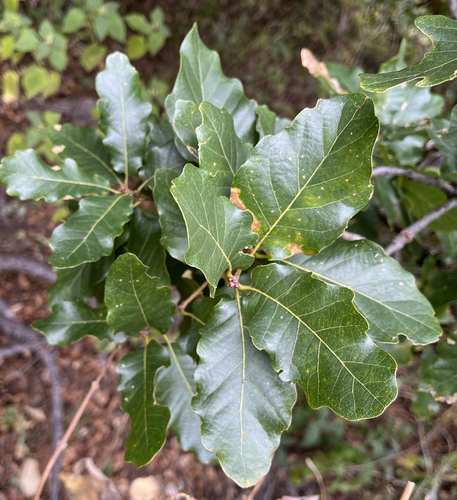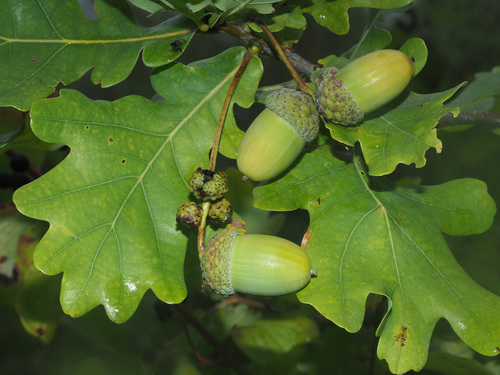
About Quercus robur L.
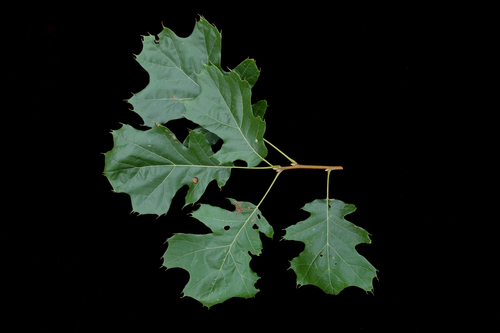
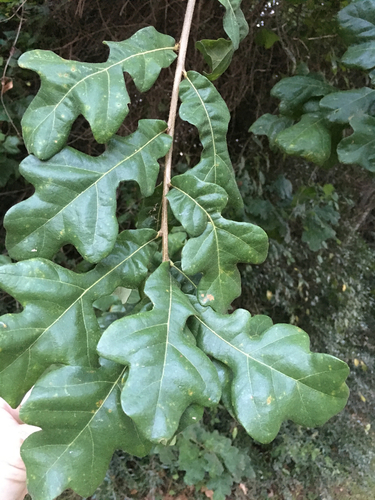
Quercus robur L., commonly known as pedunculate oak, is a deciduous tree that reaches up to 40 metres (130 ft) tall. It grows from a single stout trunk that can exceed 10 m (33 ft) in girth, measured as circumference at breast height, and pollarded specimens can even reach 14 m in girth. Older trees are typically pollarded, with main trunks (boles) around 3 m long. Pollarded pedunculate oaks often live longer and grow stouter than unpollarded trees. The crown is spreading and unevenly domed, and trees usually have massive lower branches. The bark is greyish-brown, marked by close grooves and vertical plates. Large burrs are common on the trunk, and these typically produce many small shoots. This oak species does not produce suckers, but it recovers well from pruning or lightning damage. Twigs are hairless, and buds are rounded (ovoid), brownish, and pointed. Leaves grow alternately along twigs and are broadly oblong or ovate, 10–12 cm long by 7–8 cm wide, with a short petiole that is typically 2–3 mm long. Leaves have a cordate (auricled) base and 3–6 rounded lobes, with divisions that do not extend more than halfway to the midrib. Leaves are usually glabrous, or only bear a few simple hairs on their lower surface. They are dark green on the upper surface and paler below, and are often covered in small disks of spangle gall by autumn. Flowering occurs in spring, which is early May in Northern Europe, and flowers are wind-pollinated. Male flowers grow in narrow catkins 2–4 cm long, arranged in small bunches. Female flowers are small, brown with dark red stigmas, around 2 mm in diameter, and grow at the tips of new shoots on 2–5 cm long peduncles. The fruits, acorns, are borne in clusters of 2–3 on a long 4–8 cm peduncle (stalk). Each acorn is 1.5–4 cm long, ovoid with a pointed tip, starting whitish-green and turning brown, then black, as it matures. Like all oaks, acorns sit in a distinctive shallow cup that is useful for identifying the species. Pedunculate oak is an alternate bearing species, meaning it produces large acorn crops every other year. This species is native to most of Europe and western Asia, and is widely cultivated in other temperate regions. Pedunculate oak is a long-lived tree that grows in high-canopy woodland, coppice, and wood pasture, and it is commonly planted in hedges. It is rare on thin, well-drained calcareous (chalk and limestone) soil. It sometimes occurs on the margins of swamps, rivers, and ponds, showing it is fairly tolerant of intermittent flooding. Its 2022 revised Ellenberg values in Europe are L = 7, T = 6, F = 6, R = 5, N = 2-6 and S = 0, which indicate it favours bright sunlight, moderate temperature, moderate moisture, moderate pH, a wide range of nutrient levels, and low salinity. In 2019, it was estimated that 2,300 species of insects, bryophytes, lichens, birds, mammals, and other organisms are associated with Q. robur in the UK. Some of these species rely entirely on pedunculate oak, while others can also use different tree species. Within its native range, Q. robur is valued for its importance to insects and other wildlife; it famously supports the highest biodiversity of insect herbivores of any British plant, with at least 400 species recorded. The most well-known associated species are the 35 or so that form galls. Knopper galls are very common, and Andricus grossulariae produces similarly spiky galls on acorn cups. Two types of spherical twig galls are also common: oak marble galls and cola nut galls. Cola nut galls are smaller and rougher than oak marble galls. A single large exit hole in a gall indicates the wasp inside has escaped, while multiple smaller holes mean the wasp was parasitised by another insect that later emerged from the gall. Spangle galls often cover the undersides of oak leaves, and persist after leaves fall. One of the most distinctive galls is the oak apple, a 4.5 cm diameter spongy ball formed from buds by the wasp Biorhiza pallida. Pineapple galls are less common but also easily recognised. The number of caterpillar species living on an oak tree increases as the tree ages, and blue tits and great tits time their egg hatching to match when oak leaves open. The most common caterpillar species include the winter moth, the green tortrix, and the mottled umber. All three can become extremely abundant on the first flush of May leaves, but oak trees regrow their foliage later in the year. Acorns are typically produced in large quantities every other year, unlike Q. petraea which produces large crops only every 4–10 years, and acorns are a valuable food source for several small mammals and some birds, most notably Eurasian jays Garrulus glandarius. Before humans began commercially planting oaks, jays were overwhelmingly the primary propagators of wild pedunculate oaks, and they remain the main propagators for wild populations today. This is because jays take acorns from the shade under the parent tree and bury them undamaged in other locations. Quercus robur is planted for forestry, and produces long-lasting, durable heartwood that is in high demand for interior work and furniture. The wood can be identified by close examination of a cross-section cut perpendicular to the wood fibres. It is characterised by distinct, often wide, dark and light brown growth rings. The earlywood contains a very large number of large vessels around 0.5 mm in diameter. Thin yellow or light-brown lines, called rays, around 0.1 mm thick run across the growth rings. The timber has a density of around 720 kg per cubic meter. Additionally, while acorns are bitter due to their high tannin content, they can be roasted and ground into a coffee substitute.