About Quercus palmeri (Engelm.) Engelm.
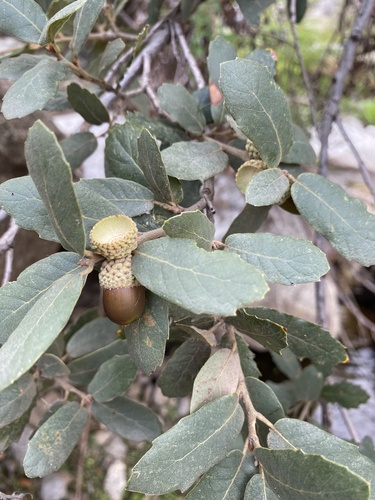
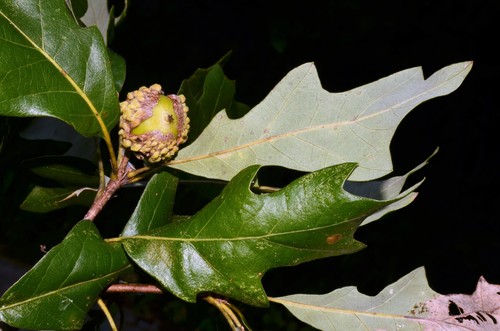
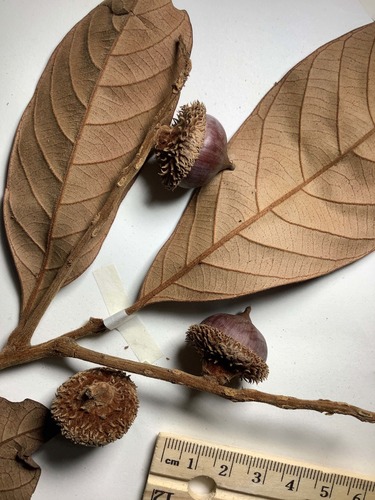
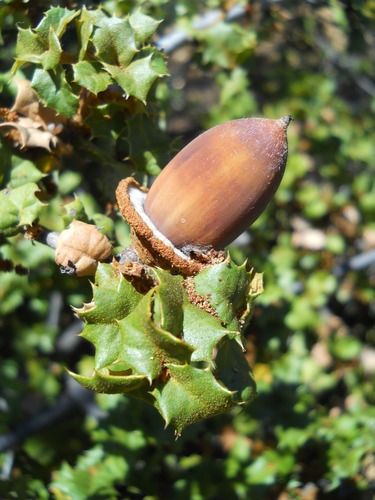
Quercus palmeri (Engelm.) Engelm. grows as a shrub or small tree, reaching 2–6 meters (6 feet 7 inches to 19 feet 8 inches) in height. Its branches produce angular, reddish brown twigs. The leaves are 1 to 3 centimeters (3⁄8 to 1+1⁄8 inches) long, with a stiff, leathery, and brittle texture. Leaf edges are wavy and lined with sharp spine-shaped teeth. The upper leaf surface is shiny, waxy, and olive green, while the lower surface is gray-green and covered in glandular hairs. The species produces acorns as fruit: the acorn cap is hairy and can grow up to 2.5 centimeters (1 inch) wide, and the nut has a blunt end and measures 2 to 3 centimeters (3⁄4 to 1+1⁄4 inches) long. Quercus palmeri most often grows in small populations, and some of these populations are actually entirely composed of clones from a single original plant. One well-known clonal individual grows in the Jurupa Mountains of Riverside County, California; this clone, called the Jurupa Oak, has been confirmed to be over 13,000 years old. It is a single individual that survives as a relict species from the Pleistocene, and is therefore considered one of the oldest living plants in the world.