About Quercus pagoda Raf.
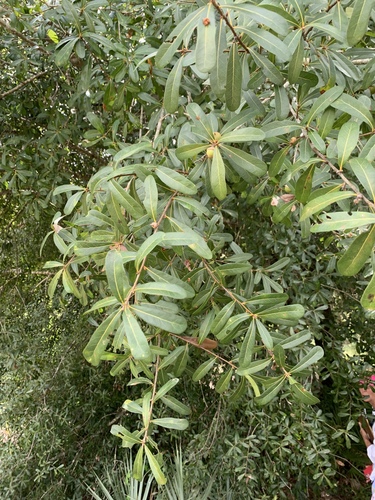
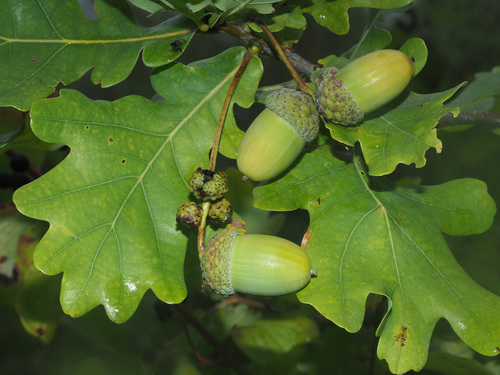
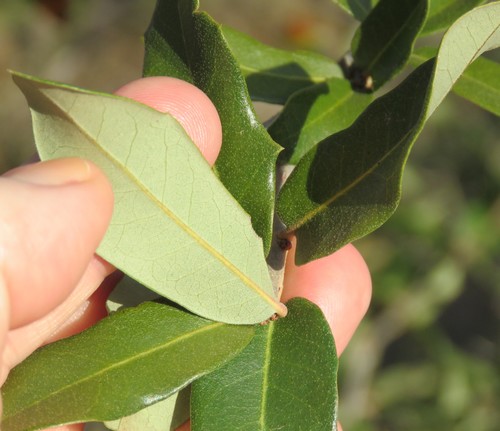
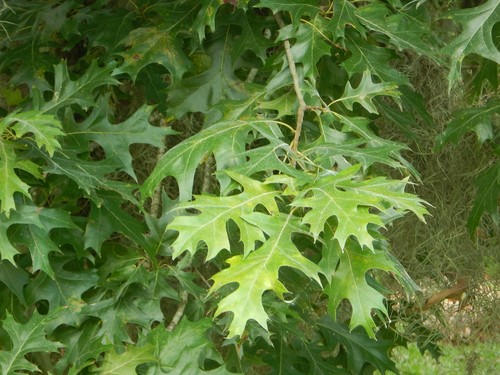
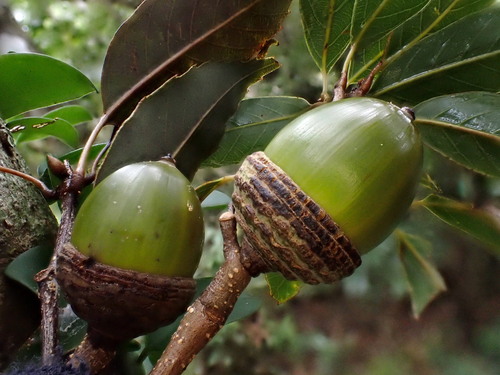
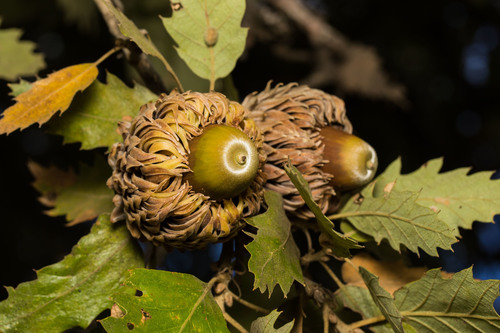
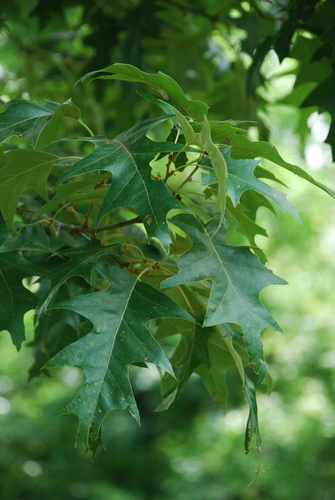
Quercus pagoda Raf., commonly called cherrybark oak, is a species of red oak. Cherrybark oaks are among the largest red oaks native to the southern United States, typically reaching 30 to 40 meters (100 to 130 feet) in height, with trunk diameters of 91 to 152 centimeters (36 to 60 inches). It is one of the hardiest and fastest growing oak species, growing on a wider range of sites than any other bottomland oak except possibly willow oaks and water oaks. Its diameter growth typically falls between 7.6 to 15.2 centimeters (3 to 6 inches) per decade. The common name 'cherrybark' comes from its gray bark, which is marked by scaly, narrow ridges that resembles the bark of black cherry. The scientific epithet 'pagoda' refers to the tiered arrangement of the species' leaves, which is reminiscent of the shape of a pagoda. Cherrybark oak has simple, alternate leaves that generally have V-shaped bases and 5 to 11 deeply incised lobes ending in short, broad, uncurved tips. This species is unusual because its leaf lobes do not necessarily grow in paired positions on opposite sides of the leaf; instead lobes may appear alternate or haphazardly arranged. Leaves measure 18 to 25 centimeters (7 to 10 inches) long, and grow up to 18 centimeters wide. The upper leaf surface is dark green, smooth, and shiny, while the undersides are paler and covered in fine hairs. Its twigs are thick, brown or gray, and hairy when young. The buds are egg-shaped with a pointed tip, angular, and hairy, and twigs commonly bear galls in some regions. Cherrybark oak is monoecious, meaning it produces separate staminate and pistillate catkins on the same individual tree. Catkins grow from stalks that emerge from leaf axils on the current year's growth, and flowers open from February to May depending on latitude. The acorns produced by this species are about 1.5 centimeters (1/2 inch) long, and are globular or hemispheric, with up to one-third of their length enclosed in a shallow, thin cap. There are between 200 and 750 acorns per pound. Acorns mature from August to November of their second year. Trees start bearing acorns at around 25 years old, and reach optimum acorn production between 50 and 75 years of age. Good acorn crops are frequent, occurring at 1- or 2-year intervals, with light crops in off years. Acorns are dormant and do not germinate until the following spring, and germination follows a hypogeal pattern. Cherrybark oak has a discontinuous (disjunct) distribution: it is common in the Carolinas and the lower Mississippi Valley, but rare in Georgia and Florida between these two common areas. There are also scattered, outlying populations that extend as far north as New Jersey and as far west as Texas and Oklahoma. It very often grows on high-quality loamy sites including first bottom ridges, well-drained terraces, and colluvial sites. Acorns of this species form a substantial part of the diet for many wildlife species, including gray squirrels, fox squirrels, white-tailed deer, raccoons, and multiple types of birds such as wild turkey, blue jay, wood duck, and common grackle. Natural cherrybark oak reproduction occurs on areas protected from fire and grazing. The species is intolerant of shade and requires full light for development, which encourages heavy competition from herbs, vines, and brush. Seedling development is typically good in old fields with well-drained loamy soils. The amount of available acorns is one of the main factors that determines the extent of natural cherrybark oak reproduction, with other contributing factors including microclimate, soil properties, and stand variables. Seedling development is linked to overhead release, requiring large open spaces. Cherrybark oak is most often found as individual trees growing in mixed stands, where it usually holds a dominant or codominant position. Occasionally it occurs in groups where it dominates an entire stand. It cannot tolerate being suppressed for very long, it is classified as shade intolerant, and it is thought to only become established in open canopy openings. It hybridizes easily with willow oak (Quercus phellos), producing the vigorous hybrid Louisiana oak, Quercus × ludoviciana. It is slightly less cold tolerant than southern red oak. Compared to other bottomland red oaks like water oak and willow oak, cherrybark oak usually grows a relatively branch-free merchantable trunk. Because of its good form and high quality, cherrybark oak is considered one of the best red oak species. Its wood is heavy, hard, and coarse-grained, it is light reddish brown in color, and it is used for interior finishing, veneer, general construction, furniture, and cabinets.