About Quercus nigra L.
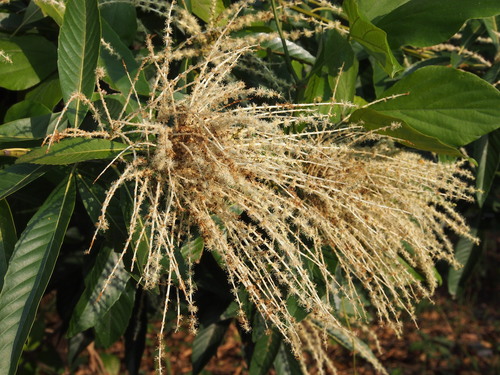
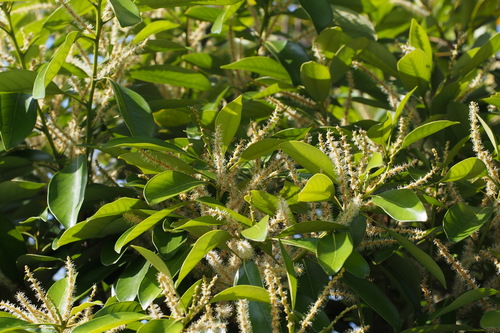
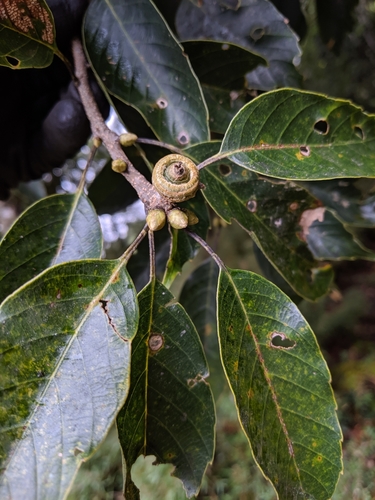
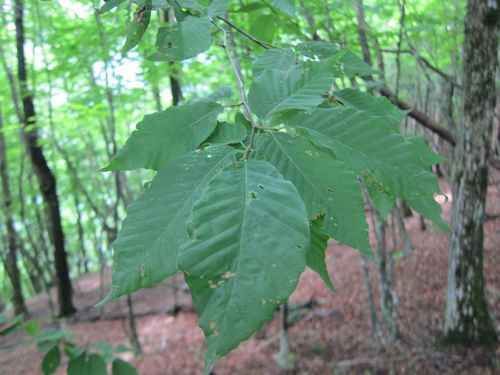
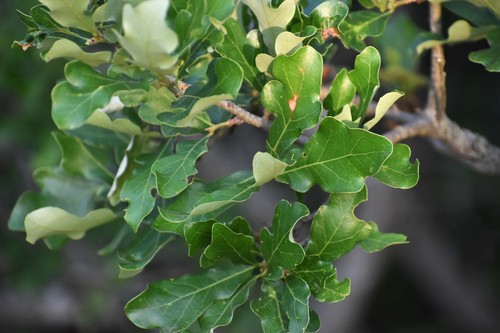
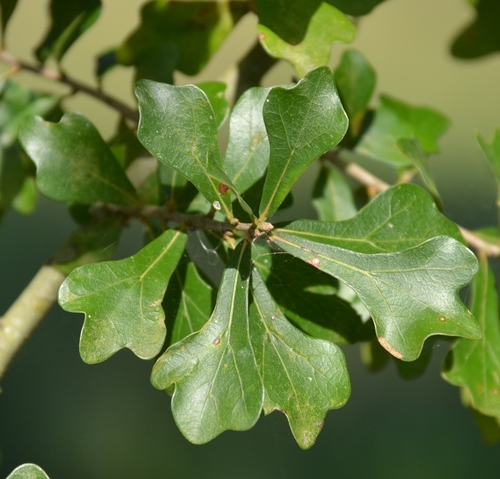
Quercus nigra L., commonly called water oak, is a medium-sized deciduous tree that reaches up to 30 meters (98 feet) in height, with a trunk up to 1 meter (3 feet 3 inches) in diameter. The bark of young water oaks is smooth and brown, and matures into gray-black bark with rough scaly ridges. Its leaves are alternate, simple, and tardily deciduous, remaining on the tree until mid-winter. Leaves measure 3–12 centimeters (1+1⁄4–4+3⁄4 inches) long and 2–6 centimeters (3⁄4–2+1⁄4 inches) wide, and are variable in shape. Most leaves are spatula-shaped, with a broad, rounded tip and a narrow, wedge-shaped base. Leaf margins vary, but are usually smooth to shallowly lobed, with a bristle at the apex and each lobe tip. The species is easily identifiable by its leaves, which have a lobe that looks like a drop of water hanging from the leaf tip. The upper leaf surface is dull green to bluish green, while the lower surface is a paler bluish green, with rust-colored hairs along the veins on the lower portion. Acorns grow singly or in pairs, and are 10–14 millimeters (3⁄8–1⁄2 inch) in both length and width, with a shallow cupule. They mature about 18 months after pollination, in the autumn of the second year. Ecologically, water oak fills the same role as weeping willows and other wetland trees. It is adapted to wet, swampy areas such as pond edges and stream banks, but can also tolerate well-drained sites and even heavy, compacted soils. It grows in sandy soils, red clays, and old fields, extending to the borders of swamps and streams, and into bottomlands. Because it grows and reproduces quickly, water oak is often the most abundant species in a tree stand. Compared to other oaks, it is relatively short-lived, typically surviving only 60 to 80 years. It does not compete well and cannot tolerate even light shade. Water oak is frequently used to restore bottomland hardwood forests on land that was previously cleared for agriculture or pine plantations. The minimum age for flowering and fruiting is 20 years, and the tree produces heavy acorn crops nearly every year. It is not recommended as an ornamental tree because it is short-lived, prone to disease, and extremely messy. Known hybrids exist between water oak and southern red oak (Quercus falcata), bluejack oak (Quercus incana), turkey oak (Quercus laevis), blackjack oak (Quercus marilandica), willow oak (Quercus phellos), Shumard oak (Quercus shumardii), and black oak (Quercus velutina). Water oak acorns are an important food source for white-tailed deer, eastern gray squirrels, raccoons, wild turkeys, mallards, wood ducks, and bobwhite quail. In winter, deer browse the tree's buds and young twigs. Like all oak species, this tree is a keystone species. When free of pesticides, it supports multiple pollinators, including the larvae of the imperial moth (Eacles imperialis), as well as many butterflies: banded hairstreak (Satyrium calanus), Edward's hairstreak (Satyrium edwardsii), gray hairstreak (Strymon melinus), White-m hairstreak (Parrhasius malbum), Horace's duskywing (Erynnis horatius), and Juvenalis duskywing (Erynnis juvenalis). Since the 17th century, people in the southern United States have used water oak for timber and fuel.