About Quercus myrtifolia Willd.
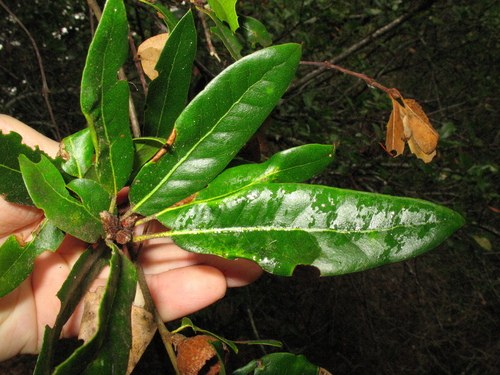
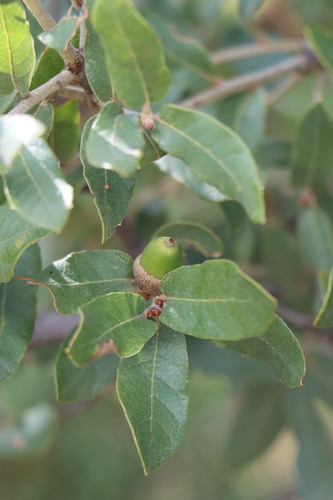
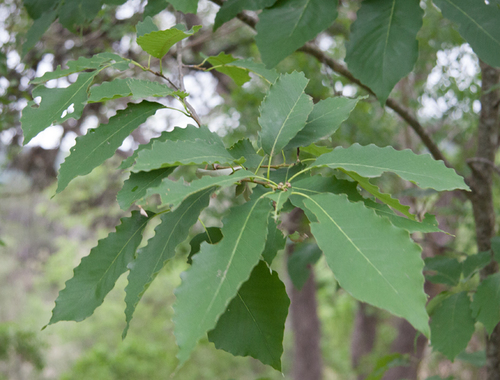
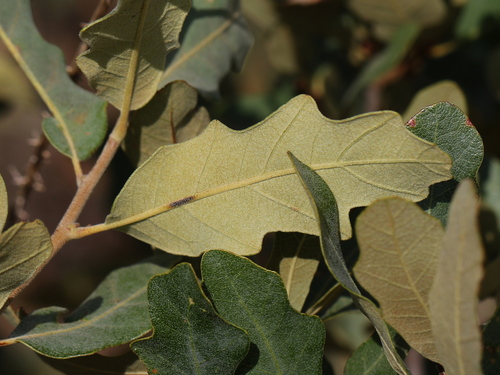
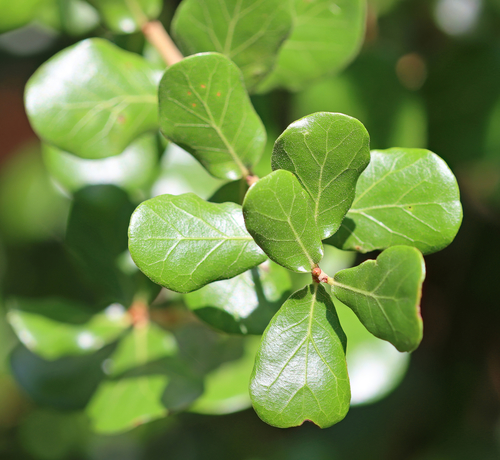
Quercus myrtifolia Willd., commonly called Myrtle Oak, is classified as a red oak. It most often grows as a shrub, but can also develop into a tree form. Mature specimens reach 15–20 feet (4.6–6.1 m) in height and 8–10 feet (2.4–3.0 m) in width. Its leaves are simple and arranged alternately; they are dark green on the upper surface with a yellow-green underside, have a leathery texture and obovate shape, and bear small hairs on the underside. Its acorns are approximately 1⁄2 inch (13 mm) long and take 18 months to mature. Small green flowers bloom between April and May. Young twigs are reddish brown, while the stem is grey and smooth when young, and develops furrows as it matures. A common associated oak species is Quercus geminata, which differs from Quercus myrtifolia by having narrow elliptic leaves that appear wrinkled. Quercus myrtifolia grows best in shaded, upper dune environments. Quercus myrtifolia is distributed across the southeastern United States, where it occurs in sandy coastal soils up to 350 feet (110 m) above sea level. Its typical habitats are dry sandy ridges in scrub oak forests alongside yellow pines, and dry-site hardwood forests. The most common tree species it grows alongside are Quercus incana, Quercus laevis, Quercus marilandica, Quercus margaretta, Quercus geminata, and Quercus virginiana. This plant is mostly used in gardening as a backdrop or accent plant. It is very low maintenance, and its evergreen leaves provide cover during winter. It may also have medicinal uses: its bark may be used as an antiseptic and hemostatic, and may be useful for treating toothaches, gastropathies, and burns, as well as reducing inflammation. These medicinal uses are typical of many oak species. Myrtle Oak can be grown as an accent plant in garden settings, though it is rarely available for purchase at nurseries. To grow Myrtle Oak, plant it in full sun in well-drained soil. It is very drought resistant. When planted outdoors, it should be protected from pests, and acorns should be buried at a depth equal to the acorn's diameter.