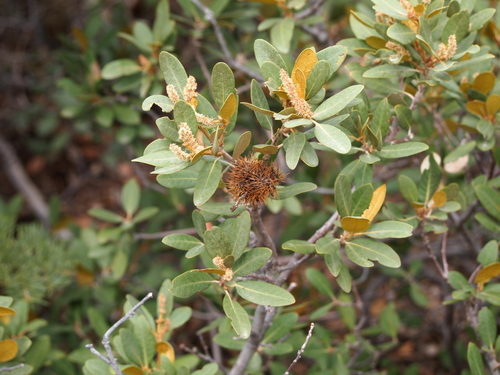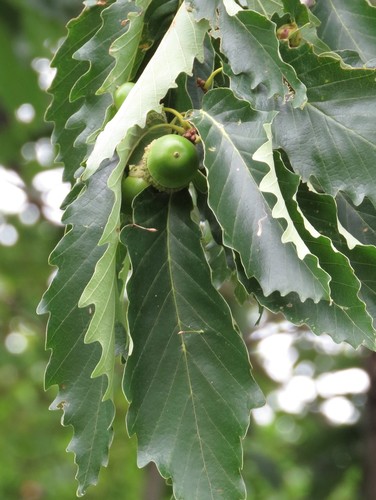
About Quercus montana Willd.
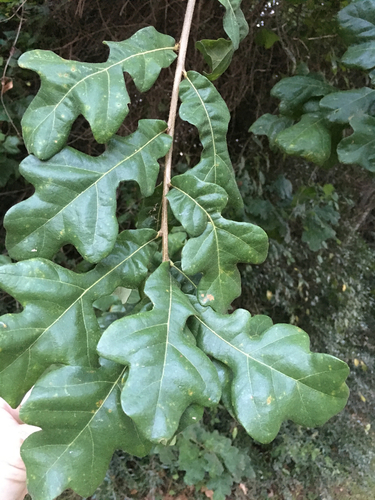
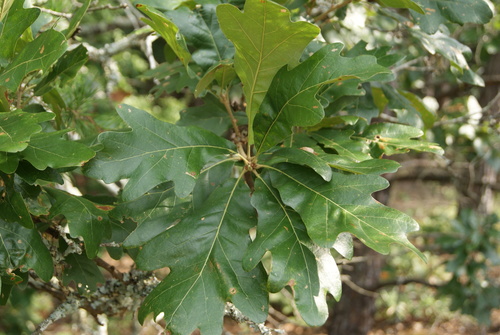
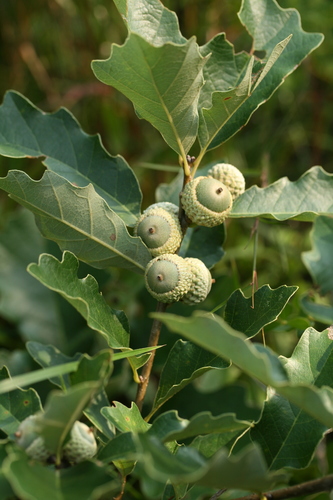
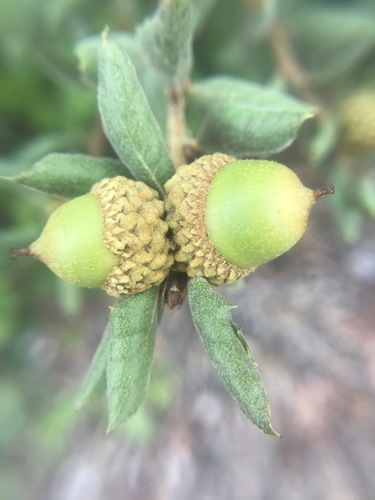
Quercus montana Willd. (commonly called chestnut oak) does not usually grow to a large size, a result of its dry habitat and exposure on ridgetops. It typically reaches 18–22 metres (59–72 feet) tall, with a matching spread of 18–22 m (59–72 ft). Specimens growing in more favorable conditions can reach up to 40–43 m (131–141 ft) tall. A 10-year-old sapling grown in full sun stands about 5 m (16 ft) tall. This species is often an important canopy species in oak-heath forests, and is a predominant ridge-top tree in eastern North American hardwood forests. It is easily identified by its dark gray-brown bark with deep, massive ridges, which is the thickest bark of any oak native to eastern North America. Its leaves measure 12–20 cm (4+3⁄4–7+3⁄4 in) long and 6–10 cm (2+1⁄4–4 in) wide, with shallow lobing and 10–15 rounded lobes along each margin. These leaves are nearly identical to the leaves of swamp chestnut oak and chinkapin oak, but the three species can be readily distinguished by bark: chinkapin oak has light ash-gray bark that peels somewhat like the bark of white oak, and swamp chestnut oak has paler ash-gray scaly bark. Chinkapin oak also produces much smaller acorns than chestnut oak. Chestnut oak can be easily told apart from swamp white oak by leaf underside color, as swamp white oak leaves have whitened undersides. Habitat is another common distinguishing feature between chestnut oak and swamp chestnut oak: plants growing on ridges are usually chestnut oak, while plants growing in wet bottomlands are usually the larger swamp chestnut oak, though this method of identification is not fully reliable. Detailed characteristics of Quercus montana are as follows: Bark is dark, fissured into broad ridges, and scaly. Branchlets are stout, starting bronze green, maturing to reddish brown, and finally becoming dark gray or brown; branchholds hold a large amount of tannic acid. The wood is dark brown, with lighter sapwood; it is heavy, hard, strong, tough, close-grained, and durable when in contact with soil. It has a specific gravity of 0.7499, and a cubic foot of the wood weighs 21.20 kilograms (46.73 pounds). Winter buds are light chestnut brown, ovate, acute, and 1/4 to 1/2 of an inch long. Leaves are alternate, 13 to 23 cm (5 to 9 in) long and 8 to 11 cm (3 to 4+1⁄2 in) wide, shaped obovate to oblong-lanceolate with a wedge-shaped or rounded base, and coarsely crenately toothed, with either rounded or acute teeth, and a rounded or acute apex. New leaves emerge convolute, colored yellow green or bronze, shining on the upper surface, and very pubescent (hairy) below. When fully grown, leaves are thick and firm, dark yellow green and somewhat shining on top, and pale green and pubescent below. Midribs are stout and yellow, with conspicuous primary veins. In autumn, leaves turn dull yellow, which soon changes to yellow brown. Petioles are short, and either stout or slender; stipules are linear to lanceolate, and caducous (fall off early). Flowers open in May, when leaves are one-third fully grown. Staminate flowers form in hairy catkins (aments) 2 to 3 inches long; the calyx is pale yellow, hairy, and deeply seven to nine-lobed; there are 7 to 9 stamens with bright yellow anthers. Pistillate flowers grow in short spikes, on green, stout, hairy peduncles; involucral scales are hairy, and stigmas are short and bright red. Acorns mature annually, and occur singly or in pairs. The nut is oval, rounded or acute at the apex, bright chestnut brown, shining, and 1+1⁄4 to 1+1⁄2 inches in length. The cup is cup-shaped or turbinate, usually enclosing one-half to one-third of the nut, it is thin, light brown and downy on the inside, reddish brown and rough on the outside, and tuberculate near the base. Scales are small and much crowded toward the rim, sometimes forming a fringe. The kernel is white and sweetish. Overall, acorns of this species are 1.5–3 cm (1⁄2–1+1⁄4 in) long and 1–2 cm (3⁄8–3⁄4 in) wide, placing them among the largest acorns of any oak native to North America; only bur oak and potentially swamp chestnut oak produce larger acorns. Chestnut oak drops its acorns about 2 to 5 weeks earlier than many other native oak species. Unlike many other oaks, its acorns have no dormancy, so they must begin germinating immediately after falling. Early acorn drop helps with ecological succession, as it occurs before peak foraging season for wildlife. The acorns of Quercus montana are a valuable wildlife food, and are also edible for humans: if they are bitter, tannins must be leached out before eating. In terms of ecology, young Quercus montana can easily regrow from stump sprouts after being cut. Many chestnut oaks growing in the Appalachians today regrew from stump sprouts after past logging. It is a long-lived tree, and produces high-quality timber when it grows with a straight, well-formed trunk. Acorn production (masting) is higher after warmer summer temperatures than after cooler summer temperatures. One study found that after a thin and burn treatment, which increased available light and resources, trees produced higher acorn yields. Most chestnut oak trees are not ideal for timber production, because they usually branch low and do not grow straight stems. When they grow in good conditions, however, their timber is valuable, and is sold as 'mixed white oak'. The bark has an especially high tannin content, and was heavily used in the leather tanning industry before the 20th century; during this period, the wood was usually discarded, as it was considered inferior to the wood of Quercus alba (white oak). By the late 19th century, as the population of mature white oaks in the eastern United States declined, loggers began to harvest chestnut oak wood more heavily. This wood serves many of the same uses as white oak wood, and is fairly rot-resistant, so it has been used for fencing, railroad ties, and other applications where wood comes into contact with soil. Thanks to its relatively high density, chestnut oak makes excellent firewood.