About Quercus lyrata Walter
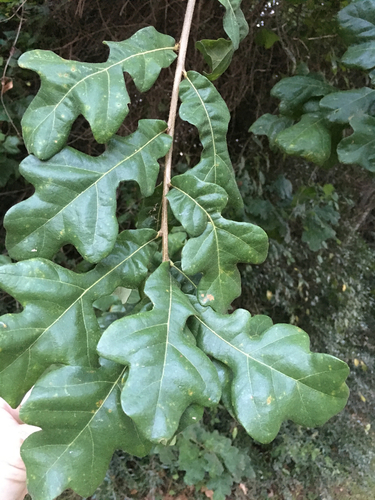
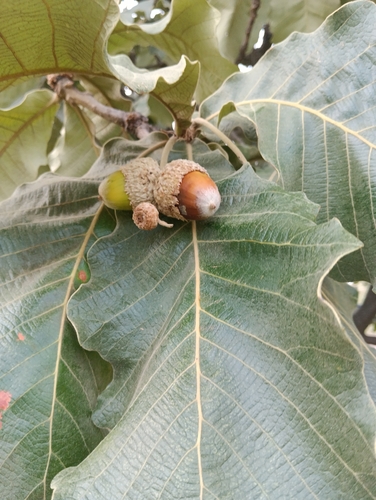
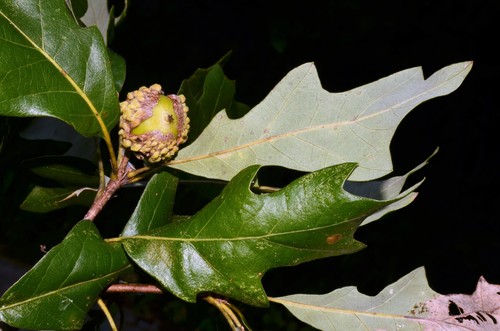
Quercus lyrata Walter, commonly called overcup oak, is a medium to large-sized deciduous tree. It reaches a maximum height of 47 meters (154 feet), with an average height of 24 m (79 ft). Its trunk averages up to 80 centimetres (31 inches) in diameter, and rarely reaches 140 cm (55 in). It is slow-growing, typically requiring 25 to 30 years to reach maturity. Its leaves are simple, alternately arranged, and average 15 to 20 cm (6 to 8 in) long. They are broad, deeply lobed, and somewhat lyre-shaped (lyrate), with a leathery texture. The upper leaf surface is dark green and shiny, while the underside is paler gray-green and covered in fine hairs. In autumn, leaves turn varying shades of red, yellow, or brown. Like other oaks, overcup oak has clustered terminal buds. Its bark ranges from light to dark gray, and is made up of irregular, deeply ridged and furrowed bark plates. Quercus lyrata is monoecious, bearing both male and female flowers. Male flowers are brown or yellow, and grow in drooping, elongated clusters. Female flowers grow as individual reddish spikes among surrounding leaves. Flowering occurs in mid-spring, around April or May. The fruit of Quercus lyrata is an acorn, which gives the tree its common name. Acorns are generally oval or oblong, 13 to 25 millimetres (1⁄2 to 1 in) in length. Almost the entire acorn is covered by its cup, which bears gray, pubescent scales. Acorns have a unique spongy shell that makes them buoyant. For an oak, the pericarp of an overcup oak acorn is unusually large, making up 50% of the acorn's total mass, compared to 30% for most other oaks. After flowering, acorns mature in 6–7 months, reaching a full size of 2.5–5 cm (1–2 in) long and 2–4 cm (3⁄4–1+1⁄2 in) broad. Thanks to their buoyancy and the species' wetland habitat, acorns are most often distributed by water. Acorns germinate best in moist soil when covered by leaf litter. Quercus lyrata has an extensive range across the central and eastern United States. It grows in all coastal states from New Jersey to Texas, and extends inland as far as Oklahoma, Missouri, and Illinois. It occurs in small populations in Delaware, Tennessee, Maryland, and Alabama. There are historical records of the species growing in Iowa, but it is now considered extirpated there. It is classified as endangered in New Jersey. This species is most commonly found on floodplains, in wetlands, and in swamps. It prefers clay-type soils, generally low-lying clay or silty clay, and is adapted to survive in poorly drained areas that experience extensive flooding. It can withstand continuous flooding for two or more growing seasons. Overcup oak is one of the dominant tree species in oak–water hickory forests, where it is commonly associated with willow oak (Quercus phellos), American elm (Ulmus americana), green ash (Fraxinus pennsylvanica), water hickory (Carya aquatica), and red maple (Acer rubrum). It is not a dominant species in most other forest types. Quercus lyrata provides food and habitat for a wide range of wildlife. Its acorns are eaten by small mammals and birds including squirrels and wild turkeys; while the species is somewhat deer-resistant, white-tailed deer also eat its acorns. The tree provides canopy cover and habitat for many species. Like many oaks, it hosts a variety of Lepidoptera, including the imperial moth (Eacles imperialis), Banded Hairstreak (Satyrium calanus), Edward's Hairstreak (Satyrium edwardsii), Gray hairstreak (Strymon melinus), White M Hairstreak (Parrhasius m-album), Horace's Duskywing (Erynnis horatius), and Juvenal's Duskywing (Erynnis juvenalis). The wood of Quercus lyrata is considered less valuable than that of other white oaks, due to its relatively high susceptibility to injury and disease. It can be used for lumber and cooperage, but is not often used to make high-quality products such as furniture. It can be used as firewood. While its acorns are consumed by birds and mammals, they are a low severity poison to humans. The tree may also be planted as an ornamental.