About Quercus lobata Née
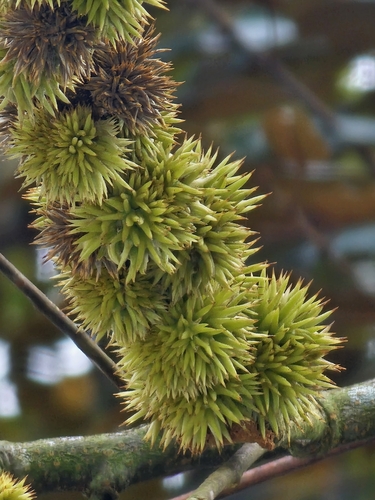
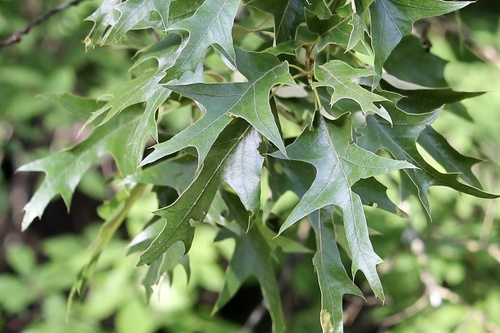
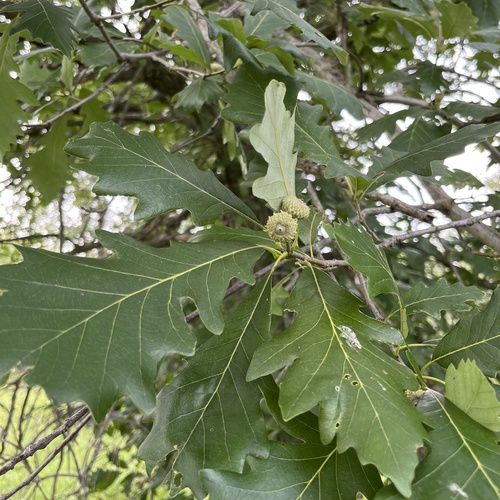
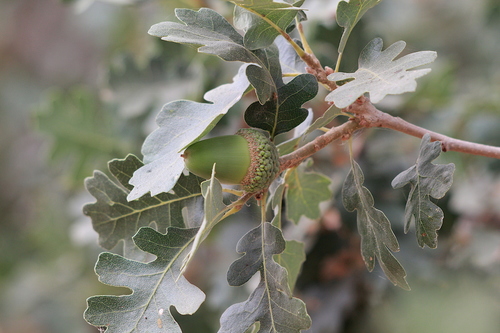
Quercus lobata Née, commonly called valley oak, may grow over 30 meters (98 feet) tall, with a thick trunk that can exceed 3 meters (10 feet) in diameter. The tallest known valley oak, named the "Henley Oak" located in Covelo, California, reaches 47 meters (153 feet) tall. Its branches grow in an irregular, spreading, arching pattern, and droop as the tree ages. The bark of this species is pewter-colored and rippled. In autumn, valley oak leaves turn from yellow to light orange before becoming brown later in the season. Leaves are typically 5 to 10 centimeters (2 to 4 inches) long, with deep, rounded lobes. Leaf width is roughly half the leaf length. Each leaf is matte green on the upper surface, pale green underneath, and covered in abundant soft fuzz that gives an almost velvety texture. When a fresh leaf is rubbed or broken, it releases an aromatic scent like that of a forest. The wood of Quercus lobata is a dull brown that leans toward yellow. The species produces medium to dark brown acorns that measure 2 to 3 cm (3⁄4 to 1+1⁄4 inches) long. The acorn caps have deep stippling, and acorns most often grow singly, though they occasionally grow in pairs. Acorns ripen between October and November. Viable acorns germinate in their first winter, and no viable acorns remain by mid-winter. Valley oak tolerates cool wet winters and hot dry summers, but requires abundant water. It is most abundant in rich deep soils on valley floors located below 600 meters (2000 feet) in elevation. It grows in dense riparian forests, open foothill woodlands, and valley savannas. Common tree species associated with valley oak include coast live oak, interior live oak, blue oak, California black walnut, California sycamore, and gray pine. This oak is widely distributed across the California Central Valley, many smaller California valleys including the San Fernando Valley, Santa Clarita Valley, Conejo Valley, and Santa Ynez Valley, the Inner Coast Ranges south of the Eel River, and the Transverse Ranges from the Tehachapi Mountains to the Simi Hills and Santa Susana Mountains. It is also present on Santa Cruz Island and Catalina Island in the Pacific Ocean. Some of the most picturesque stands of valley oak are located in Sonoma Valley, Round Valley in Mendocino County, and the southern Salinas Valley near the upper reaches of the Salinas River. Like many oaks, valley oak can tolerate wildfires. While smaller individual trees may be killed above ground, most resprout from their root crown. A variety of mammals and birds eat valley oak acorns, including the acorn woodpecker, California scrub jay, yellow-billed magpie, and California ground squirrel. Acorns are also attacked by bruchid beetles, but can survive moderate levels of infestation. Globular galls are often found attached to twigs of mature valley oaks; these galls house the larval stage of the small native wasp Andricus quercuscalifornicus. A related wasp species, Feron kingi, produces small red conical galls on valley oak leaf surfaces. Valley oak is the only known food plant for caterpillars of the moth Chionodes petalumensis. The acorns of valley oak are sweet and edible. Native American groups including the Southern Paiute people roasted the acorns, ground the edible portion into meal, and used the meal to make bread and mush. Harvesting difficulties and drying problems such as cracking and warping mean valley oak wood is no longer used as general purpose lumber, and is now primarily a niche product. However, valley oak wood has a small but significant market for cabinetry, and is also suitable for hardwood flooring. Tyloses in the wood pores make valley oak wood impermeable to fluids, so it can be used to make water-tight vessels, including wine barrels. It plays a limited role in wine barrel production, and shares similar properties with other white oaks: it has lower tannin content than red oaks, and an open grain that allows increased oxygen transfer.