About Quercus kelloggii Newb.
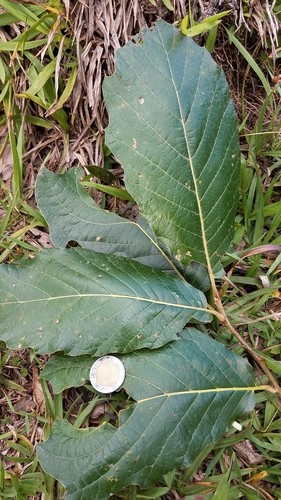
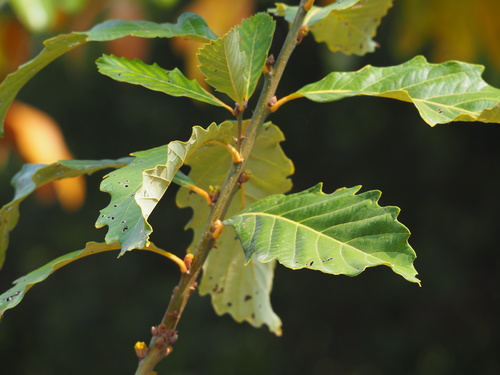
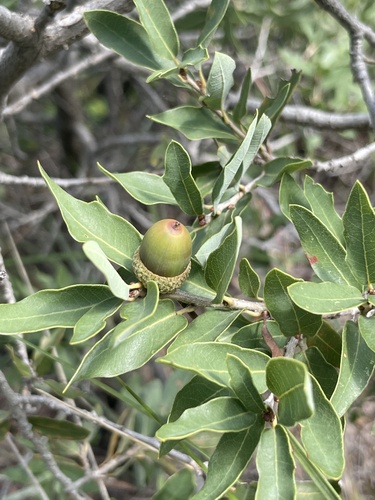
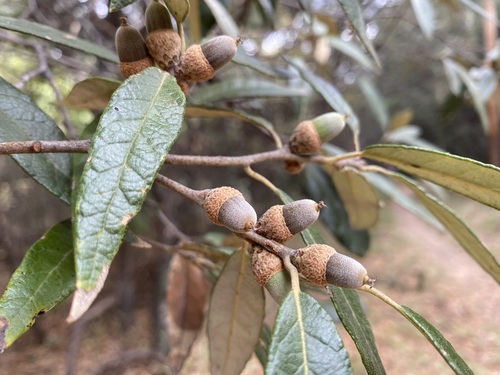
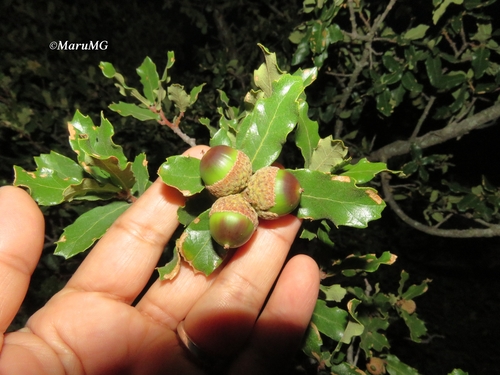
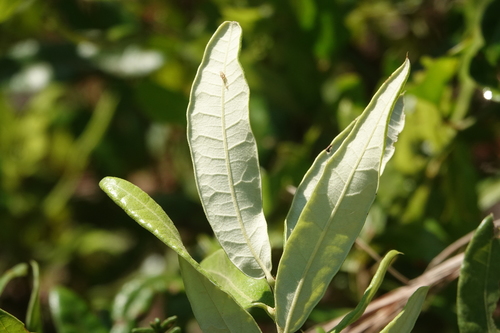
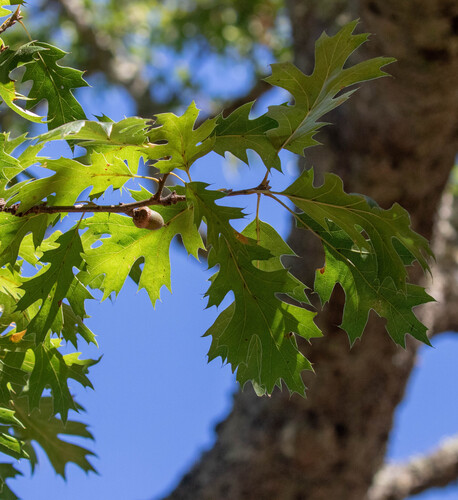
Quercus kelloggii Newb., commonly known as California black oak, has a root system consisting of one to several vertical roots that grow down to bedrock, with large lateral roots extending from these vertical roots, plus a number of additional surface roots. This species can reproduce vegetatively: new growth sprouts from the root crown after the above-ground portion of the tree is killed by events such as wildfire, logging, or frost. Individual trees typically live between 100 and 200 years, though the species can live up to 500 years. Mature trees usually reach 9–25 meters (30–82 feet) in height and 0.3–1.4 m (1–4+1⁄2 ft) in trunk diameter. Large specimens may exceed 36 m (118 ft) in height and 1.6 m (5 ft 3 in) in diameter; the current record holder, located in Oregon's Siskiyou National Forest, measures 38 m (124 ft) tall and 2.7 m (9 ft) thick. On poor quality sites, this species grows as a low, shrubby scrub oak. In open growing areas, the crown is broad and rounded, with lower branches that nearly reach the ground or form a distinct browse line. In closed forest stands, young trees have narrow, slender crowns, while old trees have irregularly broad crowns; in these closed stands, trunks are typically free of branches on the lower 6–12 m (20–39 ft). Trunks are often forked, and older trees usually have decayed, hollow trunks. Young trees have thin, smooth bark, which becomes thick, ridged, plate-like, and blackish as the tree ages. Leaves are typically 10–25 centimeters (4–10 in) long and deeply lobed, most often into seven lobes. When young, leaves are red and velvety; they turn yellow-green during the growing season, then change to orange-brown in autumn. This species blooms late in spring, and is monoecious: male flowers form in catkins, while female flowers grow in leaf axils. It produces relatively large acorns, 2.5–4 cm (1–1+1⁄2 in) long and 1.5–1.8 cm (1⁄2–3⁄4 in) wide. California black oak is a deciduous tree that grows in mixed evergreen forests, oak woodlands, and coniferous forests. Its natural range covers the foothills and lower mountains of California and western Oregon, from Lane County, Oregon, south through the Cascade Range, Sierra Nevada, Coast Ranges, Transverse Ranges, and Peninsular Ranges, reaching as far south as San Diego County, California. It grows at altitudes up to 1,800 m (5,900 ft), for example near Mount Shasta. It occurs in either pure stands or mixed stands; pure stands typically grow on sites unfavorable for conifer growth, or in areas with recurring disturbance like fire or logging. While it can grow in many different soil types, all soils it grows in must be well-drained. California black oak is a critical species for wildlife. In California's forests and rangelands, oaks (genus Quercus) are likely the most important plant genus for wildlife food and cover, and California black oak occupies more total area in California than any other hardwood species. Livestock also rely heavily on this species for food and cover. Older trees with heart rot develop cavities that provide den and nest sites for owls, multiple woodpecker species, tree squirrels, and American black bears. The tree provides valuable shade for livestock and wildlife during hot summer months, and California black oak forest types are heavily used as spring, summer, and fall cover by black bears. Deer and livestock browse its foliage, and acorns are a major food source for livestock, mule deer, feral pigs, rodents, mountain quail, Steller's jays, and woodpeckers. In good acorn mast years, acorns make up an average of 50% of the fall and winter diets of western gray squirrels and black-tailed deer, and fawn survival rates correlate directly with the size of the annual acorn crop. It is a preferred foraging substrate for many birds; all 68 bird species observed in California's Tehachapi Mountains oak woodlands used California black oak for at least part of their foraging, and the acorn woodpecker, Bullock's oriole, and Nashville warbler show strong preferences for this species. The parasitic plant Pacific mistletoe (Phoradendron villosum), which commonly grows on this oak, produces berries that also attract birds. Many animal species cache California black oak acorns; acorns stored underground or buried are more likely to sprout than acorns that remain on the surface. This tree is adapted to wildfire: its thick bark protects it from smaller fires, and if its above-ground growth is killed in larger fires, it can easily resprout using the abundant water and nutrients stored in its root system. Acorns germinate into seedlings after fire, and sites cleared of canopy and leaf litter by fire are ideal for successful seedling establishment. California black oak is less shade tolerant than its common associate ponderosa pine, and it is vulnerable to sudden oak death. Some California Native American groups prefer California black oak acorns over acorns from other oak species for making acorn meal. Historically, these acorns were a staple food for many Native American groups, who typically leached the bitter tannin out before use. Native Americans understood fire's importance to this oak, and intentionally set fires in oak woodlands to promote the tree's health and protect their food source. The wood of California black oak is used to make furniture, pallets, and construction timber, and the tree is also grown as an ornamental. Quercus kelloggii is cultivated in the specialty horticulture trade, grown as an ornamental tree for native plant, drought-tolerant, water-conserving, and habitat gardens, and used in various municipal, commercial, and agency sustainable landscape and restoration projects.