About Quercus ithaburensis Decne.
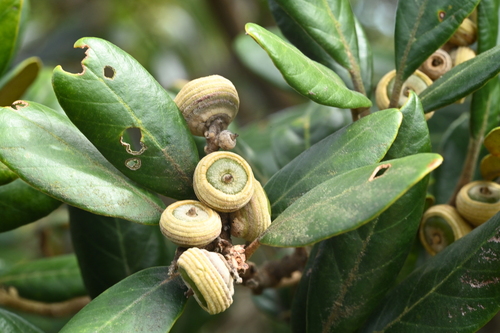
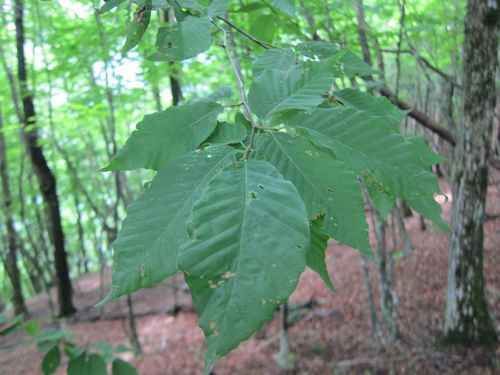
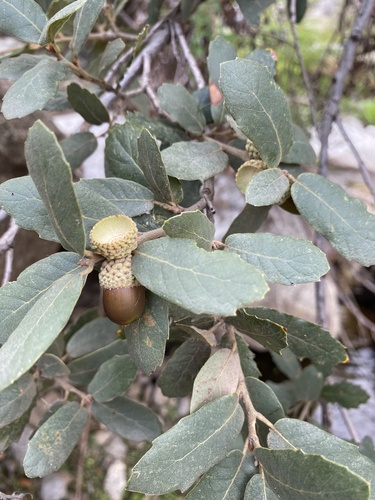
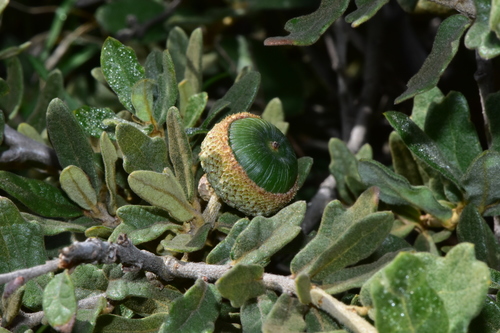
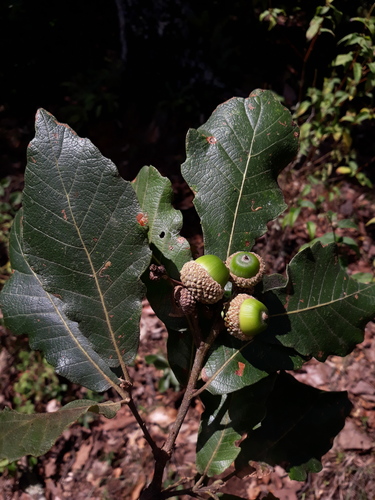
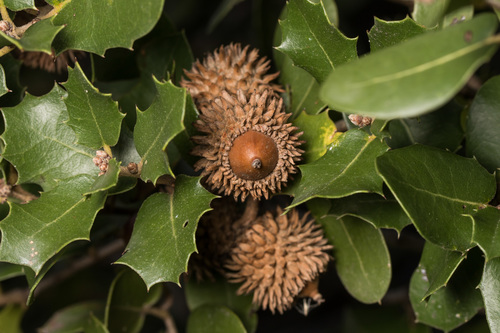
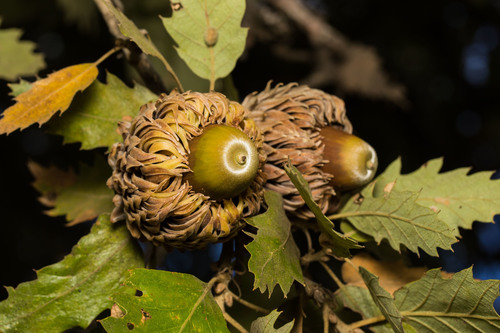
Quercus ithaburensis Decne. is a small to medium-sized semi-evergreen to tardily deciduous tree, reaching a maximum height of around 15 metres (49 feet). It has a rounded crown, and often develops a gnarled trunk and branches. Its leaves are 4–9 centimetres (1+1⁄2–3+1⁄2 inches) long and 2–5 centimetres wide, oval in shape. Each leaf has 7 to 10 pairs of either teeth (the most common form) or rare shallow lobes along its revolute margin. The upper leaf surface is dark glossy green, while the lower surface is gray and covered in dense, matted hairs. Male flowers are light green catkins 5 centimetres long. Female flowers, which are pollinated by wind, are very small, reaching up to 0.4 millimetres (1⁄32 inch). They are produced in groups of three on short stalks called peduncles. In most of the species' native range, flowering occurs from March through April. Acorns of Quercus ithaburensis are generally oval, up to 5 centimetres long and 3 centimetres wide. A cap covers roughly one-third of the acorn. Acorns mature in 18 months, and drop from the tree in the second autumn after pollination. The acorn cap is covered in long, stiff, loose scales that are rolled backward (involute), especially along the cap's edges. This species is native to the central and eastern Mediterranean basin. It grows in southeastern Italy, southern Albania, coastal areas and islands of Greece, southern and western Turkey, Syria, Lebanon, Israel, the Palestinian territories, and Jordan. Before the 20th century, the Plain of Sharon was covered by open woodland dominated by Quercus ithaburensis, which extended from Kfar Yona in the north to Ra'anana in the south. Local Arab inhabitants traditionally used this area for pasture, firewood collection, and intermittent cultivation. During the 19th century, intensification of settlement and agricultural development, plus exploitation of native woodlands along the coastal plain by the Ottoman Empire (primarily to harvest timber for railroad construction) led to deforestation and subsequent environmental degradation. This topic is commonly discussed in Hebrew sources. The acorn cups of Quercus ithaburensis subsp. macrolepis, known as valonia, are used for tanning and dyeing. Unripe acorns of this subspecies, called camata or camatina, are also used for the same purposes. Ripe acorns are eaten raw or boiled.