About Quercus ilex L.
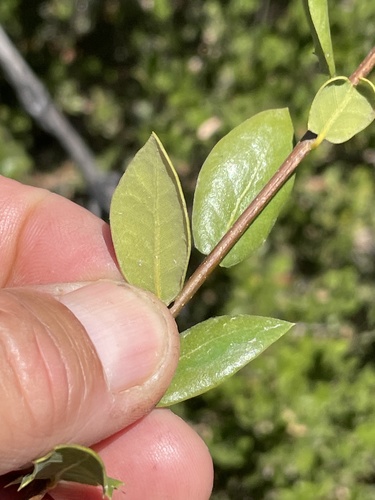
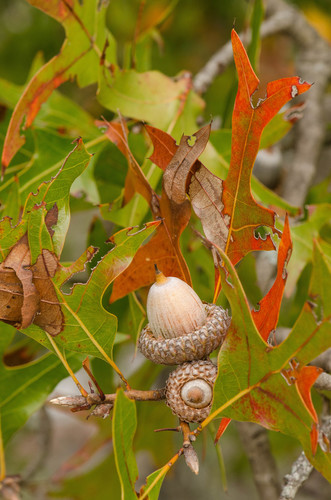
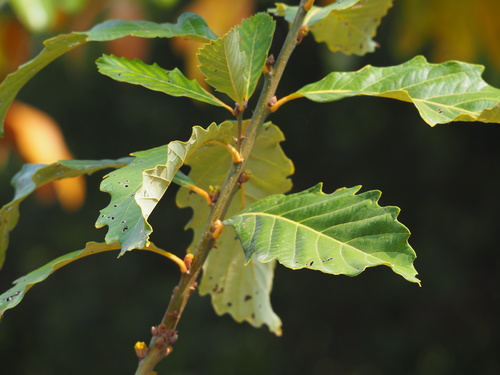
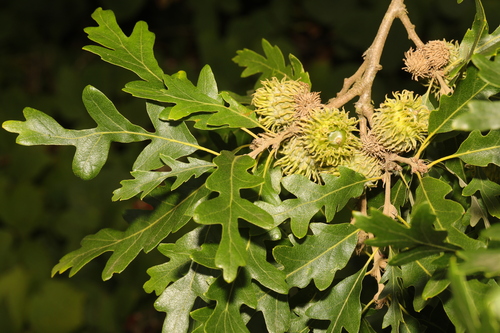
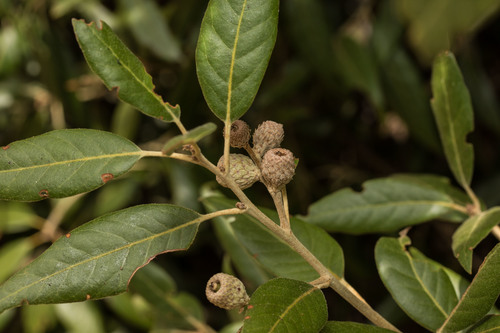
Quercus ilex L., commonly called holm oak or holly oak, is a large evergreen tree. In favourable growing conditions, it reaches a height of 21–28 metres (69–92 feet). When growing in open sites, it develops a broad, dense crown of leafy branches that matches its height in width; the ends of old trees' branches are often pendulous. The tallest recorded individual, planted at Windsor Great Park, reaches 30.4 m tall, and its trunk can sometimes exceed 6 m (20 ft) in girth. Young shoots are covered in a dense, grey felt-like fuzz. Its leaves are very variable in shape, most often narrowly oval or ovate-lanceolate, 4–8 centimetres (1+1⁄2–3 inches) long (rarely reaching 10 cm long), and 2–5 cm wide (rarely reaching 8 cm wide). Leaf bases are rounded or broadly tapered, and leaf tips are pointed. Mature trees almost always have leaves with smooth, entire margins, while leaves on young trees are commonly more or less spiny-toothed. Newly emerged leaves have whitish down on both surfaces; this down falls away completely from the upper leaf surface, leaving it dark glossy green. The down on the lower leaf surface turns grey or tawny and persists until the leaf drops. Leaf petioles are 3–16 millimetres (1⁄8–5⁄8 in) long. Acorns grow in groups of 1 to 3 on a short, downy stalk, and ripen during their first season. In the UK, acorns are usually 12–20 mm long, held in cups covered with pressed, downy scales that often form a wavy cup margin. Holly oak grows in pure stands or mixed forest across the Mediterranean region, usually at low to moderate elevations, and occurs at higher altitudes in the Atlas Mountains. It is native from westernmost Turkey, west through Greece to parts of the Iberian Peninsula (where it grows alongside Quercus rotundifolia), along the northern Mediterranean coastal belt, and in the Atlas Mountains of Tunisia and Algeria. The wood of Quercus ilex is hard and tough, and has been used since ancient times for general construction, including pillars, tools, wagons, vessels, and wine casks — it is mentioned as used for this purpose in Hesiod's *Works and Days* page 429. It is also used as firewood and to manufacture charcoal. The holm oak is one of the top three tree species used to establish truffle orchards (truffières), as truffles form an ectomycorrhizal association with the tree's roots. In the United Kingdom, Quercus ilex is not officially listed as an invasive species, but it is naturalised and able to naturally regenerate. The first trees grown from acorns in England still stand on the grounds of Mamhead Park, Devon. According to Britton & Brayley's 1803 work *The Beauties of England and Wales*, Thomas Balle (the last member of his family) established many extensive plantations of introduced trees at Mamhead after returning from the continent, bringing acorns and seeds of cork oak, ilex, wainscot oak, Spanish chestnut, acacia, and other exotic species. Normally, the tree cannot withstand severe frost, which would stop it from spreading north, but climate change has allowed it to successfully penetrate and establish in areas north of its native range. The largest population of holm oak in Northern Europe grows on and around St. Boniface Down on the Isle of Wight, extending into the nearby town of Ventnor, which has a naturally warmer microclimate that supports the species, and the population tolerates the high winds of the down. This population, originally planted by Victorian residents in the late 1800s, has increased in size with help from native Eurasian jays (Garrulus glandarius), which harvest acorns from the oaks and bury them for storage, leaving many to germinate. Feral goats have been brought to Ventnor to control the spread of this holm oak population. Quercus ilex can be clipped to form a tall hedge, and it is suitable for coastal windbreaks, growing well in any well drained soil. It forms a picturesque rounded crown with pendulous, low-hanging branches. Its large size and dense evergreen foliage give it a striking architectural form that makes it popular for urban and garden landscaping. While it can be grown across most of maritime northwestern Europe, it does not tolerate cold continental winters. It is one of the parent species of the hybrid Quercus × turneri, paired with Quercus robur. It was introduced to California in 1858, and is now a widely planted and locally naturalised species there, where it is most often called holly oak.