About Quercus hypoleucoides A.Camus
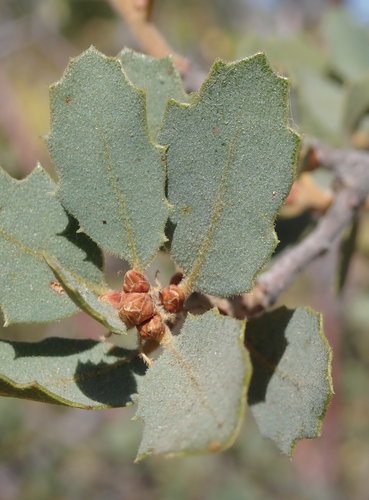
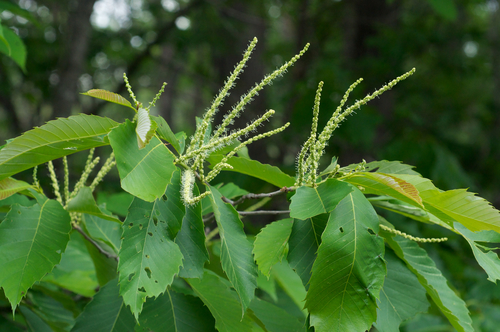
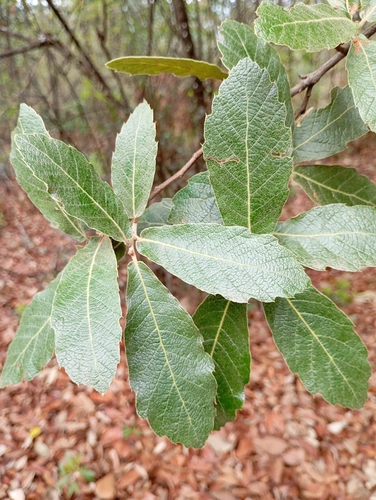
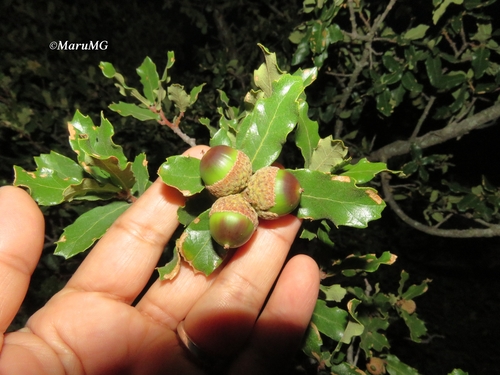
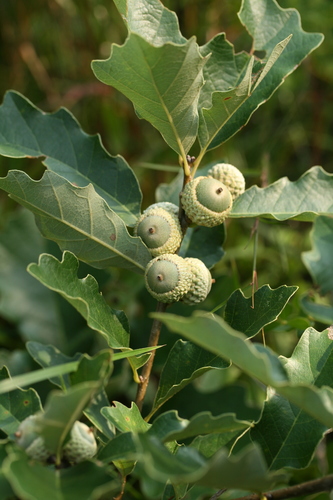
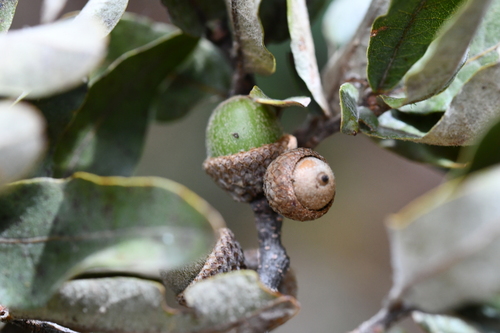
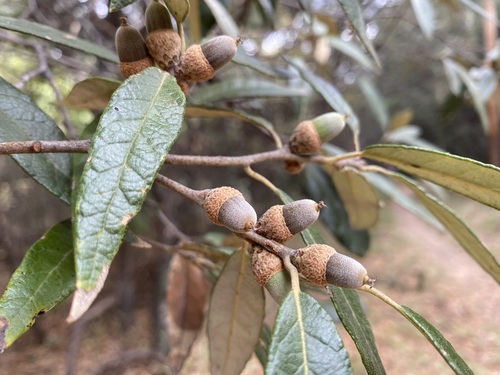
Quercus hypoleucoides A.Camus is most often found as a shrub, but can grow into a full-sized tree when it has access to sufficient water. It grows in warm regions and is used as an ornamental plant for its unusual foliage. Its bark is dark gray, thin, and marked with shallow, lighter-colored fissures and narrow ridges. Its twigs are reddish brown, slender to moderately thick, broadly triangular with a sharp point, and usually covered in white fuzz, with clustered end buds. Its leaves are alternate, evergreen, simple, and range from narrowly oblong to lanceolate. They are usually 5–10 cm (2 to 4 inches) long, with rolled edges, and occasionally a small number of shallow teeth, a narrow pointed tip, and a leathery texture. The top surface of the leaf is typically shiny yellow-green, while the bottom surface is white or silvery. Fruits are oblong acorns 1.5–2 cm (1⁄2–3⁄4 in) long. The acorn cap is a scaly, bowl-shaped structure that covers one-third of the nut. Acorns ripen over one or two growing seasons and mature in early fall. This species is monoecious, meaning both male and female flowers grow on the same individual, unlike dioecious species that have separate male and female plants. It produces flowers in spring, like most plants. Male flowers form long, drooping, yellow-green catkins. Female flowers grow on very small spikes in leaf axils, and emerge at the same time as new leaves. When well-watered, this species can grow into a medium-sized tree reaching up to 18 m (60 ft) tall, with a spreading round crown. Quercus hypoleucoides can be distinguished from other oak species by its lanceolate leaves, which are dark green on the upper surface and silver white on the lower surface. This species is commonly found in moist canyons, on ridges, in coniferous forests, and in high elevation lands between 1,500–2,400 m (5,000 to 8,000 ft) above sea level. It occurs in the mountains of southern Arizona and New Mexico (including the Santa Catalina Mountains and Chiricahua Mountains), where it grows in pine-oak woodland at roughly 1,710–2,160 m (5,700 to 7,200 ft) elevation alongside other oak species including Quercus arizonica, Quercus emoryi, and Quercus rugosa. Specimens have also been collected south of the US-Mexico border, in the Mexican states of Sonora, Chihuahua, Coahuila, and Sinaloa. In ecology, squirrels and birds eat the acorns of this species. Taller individuals provide shade for animals seeking shelter from strong sunlight. It is a vigorous post-fire resprouter, and will grow as a multi-stem shrub in areas that experience repeated fires. For human uses, the acorns can be eaten after the toxic tannic acid is leached out. The species is widely planted as an ornamental, valued for the unique visual contrast of its leaves from the bright silver-white color of their lower surface.