About Quercus havardii Rydb.
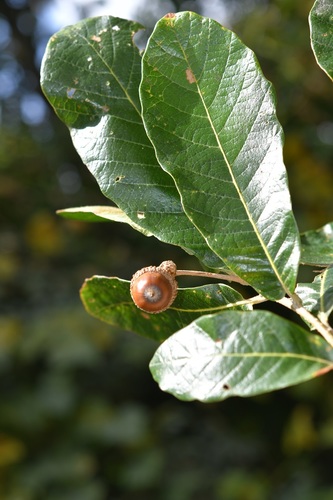
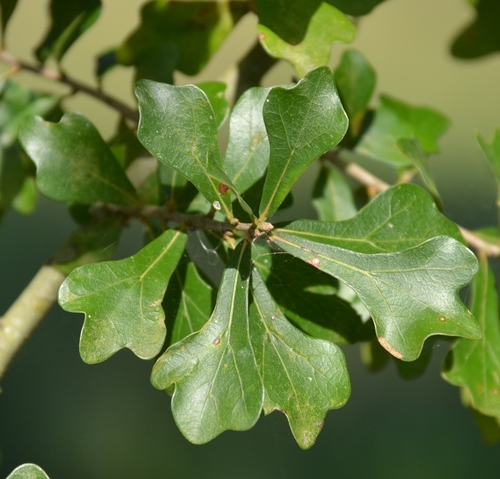
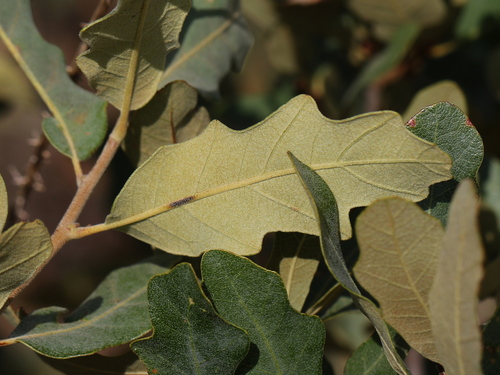
Quercus havardii Rydb., commonly called shinnery oak, typically grows as a low shrub reaching up to 2 meters (6+1⁄2 feet), or occasionally as a small tree. It most often grows in sandy soil, where it forms large clonal thickets by spreading rhizomes. These rhizomes measure 3–15 centimeters (1+1⁄4–6 inches) in diameter, and are mostly concentrated in the upper 60 cm (24 in) of soil, though they have been recorded reaching depths of 9 m (30 ft) in shifting sand dunes. Lateral roots and woody rhizomes are widespread close to the soil surface. At least 90% of a shinnery oak's total biomass is located underground, and accidental root grafting between individual plants is common. These underground stems usually spread to form clonal patches 3 to 15 m (10 to 49 ft) or more across. Single clones have been reported to cover up to 81 hectares (200 acres) and reach ages over 13,000 years. Shinnery oak is monoecious, meaning it produces both female and male flowers separately on the same individual plant. Male catkins are densely flowered, 1.5–3.8 cm long, and hang downward. Female catkins are 3–7 millimetres (1⁄8–1⁄4 in) long, hold 1 to 5 flowers each, and usually grow in the axils of young shoots. This species is wind pollinated, and flowering takes place in spring. Its acorns develop over one year and mature in autumn. Acorns grow singly or in clusters of 2 or 3, and measure 12–25 mm (1⁄2–1 in) long by 14–18 mm wide. A scaly cup covers between one third and one half of the nut. On average, shinnery oak produces a full acorn crop in 3 out of every 10 years. The species has leathery leaves that are highly variable in form, ranging in color from grey green to olive green. The upper leaf surface is lustrous, while the underside is whitish and densely covered in hairs. Leaves are alternate and simple, with variable shapes including oblong, ovate, or elliptical, and have wavy or shallowly lobed margins. They measure 2 to 8 cm (3⁄4 to 3+1⁄8 in) long and 2 to 4 cm wide. Twigs are brown or grayish, 1–2.5 mm in diameter, and may be hairless or densely covered in short grayish or yellowish hairs that are shed as the twig ages. The buds are dark red-brown, roughly spherical, about 2 mm long, and have sparse fine hairs. Bark on larger stems is light gray and scaly. Shinnery oak is native to western Oklahoma, west Texas, and eastern New Mexico, with two isolated populations in southwest Kansas. A variety of the species is also found in northeastern Arizona and southeastern Utah. Its typical habitat is sandy plains, sand dunes, and sand hills of the southern Great Plains. Because shinnery oak thrives in harsh environments, it acts as a sand dune stabilizer that protects sandy soils from wind erosion. It also provides cover and food for a wide range of wildlife species. Collared peccaries, lesser prairie-chickens, northern bobwhites, and many other wild animals eat shinnery oak acorns. Deer, pronghorn, and southern plains woodrats browse the foliage of shinnery oak. Shinnery oak habitats are used by black-tailed jackrabbits, desert cottontails, eastern cottontails, wild turkeys, western box turtles, a wide diversity of arthropods, approximately 25 snake species, and approximately 10 lizard species. This includes the endangered sand dune lizard (Sceloporus arenicolus). Many game species also depend on shinnery oak. Scaled quail and northern bobwhites make extensive use of shinnery oak habitats, and these habitats are described as "the principal home for white-tailed deer in the southern Great Plains". Compared to the surrounding shortgrass plains, shinnery oak stands support richer wildlife habitat. Maintaining wildlife habitat and adjusting vegetation for livestock grazing are often conflicting goals, so this tradeoff should be carefully considered before carrying out shinnery oak control measures.