About Quercus greggii (A.DC.) Trel.
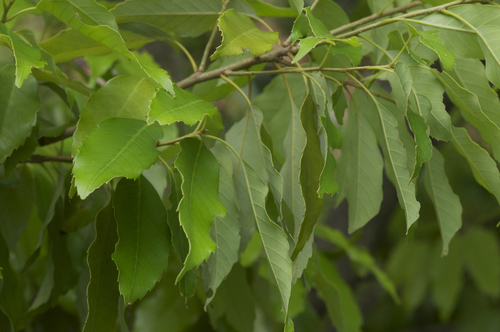
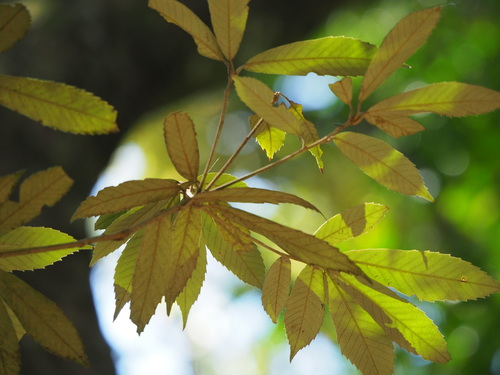
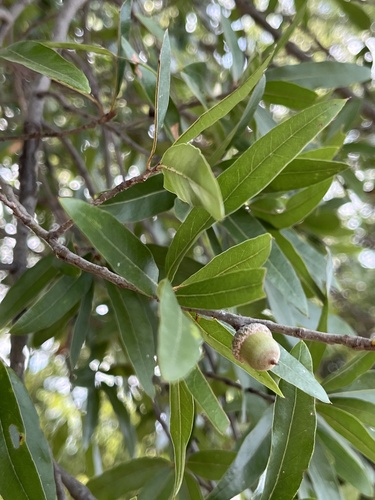
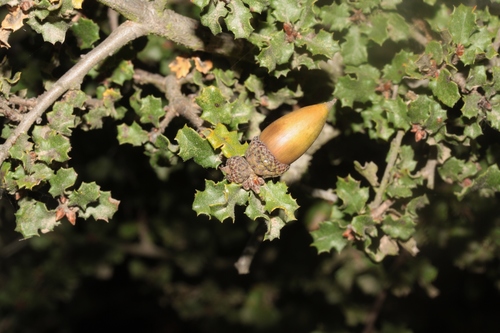
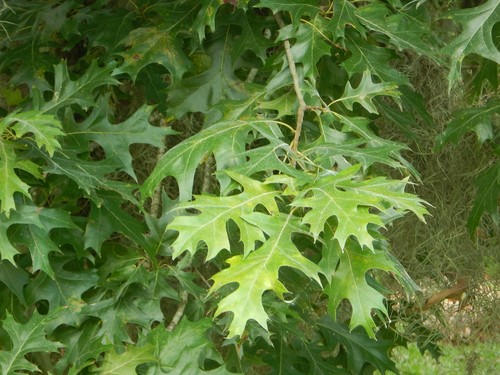
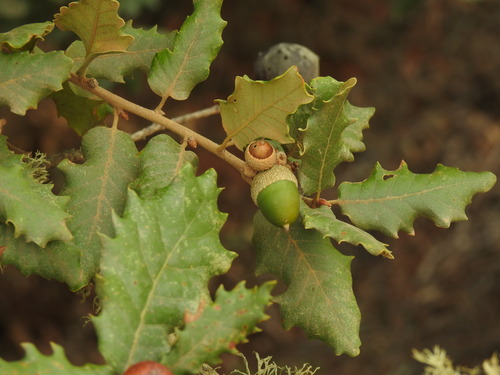
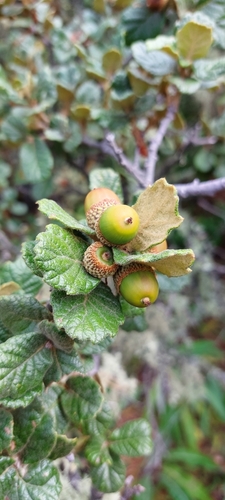
Quercus greggii (A.DC.) Trel., commonly called the Mexican oak, is a monoecious semi-evergreen oak adapted to survive arid conditions. It is native to Mexico, where it typically grows at elevations of 2,000 to 3,300 metres (6,600 to 10,800 ft) north of the 24th parallel, and can be found across multiple locations. Mature plants reach approximately 6.1 to 7.6 metres (20 to 25 feet) in height, though they can grow as small as 1.8 metres (6 feet), and reach 3 to 4.6 metres (10 to 15 feet) in width. It has waxy, rounded-ovular leaves that measure around 3–6 cm by 2–4 cm, and leaves are generally covered in a dense layer of trichomes. Its bark is light gray, scale-like, and covered in small lenticels that enable gas exchange with the surrounding atmosphere. Its twigs are covered in thick woolly hairs. Around April, the trees produce catkins that hold approximately 18 flowers and measure 3–4.5 cm long. As a monoecious species, it produces both male and female reproductive structures on the same individual, and also forms female inflorescences. Each female inflorescence typically holds 2 to 4 flowers, and is covered in trichomes, similar to the species' leaves. Like other oaks, Quercus greggii produces acorn nuts, which can grow either singly or in clusters on small peduncles attached to main branches. Each acorn contains one seed, and falls from the tree to grow into a new Mexican oak when mature. La Siberica is a registered cultivar of this species.