About Quercus garryana Douglas ex Hook.
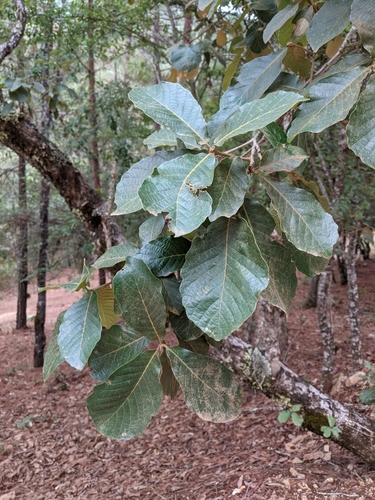
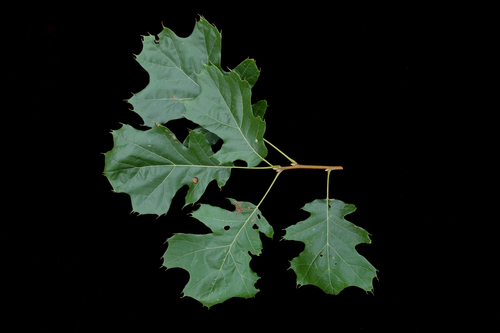
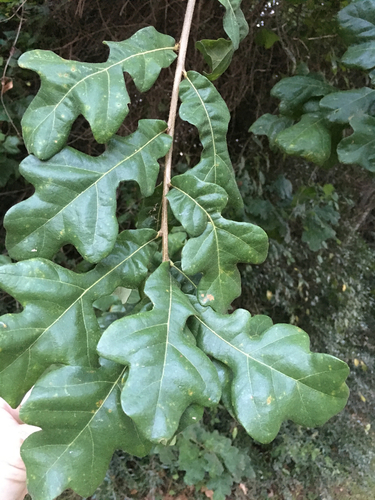
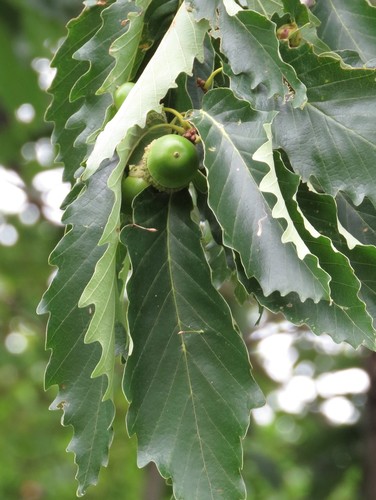
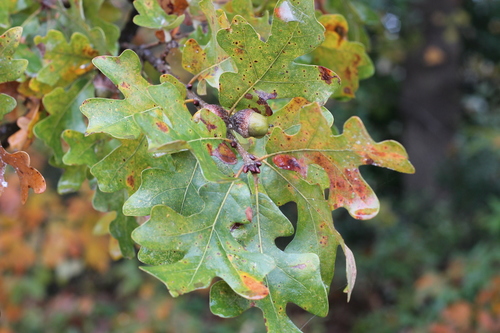
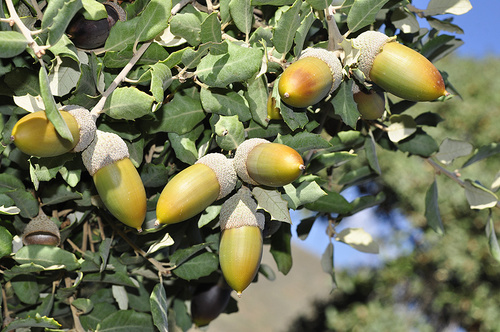
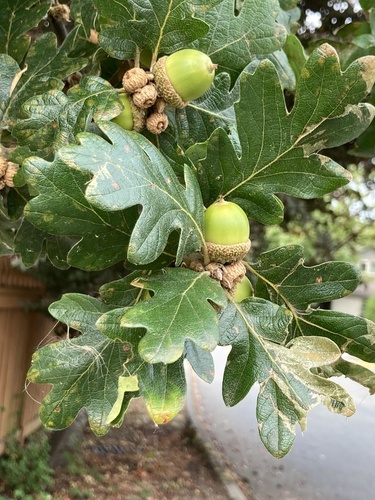
Quercus garryana Douglas ex Hook. is typically a medium-sized slow-growing tree, reaching around 80 feet (24 metres) in height, and occasionally growing as tall as 100 ft (30 m); it can also grow in a shrub form, reaching 10 to 15 ft (3.0 to 4.6 m) tall. Its trunks grow to 3 ft (0.91 m) thick, and can exceptionally reach 5 ft (2 m) thick. The bark is gray and fissured. When growing alone, it has the characteristic oval shape seen in other oaks, but it can also grow in dense groves where individual crowns may merge into a single canopy. Its leaves are deciduous, measuring 2–6 in (5.1–15 cm) long and 1–3 in broad, with 3–7 deep lobes on each side; they are darker green on the upper surface and covered in fine hairs on the underside. It produces catkin flowers, and its fruit is a small acorn, 3⁄4–1 in (19–25 mm) long (rarely 1+1⁄2 in) and 1⁄2–3⁄4 in (13–19 mm) broad, held in shallow, scaly cups. Its autumn foliage color is unspectacular, with most trees turning plain brown. This species, commonly called Oregon white oak, is frequently host to the mistletoe Phoradendron flavescens in the Willamette Valley. It is also commonly host to galls formed by wasps from the family Cynipidae. The most striking of these galls are 'oak apples', green or yellow balls up to 5 cm in size that attach to the undersides of leaves; Cynips maculipennis is one common wasp species that forms these galls. Another common cynipid wasp, the oak twig gall wasp (Bassettia ligni), causes death of twigs and small branches, most often near branch tips. The amount of twig die-back it causes varies greatly year to year in a cyclic pattern. Other cynipid species form different galls on the species' stems and leaves, with shapes ranging from spheres to mushroom-shaped to pencil-shaped. Individual Quercus garryana specimens can live around 500 years; notable old specimens grow on Sauvie Island near Portland, Oregon. In the northern part of its range, Quercus garryana grows from sea level up to 690 ft (210 m) in altitude, while in the southern part of its range in California, it grows between 980 and 5,900 ft (300 to 1,800 m) in altitude. In British Columbia, Garry oak grows on the Gulf Islands and southeastern Vancouver Island, extending from west of Victoria along the island's east side up to the Campbell River area. Small populations also grow along the Fraser River on the British Columbia mainland. The northernmost population of Garry oak grows just below 50°N on Savary Island, in the northern Strait of Georgia. Garry oak is the only oak native to British Columbia, and one of only two native oaks in western Canada, alongside bur oak. In Washington, the tree grows on the west side of the Cascade Range, particularly in the Puget Sound lowlands, the northeastern Olympic Peninsula, Whidbey Island, the Chehalis river valley, and the San Juan Islands. It also grows in the foothills of the southeastern Cascades and along the Columbia River Gorge. In Oregon, the tree grows on the west side of the Cascade Range, primarily in the Willamette, Umpqua and Rogue river valleys, along the Columbia River Gorge, and in canyons adjacent to the gorge. In California, the Q. garryana var. garryana grows in the foothills of the Siskiyou and Klamath Mountains, the Coast Ranges of Northern California, and the west slope of the Cascades. Q. garryana var. semota grows in the Sierra Nevada and Coast Ranges as far south as Los Angeles County. Quercus garryana is a drought-tolerant tree. Older specimens are often affected by heart rot. Its acorns are eaten by wildlife and livestock; botanist David Douglas recorded that bears consume the acorns. In British Columbia, Garry oak can be infested by three nonnative insects: the jumping gall wasp Neuroterus saltatorius, the oak leaf phylloxeran, and the spongy moth. While the invasive plant disease sudden oak death infects other Pacific Coast native oaks, it has not been found on Oregon white oak. Most oak species susceptible to this disease belong to the red oak group, while Oregon white oak belongs to the white oak group. The acorns of Quercus garryana are mildly sweet (and possibly unpalatable) and edible, ideally after leaching. The bitterness of the toxic tannic acid in acorns usually prevents people from eating enough to become ill. Native Americans ate the acorns both raw and roasted, and also processed them into a type of flour. The hardwood of Quercus garryana is hard and heavily ring-porous. It has distinctive growth rings and prominent rays. Heartwood can be a deep chocolate brown, while sapwood ranges from golden brown to nearly white. These characteristics make it especially attractive to woodworkers, but it can be difficult to work with because it is prone to warping and cracking. Though it was popular around the turn of the 20th century, historically it has not been considered to have high commercial value, and is often cleared and destroyed during land development for construction. The wood is suitable for making fence posts. It has similar qualities to other white oaks, so it has been used experimentally in Oregon to make casks for aging wine. In Washington, it has been used for aging single malt whiskey since the 2010s. Oregon white oak barrels are reported to give whiskey "burnt sugar notes, marshmallow sweetness, and a light floral character that showcases the best of the Garry oak". When used as firewood, Oregon white oak produces 28 million British thermal units per cord (2.3 MWh/m3) when burned.