About Quercus gambelii Nutt.
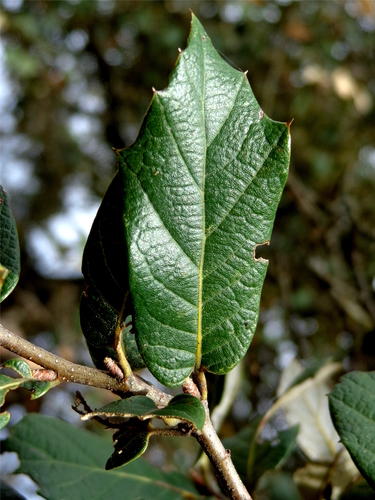
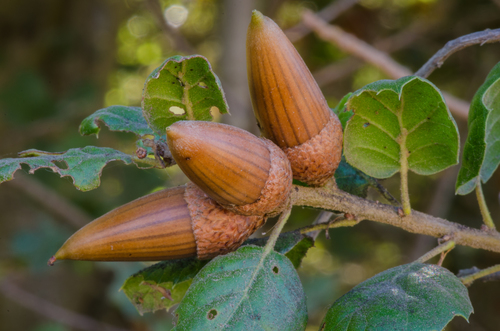
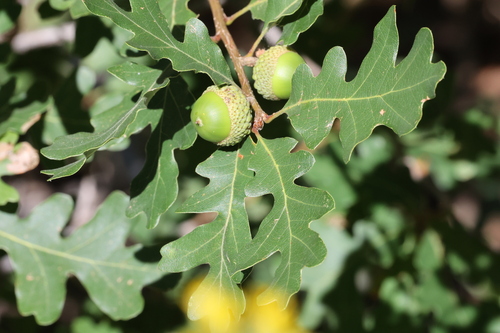
Quercus gambelii Nutt. (Gambel oak) varies in size depending on its location. The average mature height ranges from 3–9 metres (10–30 feet), but it can occasionally reach 18 m (59 ft) in some areas. Dwarf stands shorter than 1 m (3 1⁄4 ft) are common in marginal habitats that experience heavy browsing. The largest specimens grow along streams in the southern part of the species' range, and can reach up to 100 feet tall; the current champion tree, located in Arizona, reaches 35 m (114 ft) in height. While Gambel oak wood is hard and dense, its branches grow in irregular, crooked shapes that give them enough flexibility to bend without breaking under heavy snow. Its bark is rough and brownish-gray. Its leaves are typically 7–12 centimetres (3–4 1⁄2 inches) long and 4–6 cm (1 1⁄2–2 1⁄2 in) wide, with deep lobes along each side of the central vein. The upper leaf surface is glossy dark green, while the undersurface is paler and velvety. Gambel oak is deciduous; its leaves often turn orange and yellow in autumn, creating vividly colored mountainsides. Its flowers are inconspicuous unisexual catkins that bloom in spring. Its acorns are 10–20 millimetres (3⁄8–3⁄4 in) long, with between one-third and one-half of the acorn enclosed by a cap-like cupule. Acorns mature in September, changing color from green to golden brown. This species reproduces via acorns, and also spreads through root sprouts that grow from large underground structures called lignotubers. These reproductive traits often lead to dense groves or thickets that can cover entire mountainsides. The natural range of Quercus gambelii is centered in the western United States and northwestern Mexico, across the states of Arizona, Chihuahua, Colorado, New Mexico, Sonora, and Utah. It also extends into Nevada, Wyoming, Idaho, Nebraska, the Oklahoma Panhandle, Coahuila, and the Trans-Pecos region of western Texas. Gambel oak most commonly grows at elevations of 1,000–3,000 m (3,300–9,800 ft) above sea level, in areas with average annual precipitation between 30–60 cm (12–24 in). The species grows best in full sun on hillsides with thin, rocky, alkaline soil where competition from other plant species is low. It can also grow well in richer soils, but in these areas it must compete for growing space. It is well adapted to areas with wet springs and hot, dry summers, conditions that promote wildfire. After a wildfire, Gambel oak re-establishes quickly from root sprouts. It is also drought tolerant. Plant species commonly associated with Gambel oak include chokecherry, arrowleaf balsamroot, bigtooth maple, mountain mahogany, ponderosa pine, and serviceberry. Animal species associated with Gambel oak include Woodhouse's scrub jay, black-billed magpie, grouse, deer, chipmunks and squirrels. Where Gambel oak is abundant, it is an important food source for browsing animals like deer and livestock. Its sweetish acorns are often collected and stored for winter food by squirrels. Acorns are also eaten by wild turkeys, black bears, and domestic animals such as hogs. Some insects depend on Gambel oak; for example, caterpillars of the Colorado hairstreak butterfly feed on this species. Historically, acorns from Gambel oak were a reliable food source for Native Americans. If acorns are bitter, tannins can be leached out to make them usable.