About Quercus faginea Lam.
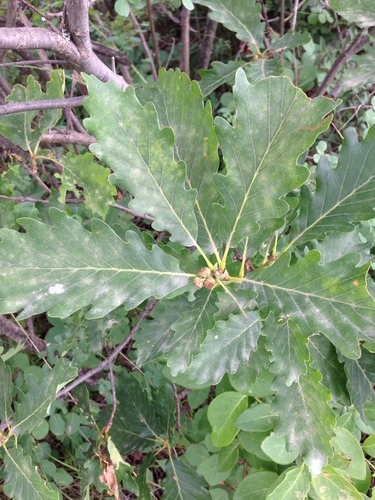
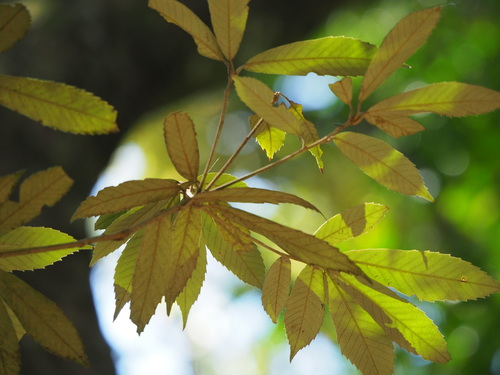
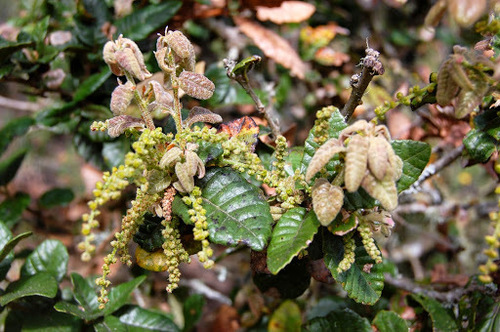
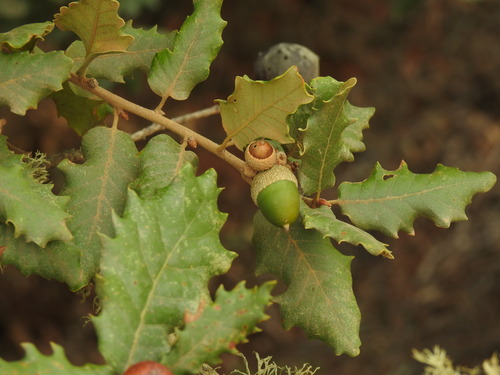
Quercus faginea Lam. is a medium-sized deciduous or semi-evergreen tree. It reaches up to 20 metres (66 feet) in height, with a trunk that can grow up to 80 centimetres (31 inches) in diameter, and has grey-brown bark. This tree can live up to 600 years. Its leaves measure 4–10 cm (1+1⁄2–4 in) long and 1.2–4 cm broad, rarely reaching 15 cm long and 5 cm broad; the upper leaf surface is glossy dark green to gray-green, while the lower surface is variably felted grey-white. Leaf margins have five to 12 pairs of irregular teeth, and leaf fall typically occurs in mid- to late winter. Its flowers are catkins, produced between March and April, almost always earlier than those of holm oak, a species that grows in similar areas. The acorns are oblong-ovoid, 2–2.5 cm long, maturing in 6 months to disperse in September or October. This species commonly develops brown galls 1–2 cm in diameter with a spongy, cork-like interior caused by gall wasp activity. Portuguese oak, the common name for this species, readily hybridizes with other related oaks including Algerian oak (Quercus canariensis) and downy oak (Quercus pubescens), which can make identification difficult. The specific epithet faginea refers to the superficial resemblance of this species' leaves to those of beech (Fagus). Traditionally, the wood has been used as firewood and as timber for construction, for beams and posts. Like the acorns of holm oak or cork oak, the acorns of Quercus faginea are an important food for free-range black Iberian pigs reared for jamón ibérico production. It is also occasionally planted as an ornamental tree.