About Quercus engelmannii Greene
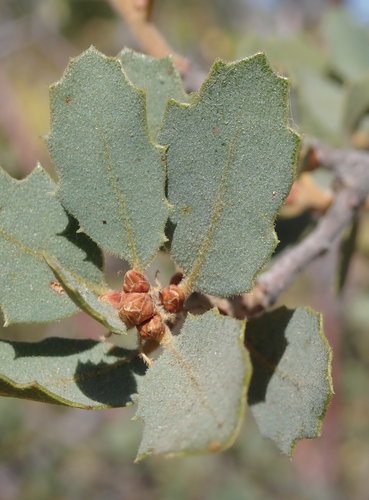
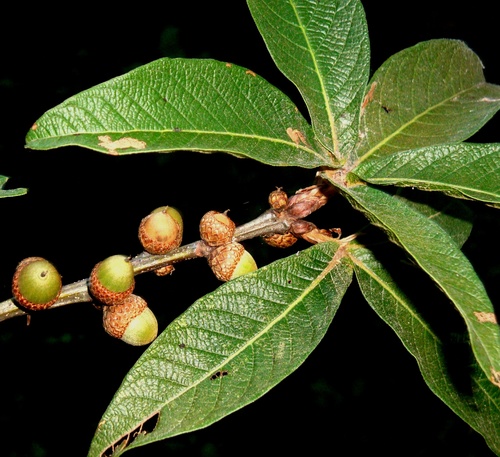
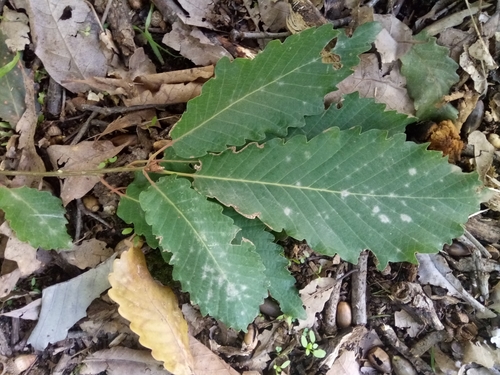
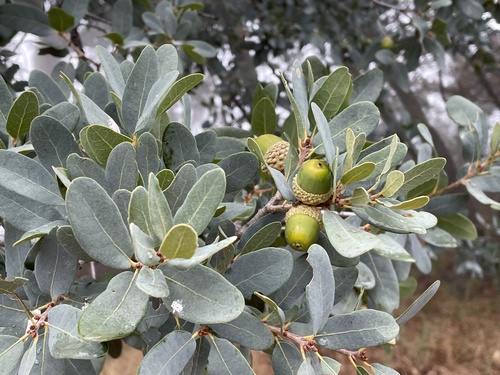
Quercus engelmannii (Engelmann oak) is a small tree that reaches 10 meters (33 feet) in height. It is generally evergreen, but may drop leaves during hot, dry local summers in response to drought, and it grows a rounded or elliptical canopy. Its bark is thick, furrowed, and light gray-brown. Its leaves are leathery, blue-green, 3–6 centimeters (1+1⁄4–2+1⁄4 inches) long and 1–2 centimeters (1⁄2–3⁄4 inch) broad; leaves can be flat or wavy, and have smooth margins. Its flowers are catkins, and its fruit is an acorn 1.5–2.5 centimeters (1⁄2–1 inch) long that matures 6–8 months after pollination. The wood of Quercus engelmannii is dark brown and strong, but it tends to warp and split when drying, so it has low value as timber. The native range of Engelmann oak extends from the foothills of the San Gabriel Mountains in eastern Los Angeles County, through the Santa Ana Mountains of Orange County and the western foothills and mesas of the Peninsular Ranges in Riverside and San Diego counties, and continues into the Sierra Juárez and Sierra de San Pedro Mártir ranges of northern Baja California. This oak typically grows in savannas and woodlands located above the dry coastal plain, but below 1,300 meters (4,300 feet) of elevation, where colder winters occur. The range of Engelmann oak is smaller than that of most California oaks, and suburban sprawl in the San Gabriel Valley has eliminated the species from most of the northern portion of its range. The largest remaining stands of Engelmann oak grow on the Santa Rosa Plateau near Murrieta, Riverside County, and on Black Mountain near Ramona, San Diego County. Fossil evidence confirms that Engelmann oak once occupied a much wider distribution, stretching through what is now the Mojave and Sonoran deserts into eastern California and Arizona. Engelmann oak is most closely related to Quercus arizonica (Arizona white oak) and Quercus oblongifolia (Arizona blue oak), which are native to subtropical pine-oak woodlands of Arizona and northern Mexico. It is considered the northernmost species of subtropical oak, isolated from its closest relatives to the east when the southwestern deserts dried.