About Quercus durata Jeps.
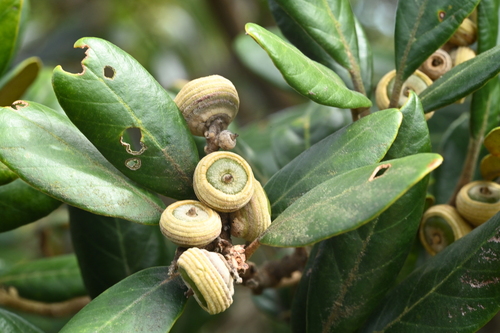
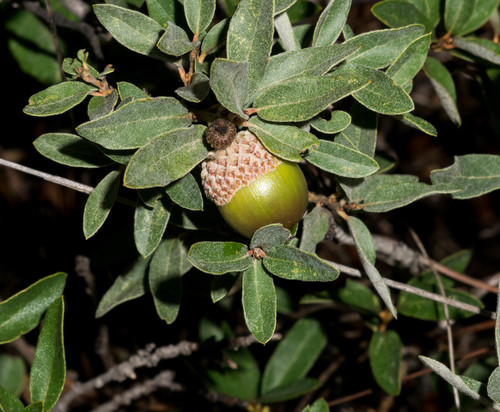
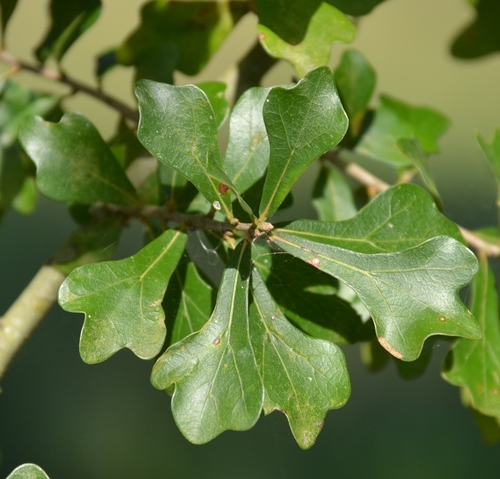
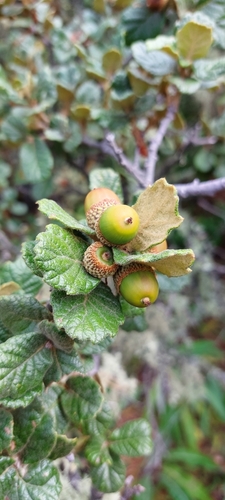
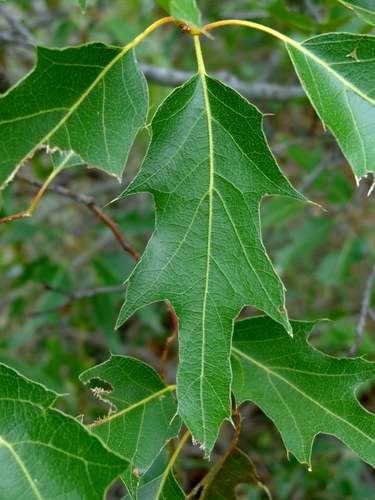
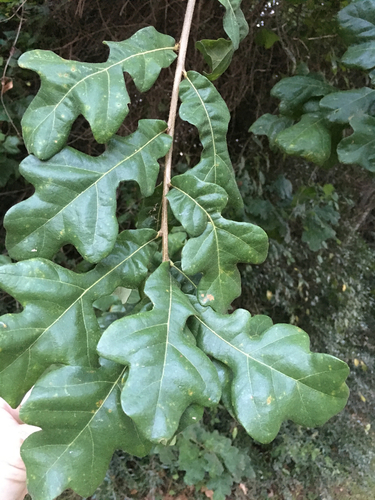
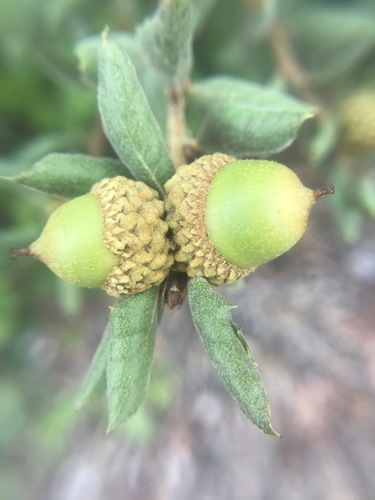
Quercus durata Jeps., commonly called leather oak, is a dicot species of oak. English horticulturist and botanist Theodore Payne described it as a "rather low spreading shrub with rigid branches, foliage rich deep green. Desirable for hillside planting." This is a short oak species, generally reaching 1–2 metres (3+1⁄2–6+1⁄2 feet) in crown diameter and growing 0.5–1.5 m (1+1⁄2–5 ft) tall. Exceptional individuals have been recorded reaching 3–4 m across. Its gray or yellowish twigs have scaly bark, and measure 1–3 centimetres (1⁄2–1+1⁄4 inches) in diameter, while the trunk diameter reaches 4–5 cm. Branches may be densely or sparsely distributed. Its buds are smooth brown or reddish brown ovals. Leaf blades are cupped or convex, rarely somewhat flat; they are 1.5–3 cm long and 1–15 cm wide, borne either densely or sparsely along branches, and their margins may be entirely or irregularly toothed. The upper (adaxial) leaf surface is greenish or yellowish, covered with short semi-erect hairs, and its secondary veins are obscure, dense or scattered. The lower (abaxial) leaf surface is covered with felty, erect rayed hairs 1–4 millimetres (1⁄16–3⁄16 in) in length, and has prominent secondary veins. Leather oak is monoecious, bearing separate male and female flowers on the same individual, and flowers in spring, typically April or May. Male (staminate) flowers grow in catkins, while female (pistillate) flowers are borne singly or in pairs in leaf axils. Its acorns occur solitary or paired at the end of a small stalk; the acorn cup, which encloses up to half of the nut, is reddish or yellowish and has a scaly texture. The nut itself is cylindrical, measuring 1.5–2.5 cm in diameter and 1–2.5 cm long, with a rounded or obtuse apex. As a white oak species, its acorns mature in approximately 6 months, are hairless inside the acorn shell, and have a sweet or slightly bitter taste. The native range of Quercus durata extends from Shasta County in Northern California south to the southern end of the South Coast Range in Santa Barbara County, California. The most common variant grows in foothill woodland and chaparral ecosystems at elevations between 30 and 1,570 m (100 to 5,150 ft). It is particularly abundant in Sargent cypress (Hesperocyparis sargentii) woodlands that occur in parts of Mendocino, Sonoma, San Mateo, Santa Clara, Monterey, San Benito, San Luis Obispo and Santa Barbara counties, as well as the San Francisco Bay region. In more sheltered inland locations such as MacNab cypress (Hesperocyparis macnabiana) woodlands, this shrub can extend into riparian zones where summer fog persists. Q. durata is well adapted to ultramafic soils, which are reddish, typically low in nutrients, high in nickel, magnesium, and chromium, and deficient in calcium. Ultramafic chaparral communities occur below 500 m (1,500 ft) from Santa Barbara County north through the North Coast Ranges, and also in the foothills of the Sierra Nevada and parts of the California Central Valley. In these communities, Q. durata grows alongside other shrubs including chamise (Adenostoma fasciculatum), coffeeberry (Frangula californica), buckthorn (Rhamnus crocea) and toyon (Heteromeles arbutifolia), with scattered populations of canyon live oak and coast live oak also present. Outside of serpentine environments, leather oaks most often occur as isolated individuals within plant associations dominated by California scrub oak (Q. berberidifolia) and interior live oak (Q. wislizeni). The climate of Q. durata's habitat has 41 to 170 cm (16 to 67 in) of annual precipitation falling during a 3 to 8 month wet season, with temperatures ranging from a December low of 30 °F to a July high of 96 °F. It can grow in soils with a pH between 5.5 and 8.3. It occurs almost exclusively on serpentine soil, and is considered a strong indicator species for this soil type. Controlled studies conducted at Jasper Ridge Biological Preserve found that the harsh conditions of Q. durata's habitat limit species re-establishment after forest clearing, and also limit colonization of grassland at chaparral-prairie boundaries. Low summer precipitation, high solar insolation, and herbivory are the cause of this difficulty, rather than low germination rates. In a 2000 study by Narvaez et al. conducted at the Hopland Research and Extension Center with goats and sheep, researchers found that for livestock used in vegetation management programs across grassy woodlands and chaparral ecosystems, both the nutritional quality and intake levels of Q. durata and Adenostoma fasciculatum foliage were low, indicating that diet supplementation is needed for livestock used in these vegetation control programs. Native American peoples used leather oak as a source of food and medicine. After leaching tannins from the acorns, they mashed the acorns into a nutritional mush that, along with other oak products, was a staple in their diets. A common leaching method involved placing raw acorns in a cloth pouch and leaving it in a stream for several weeks to break down the tannins. In modern times, mulch made from leather oak is used in gardens for its effectiveness in repelling slugs and grubs. After pupation, extracts from galls formed on the oak can be used to make tannins and dyes.