About Quercus dentata Thunb.
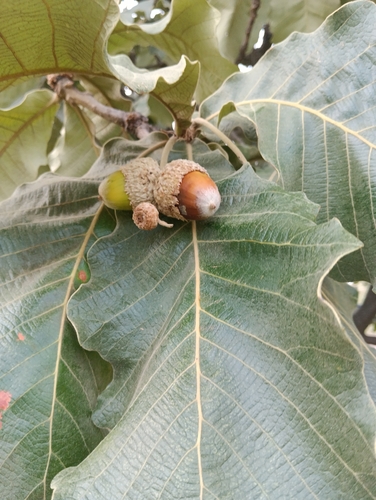
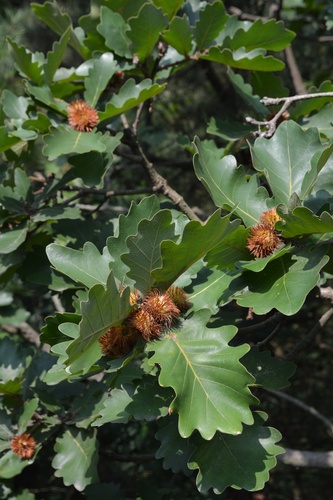
Quercus dentata Thunb. is a deciduous tree that reaches 20–25 metres (66–82 feet) in height, with a trunk up to 1 metre (3 feet 3 inches) in diameter. Its foliage is notable for its very large size, among the largest of any oak. Each leaf has a short, hairy petiole 1–1.5 centimetres (3⁄8–5⁄8 inch) long, and a leaf blade 10–40 cm (4–15+1⁄2 in) long and 15–30 cm (6–12 in) broad, with a shallowly lobed margin. The overall leaf shape resembles a greatly enlarged leaf of the pedunculate oak. Dead leaves often remain attached to the tree through winter. Both leaf surfaces are initially covered in soft downy hairs, and the upper surface becomes smooth as it matures. Flowering occurs in May: male flowers are pendulous catkins, while female flowers are sessile, growing near the tips of new shoots. After flowering, it produces acorns that are 1.2–2.3 cm long and 1.2–1.5 cm broad, held in broad cups covered in bushy scales. Acorns mature between September and October. In terms of ecological interactions on the Japanese island of Hokkaido, Quercus dentata cannot tolerate the extreme cold found in northern Hokkaido, while the related species Quercus crispula can survive these cold conditions. In more southern areas of Hokkaido, Quercus dentata grows in coastal habitats, while Quercus crispula typically grows further inland. In the more northern parts of the island, the two interfertile species have undergone introgression, producing growing, reproductively capable shoots that have formed a coastal Quercus crispula ecotype with Quercus dentata-like traits. These coastal Quercus crispula are intermediate between the two parent species in both genotype and phenotype. Quercus dentata was introduced outside its native East Asia to the British Isles in 1830, where it is only occasionally cultivated in botanical gardens. Cultivated specimens are usually smaller than wild-grown trees, typically growing as a small angular tree or a large irregular shrub. Notable cultivated specimens include one at Osterley Park that measures 14 m (46 ft) tall with a 1.5 m girth, and the largest known cultivated specimen, which reaches 18 m (59 ft) tall and grows at Avondale Forest Park, County Wicklow, Ireland. For culinary use, its acorns, called dotori in Korean, have been used in Korean cuisine since the Three Kingdoms period, most notably to make the food dotorimuk. In Japanese cuisine, its leaves are used as a wrapping for kashiwa mochi.