About Quercus conferta Kit.
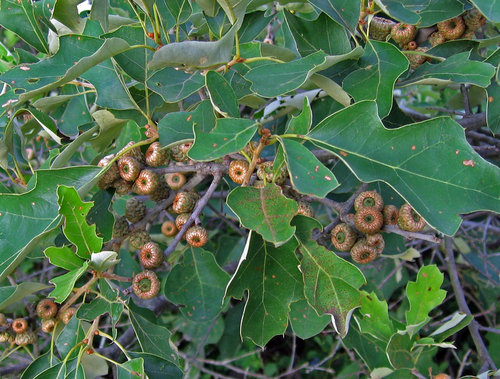
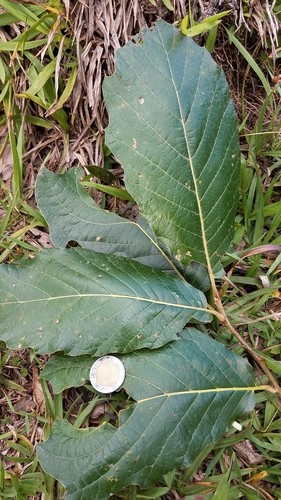
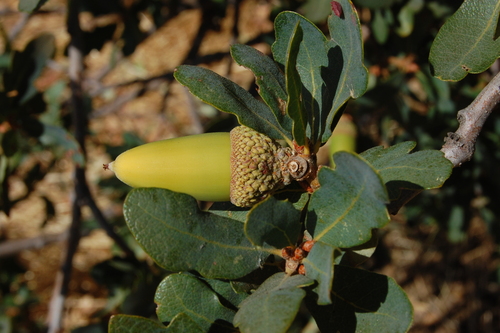
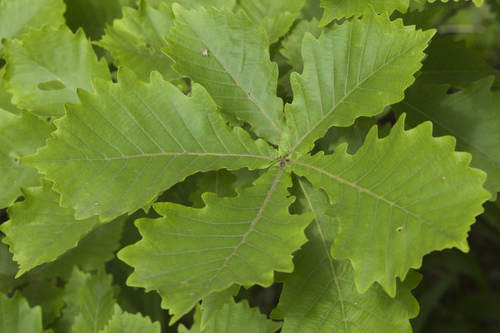
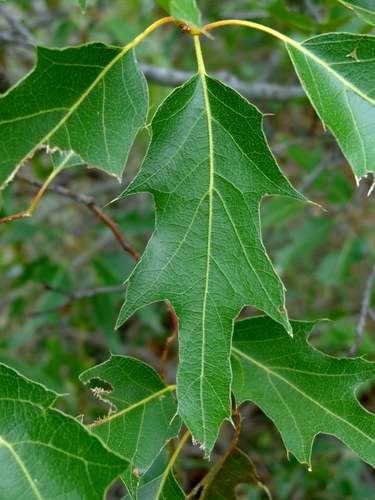
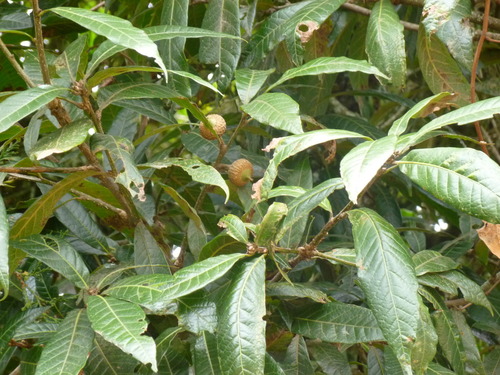
This species is also referred to as Quercus frainetto, the Hungarian oak, a large deciduous tree. It reaches up to 38 metres (125 feet) in height and 20 m (66 ft) in width, with a trunk girth of almost 2 m (7 ft). Its bark is light gray and cracks into small square plates. Its buds are large, long, and pointed, with a shiny russet or light brown color and fine, minute hair-like tomentum. Stout twigs are covered in upward-pointing russet hairs. Its leaves are large, measuring 14–25 centimetres (6–10 inches) long, occasionally growing as long as 33 cm (13 in). Leaves are variable in shape, divided into 6–10 very deep parallel lobes that usually branch into sublobes. Leaf stalks are typically short, 2–6 millimetres (3⁄32–1⁄4 inch) long, rarely reaching 22 mm. Leaves are widest near the apex, which is broad and short-pointed. The base of the leaf usually has auricles that sometimes overlap the twig. Newly expanding leaves are light yellow green, turning to a rich dark green by the start of summer. Leaves are covered in minute russet hairs, particularly on the lower surface, and are concentrated at the ends of twigs. In autumn, leaves turn brown, russet, or yellow, and sometimes stay attached to the twigs until the following spring. Light brown acorns mature in approximately 6 months. They are 15–35 mm (5⁄8–1+3⁄8 in) long, egg-shaped, and usually have a blunt apex. The acorn cup is covered with long overlapping scales and russet hairs. Acorns usually grow in groups of two to eight at the ends of twigs. The center of this tree’s native range is in the Balkans. It is adapted to the subcontinental climate of southeastern Europe, and soil conditions are the main factor determining where it grows. It is specially adapted to heavy acidic soils, specifically cambisols and vertisols, which are common in Kosovo, Serbia, Bulgaria, and Romania. These soils are typically leached, very dry in summer, and sometimes waterlogged in spring. However, Hungarian oak does not tolerate flooding or high water tables, and it is also extremely sensitive to lime in the soil. The English common name “Hungarian oak” was assigned when the Kingdom of Hungary controlled large areas of the Balkans; in contrast to this name, the tree is very rare in modern Hungary, where soils are generally very rich in lime. The Hungarian oak-Turkey oak forest association (Quercetum frainetto-cerris Rud.) is the most widespread association of this oak in the Balkans, and it is also the most common forest type in Serbia and Kosovo. This tree is cultivated in parks and large gardens, and the cultivar 'Hungarian Crown' has earned the Royal Horticultural Society's Award of Garden Merit.