About Quercus coccinea Münchh.
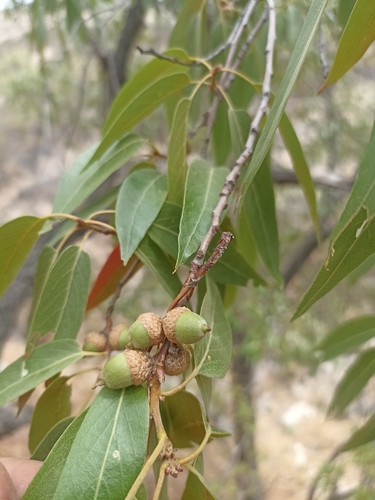
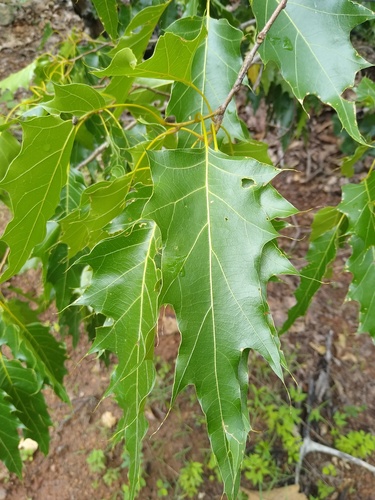
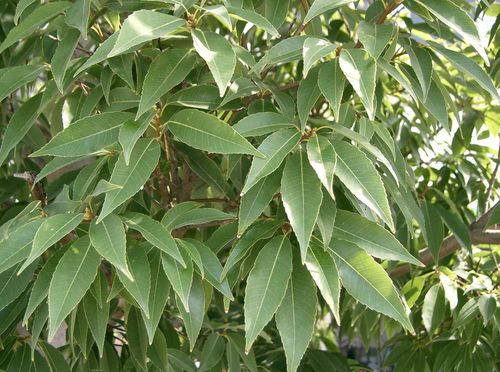
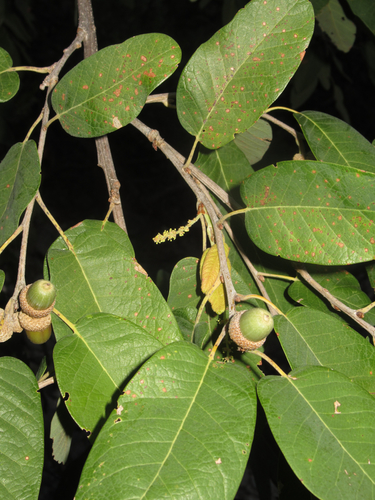
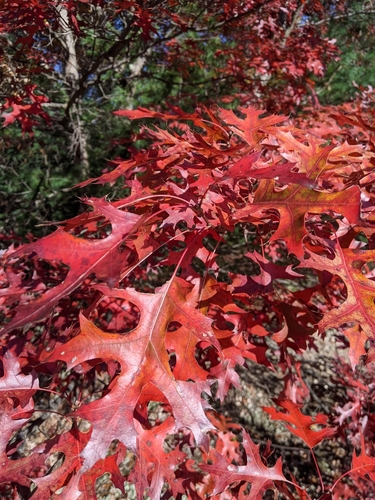
Quercus coccinea Münchh., commonly known as scarlet oak, is a medium to large deciduous tree. It typically reaches 5.5–7.3 metres (18–24 feet) in diameter across its open, rounded crown, and grows to a maximum height of approximately 30 m (100 ft). The trunk diameter at breast height is usually 61 to 91 centimetres (24 to 36 inches). This species grows quickly and matures relatively early. Seedlings develop a strong taproot with relatively few lateral roots. Its leaves are glossy green, 7–17 cm (2+3⁄4–6+3⁄4 in) long and 8–13 cm (3+1⁄4–5 in) broad, with seven lobes separated by deep sinuses. Each lobe bears 3–7 bristle-tipped teeth, and the leaves are entirely hairless. This distinguishes scarlet oak from the related pin oak (Q. palustris), which has tufts of pale orange-brown down at the junction of lobe veins and the central vein. Its foliage typically turns bright scarlet in autumn. Flowers are yellow to green, with color varying by season. The acorns are ovate, 7–13 millimetres (1⁄4–1⁄2 inch) broad and 17–31 mm (5⁄8–1+1⁄4 in) long. Between one-third and one-half of each acorn is covered by a deep cup. Acorns are green when young, maturing to pale brown around 18 months after pollination, and their kernel is very bitter. This species is primarily distributed across the central and eastern United States, ranging from southern Maine west to Wisconsin, Michigan, and Missouri, and south to Louisiana, Alabama, and Georgia. For best growth, scarlet oak requires full sunlight. It prefers dry to somewhat dry, well-drained acidic soil. Scarlet oak is sometimes planted as an ornamental tree, valued for its bright red autumn color. The cultivar 'Splendens' has received the Royal Horticultural Society's Award of Garden Merit. It is commonly grown for shade and ornamental use due to its excellent autumn red color. Its lumber is grouped with other red oaks and is a popular choice for lumber, most commonly used for flooring. Scarlet oak wood ranges from light to medium red-brown in color, has a fairly coarse texture and relatively large pore size. It is less durable than white oak, which has higher resistance to decay and rot. Scarlet oak lumber glues easily, and produces an attractive finish after staining. Like most oaks, it has a distinct, appealing scent. While oak is classified as a sensitizer, it rarely causes allergic reactions; reported mild reactions include eye and skin irritation, and asthma-like symptoms. Compared to more expensive white oak, scarlet (red) oak is readily available at reasonable prices, making it a very popular lumber product across the United States. Common uses for scarlet oak lumber include furniture, cabinetry, interior trim, flooring, and veneer. Scarlet oak shares many characteristics with northern red oak (Quercus rubra) and is often grouped in the broad red oak category alongside it. Galls formed on Quercus coccinea from insect interactions may be used to treat hemorrhages, chronic diarrhea, and dysentery.