About Quercus chrysolepis Liebm.
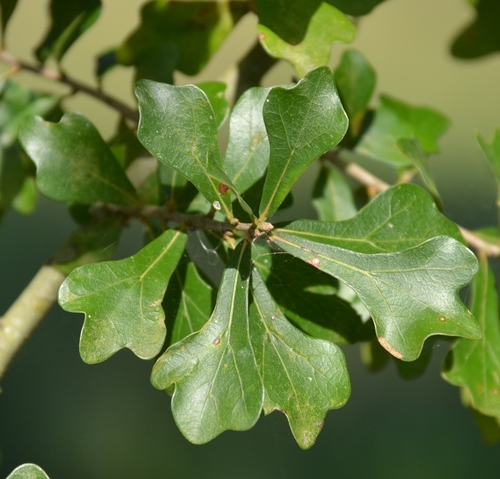
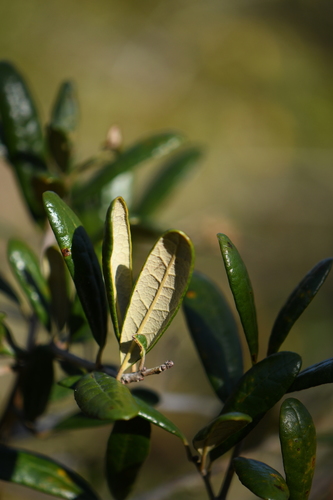
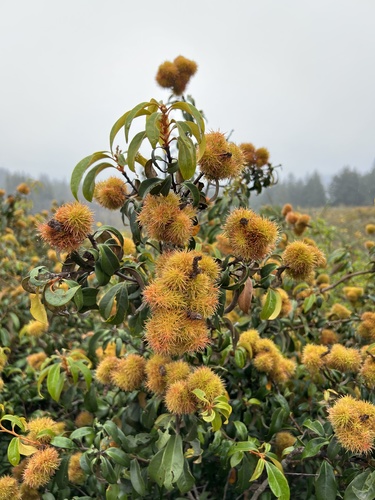
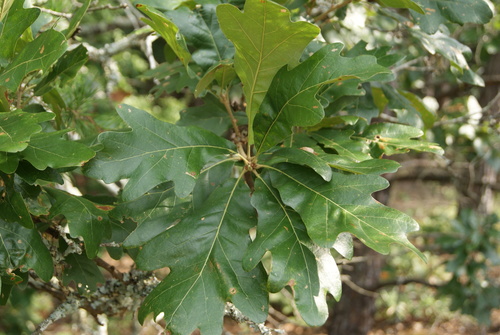
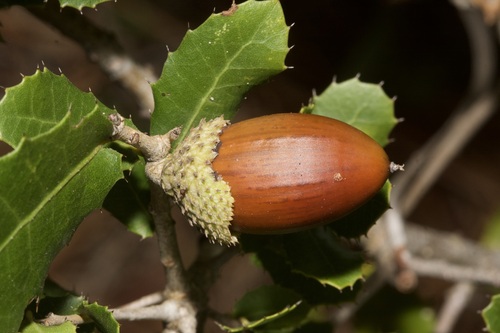
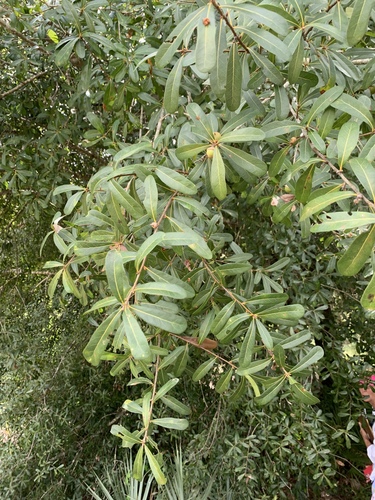
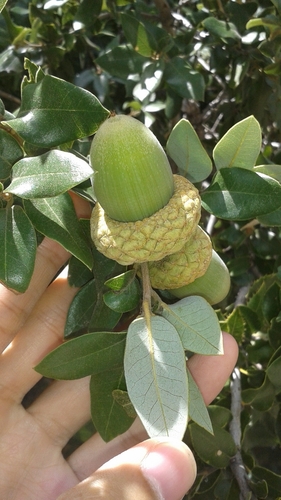
Quercus chrysolepis Liebm., commonly called canyon live oak, is an evergreen tree that grows with large spreading, horizontal branches and a broad, rounded crown. It reaches 6 to 30 meters (20 to 100 feet) in height, and often grows as a shrub. Its trunk diameter typically ranges from 30 to 100 centimeters (12 to 39 inches). Exceptionally large specimens grow in the mountains of Southern California, and rank among the largest oaks in North America. The largest known specimen, located in the San Bernardino Mountains, measures 38 m (124 ft) high, with a trunk circumference of 12 m (39 ft 4 in) and a crown spread of 30 m (98 ft). Its bark is grayish brown, and is either rather smooth or sometimes scaly. Its leaves are elliptical to oblong, 2.5 to 8 cm (1 to 3+1⁄4 in) long and about half as wide. Leaves are short-pointed at the tip, and rounded or blunt at the base. While leaves are generally flat, their margins may be slightly rolled under, and typically have spiny teeth, particularly on young twigs. These leathery leaves are glossy dark green on the upper surface, with a dull golden fuzz on the underside that often becomes gray and nearly hairless by the second year. Both male and female flowers grow on the same individual plant. Male flowers droop as catkins, while female flowers grow from leaf axils, usually one per axil. Acorns grow singly or in pairs, and are 2–5 cm long. These fruits vary in size and shape, but are generally ovoid with a turban-like shape, enclosed in a shallow, thick cup of scales densely covered with yellowish hairs; the stalk is barely visible. Quercus chrysolepis grows across a variety of forest communities in the southwestern United States. It is common in mountainous regions of California, including the Sierra Nevada, Coast Ranges, Klamath Mountains, Cascades, and San Gabriel Mountains. Additional populations exist in the Siskiyou Mountains of southwestern Oregon, western Nevada, northern Baja California, Arizona, southwestern New Mexico, and Chihuahua. Populations in southwestern New Mexico are most likely the result of introgression from Quercus palmeri into Q. chrysolepis. These populations tend to have intermediate overall morphology, but lack the diagnostic trichomes and biochemical markers of Q. palmeri, so they are best classified as Q. chrysolepis with affinity to Q. palmeri. Canyon live oak tolerates many soil types, including very rocky or cobbly environments. It is hardy to cold temperatures as low as −11 °F, and grows in neutral to moderately acidic soils with pH values ranging from 4.5 to 7.5. One example of its tolerance for very rocky, serpentine soil is its occurrence at the Cedars in Sonoma County, California. Canyon live oak grows at elevations from about 500 to 1,500 m (1,600 to 4,900 ft) in southwestern Oregon, from 100 to 1,400 m (330 to 4,590 ft) in Northern California, and up to approximately 2,700 m (8,900 ft) in Southern California. Q. chrysolepis can be the dominant tree on steep canyon walls, especially in areas with shallow rocky soils. In areas with moderate to high rainfall, it occurs on south-facing slopes; in the hotter, drier parts of its range, it grows on northerly slope faces. Fossil data shows the species had a much wider distribution across the western United States during the early Holocene period. This species is often sympatric with Quercus agrifolia and several other oak species. It is more shade tolerant than Pacific madrone, but less shade tolerant than associated Douglas-fir, tanoak, and golden chinkapin. After forest fires, canyon live oak regenerates vigorously through basal sprouting, and the species has been found to have high clonal diversity. It is typically outcompeted and succeeded by other tree species except in more extremely dry and rocky climates, as it is exceptionally drought tolerant. A wide range of wildlife species consume its acorns, including the acorn woodpecker, California ground squirrel, dusky-footed wood rat, western harvest mouse, and black-tailed deer. Wildlife do not appear to have a strong preference between this and other oak species. Extensive hybridization of Q. chrysolepis with several other sympatric oak species has been documented, and this hybridization is likely more extensive than for any other Quercus species. The ability of Q. chrysolepis to compete with other dominant trees within its range has been analyzed based on leaf architecture and photosynthetic capability. Study results show that in low light environments, Q. chrysolepis outcompetes species with larger leaf size and greater crown mass per unit volume through higher photosynthetic efficiency and longer leaf lifespan. Canyon live oak provides functional habitat for many animals, offering perching, nesting, resting, and foraging sites for many bird species, and shade and cover for a diverse range of other mammals. Young Q. chrysolepis is an easily accessible browse. Canyon live oak woodlands make excellent mountain lion habitat, due to the large deer population that frequents these areas. Many species forage on canyon live oak foliage, including black-tailed jackrabbit, beaver, brush rabbit, red-backed vole, Sonoma chipmunk, cactus mouse, deer mouse, and porcupine. Pocket gophers often feed on the cambium of young canyon live oaks. Canyon live oak is a major host plant for caterpillars of the California sister butterfly (Adelpha californica). In southern California, Q. chrysolepis is also the food plant for a small moth, Neocrania bifasciata. The acorns of Quercus chrysolepis are edible. Native Americans used them as a staple food after leaching out the tannins. Roasted seeds of the species are also used as a coffee substitute. The wood of canyon live oak is strong; European-American settlers called it 'maul oak' and used it to make sledgehammers and wedges. The wood is sometimes used for paneling, and is especially popular as firewood.