About Quercus arizonica Sarg.
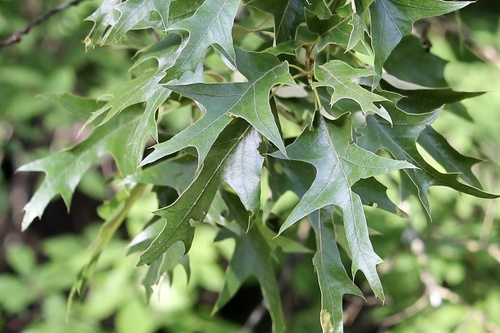
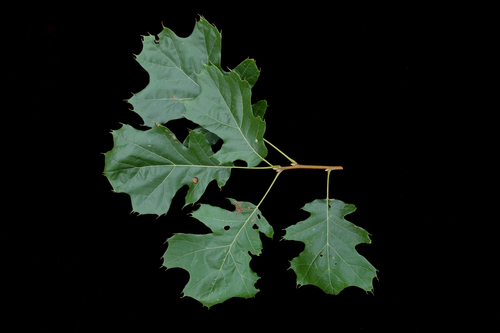
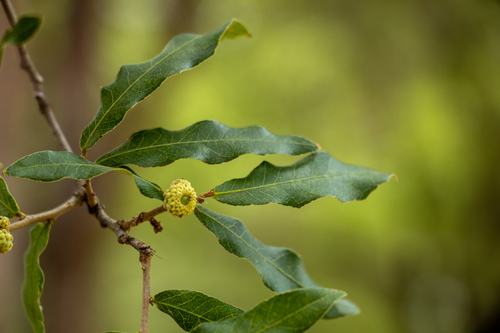
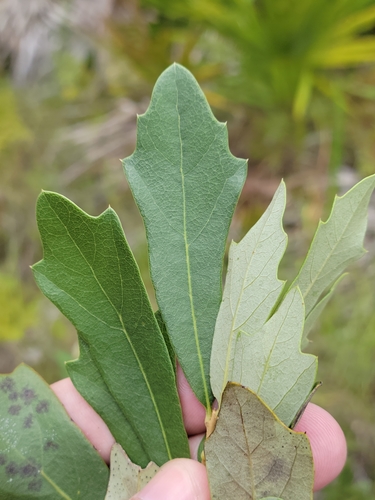
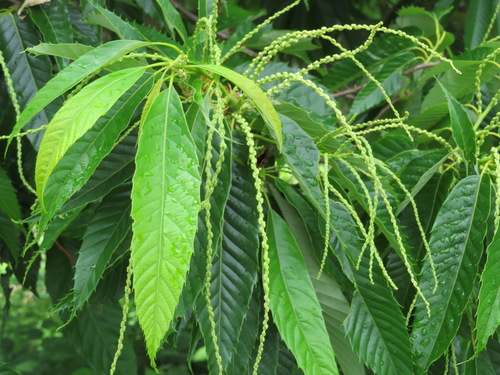
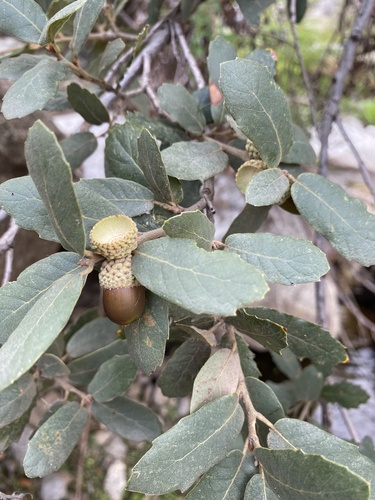
Quercus arizonica Sarg., commonly called Arizona white oak, is one of the largest oak species native to the southwestern United States. Mature trees can reach up to 60 feet (18 meters) in height, with a trunk diameter of up to 1 meter (3 feet 3 inches). They have stout branches and a spreading crown. Their leaves are typically around 8 centimeters (3 1/4 inches, or 1 1/2 to 3 1/2 inches) long, thick, leathery, stiff, and evergreen. Mature Arizona white oaks grow very slowly, adding only approximately 0.25 centimeters (3/32 of an inch) to their trunk diameter each year. The bark of this species is light grayish in color; it is initially thin and marked with lenticels, but becomes quite thick with age, developing shallow fissures and scaly ridges. Twigs are medium-sized, fuzzy, and range in color from light brown to reddish brown, with pointed, plump clusters of terminal buds. Leaves are alternate, simple, oblong, and yellowish green to bluish green. They usually have entire or toothed margins, a rounded base, parallel veins that are sunken on the leaf upper surface and raised on the underside. Old leaves typically shed in late winter, or when new leaves emerge in spring. This species produces oblong acorns that are 1/2 to 1 inch long, with bowl-shaped caps that cover one-third of the nut. Acorns typically mature in autumn, and annual production varies widely: a productive year can yield around 32,000 acorns, followed by a year with very few. Acorn germination is strongly correlated with moisture levels during the rainy season. Arizona white oak is monoecious, meaning separate male and female flowers grow on the same individual tree. Female flowers form as small spikes in leaf axils, while male flowers are long, drooping, yellowish green catkins. Arizona white oak grows across a wide variety of habitats including savannas, grasslands, and chaparrals, most commonly in mountainous areas at elevations above roughly 5,495 feet (1,675 meters). It has low water requirements, tolerates full sun or partial shade, and grows best in dry rocky or sandy soils, though it can also grow in clay loam, clay, or medium loam. It is tolerant of both heat and cold. The wood of Arizona white oak is most commonly used for fuel. Because it is hard, heavy, and strong, it is rarely used for commercial purposes such as furniture production. This tree provides cover for many animal species including deer, turkeys, javelinas, desert sheep, songbirds, quail, and specifically white-tailed deer. Both white-tailed and mule deer find the foliage highly palatable. The only species known to consume large quantities of its acorns is the thick-billed parrot. Arizona white oak can also be planted as an ornamental plant.