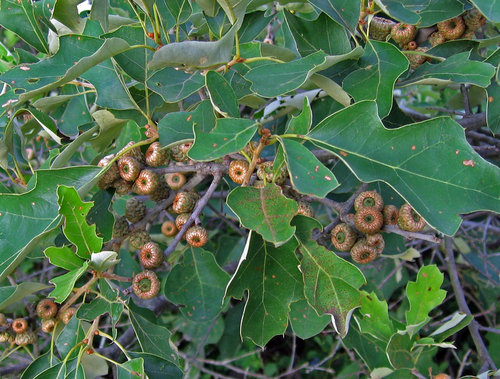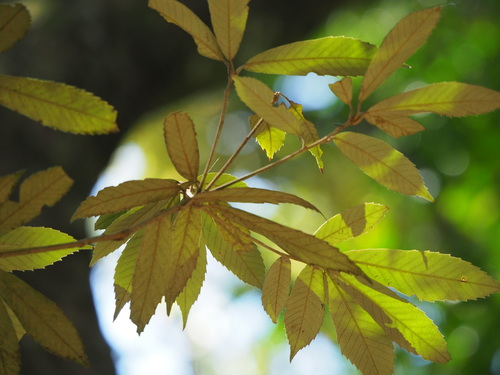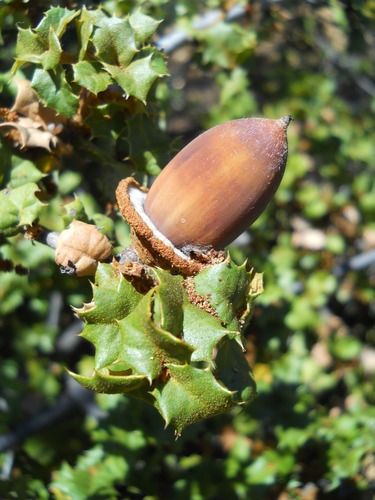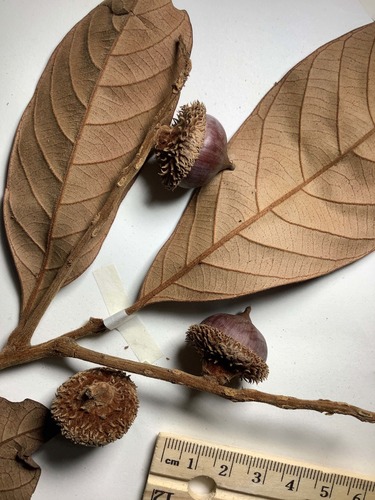
About Quercus alba L.
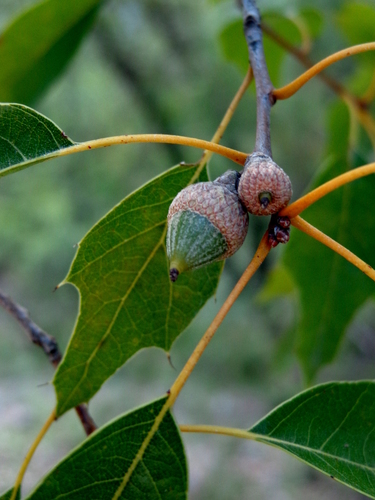
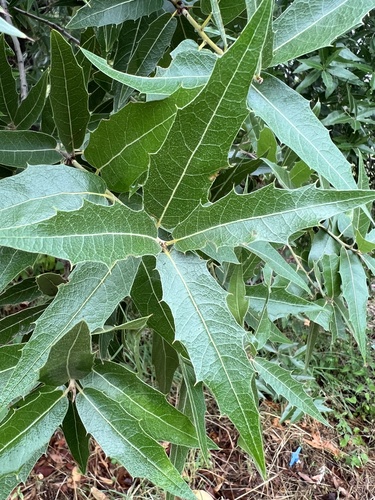
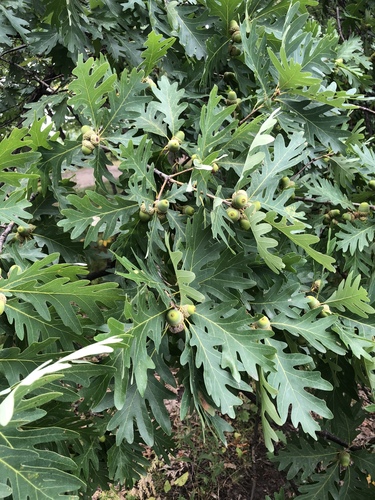
Quercus alba L. (white oak) typically reaches 24 to 30 meters (80–100 feet) tall at maturity. Its lower branches often extend far out laterally parallel to the ground, creating a very massive canopy. Forest-grown trees grow much taller, while open-grown specimens develop short, massive forms. The Mingo Oak, the tallest known white oak on record, measured over 200 feet tall with a 44.2 m (145 ft) trunk height before it was felled in 1938. It is common for a white oak’s crown spread to be as wide as the tree is tall, though high-altitude specimens may only grow as small shrubs. Its bark is light ash-gray and peels slightly from the top, bottom, and/or sides. As documented by Chris Bolgiano in *The Appalachian Forest: A Search for Roots and Renewal*, the largest tree ever cut in West Virginia was a white oak that measured thirteen feet thick at its base. White oaks typically live 200 to 300 years, and some older specimens have been recorded. The Wye Oak in Wye Mills, Maryland was estimated to be over 450 years old when it fell during a thunderstorm in 2002. Another notable specimen, the Basking Ridge white oak in New Jersey, was estimated to be over 600 years old when it died in 2016. This tree measured 8 m (25 ft) in circumference at the base, 5 m (16 ft) in circumference 1.2 m (4 ft) above ground, stood 23 m (75 ft) tall, and had branches that spanned 38 m (125 ft) from tip to tip. Claimed to be the oldest white oak in the United States, it began showing signs of poor health in the mid-2010s and was taken down in 2017. Sexual maturity begins around 20 years of age, but the tree does not produce large acorn crops until it reaches 50 years old, and acorn production varies year to year. Acorns deteriorate quickly after ripening, with a germination rate of only 10% for six-month-old seeds. Since acorns are a preferred food source for insects and other animals, all acorns may be consumed in low-production years, leaving none to grow into new trees. Acorns are usually sessile, grow 15 to 25 mm (1⁄2–1 in) long, and fall in early October. In spring, young leaves are delicate, silvery pink, and covered in a soft, blanket-like fuzz. They have short petioles, and clusters of leaves near shoot tips are pale green and downy, giving the entire tree a misty, frosty appearance. This appearance lasts for several days, and the leaves shift through opalescent color changes from soft pink to silvery white, and finally to yellow green. Mature leaves grow 12.5 to 21.5 centimeters (5–8+1⁄2 inches) long and 7 to 11.5 centimeters (2+3⁄4–4+1⁄2 in) wide, with a deep glossy green upper surface. They usually turn red or brown in autumn, but some trees consistently turn red or even purple in autumn, depending on climate, growing site, and individual genetics. Some dead leaves may stay on the tree through winter until very early spring. Leaf lobes may be shallow, extending less than halfway to the midrib, or deep and slightly branching. Quercus alba is sometimes confused with the closely related swamp white oak and with bur oak. It hybridizes freely with bur oak, post oak, and chestnut oak. Detailed traits: Bark: Light gray, ranging to dark gray or white; it is shallowly fissured and scaly. A key identification feature is that slightly over halfway up the trunk, the bark tends to form easily noticeable overlapping scales that help distinguish the species. Branchlets start bright green, later turn reddish-green, and finally become light gray. Wood: Light brown with paler sapwood; it is strong, tough, heavy, fine-grained, and durable. Winter buds: Reddish brown, obtuse, 3 mm (1⁄8 in) long. Leaves: Alternate, 13–23 cm (5–9 in) long, 7.5–10 cm (3–4 in) wide. They are obovate or oblong, with 7 to 9 lobes (usually 7), and have rounded lobes and rounded sinuses; lobes have no bristles, and sinuses vary from deep to shallow. Leaves on young trees are often repand. When emerging from buds, leaves are conduplicate, bright red above, pale below, and covered in white tomentum. The reddish color fades within a week or less, turning the leaves silvery greenish-white and shiny. When fully mature, leaves are thin, bright yellow-green, shiny or dull above, and pale, glaucous or smooth below; the midrib is stout and yellow, with conspicuous primary veins. In late autumn, leaves turn deep red and drop, though leaves on young trees may remain on branches through winter. Petioles are short, stout, grooved, and flattened. Stipules are linear and caducous. Flowers: Flowers appear in May when leaves are one-third fully grown. Staminate flowers grow on hairy aments 6.5–7.5 cm (2+1⁄2–3 in) long; the calyx is bright yellow, hairy, and six to eight-lobed, with lobes shorter than the stamens; anthers are yellow. Pistillate flowers grow on short peduncles; involucral scales are hairy and reddish; calyx lobes are acute; stigmas are bright red. Extrafloral nectaries have been reported for this species. Acorns: They develop annually, and are sessile or stalked. The nut is ovoid or oblong, round at the apex, light brown, shiny, and 20–25 mm (3⁄4–1 in) long. The cap is cup-shaped, encloses about one-fourth of the nut, is tomentose on the outside, tuberculate at the base, and has scales with short obtuse tips that get smaller and thinner toward the rim. Q. alba (and its close white oak relatives) acorns have no epigeal dormancy, and germinate readily without treatment. In most cases, the acorn root sprouts in fall, with leaves and stems emerging the next spring. Acorns take only one growing season to develop, unlike acorns of the red oak group which require two years to mature. Quercus alba is fairly tolerant of a wide range of habitats, and can grow on ridges, in valleys, in between, in both dry and moist habitats, and in both moderately acid and moderately alkaline soils. It is mainly a lowland tree, but reaches altitudes of 1,600 m (5,249 ft) in the Appalachian Mountains. It is often a component of the forest canopy in oak-heath forests. Frequent fires in the Central Plains region of the United States prevented oak forests including Q. alba from expanding into the Midwest. However, after European settlement, a decrease in the frequency of these natural fires allowed oak forests to expand rapidly into the Great Plains, which negatively impacted natural prairie vegetation. Quercus alba is cultivated as an ornamental tree only somewhat infrequently, due to its slow growth and ultimately very large size. It is not tolerant of urban pollution and road salt, and its large taproot makes it unsuited for use as a street tree or for planting in parking strips or islands. White oak acorns are much less bitter than red oak acorns. They can be eaten by humans, but tannins may need to be leached out if they are bitter. They are also a valuable food source for wildlife, most notably turkeys, wood ducks, pheasants, grackles, jays, nuthatches, thrushes, woodpeckers, rabbits, squirrels, deer, and black bear. Quercus alba is the only known food plant for caterpillars of Bucculatrix luteella and Bucculatrix ochrisuffusa. Young shoots of many eastern oak species including Q. alba are readily eaten by deer. Dried oak leaves are also occasionally eaten by white-tailed deer in fall or winter. Rabbits often browse twigs and can girdle stems.