About Quercus agrifolia Née
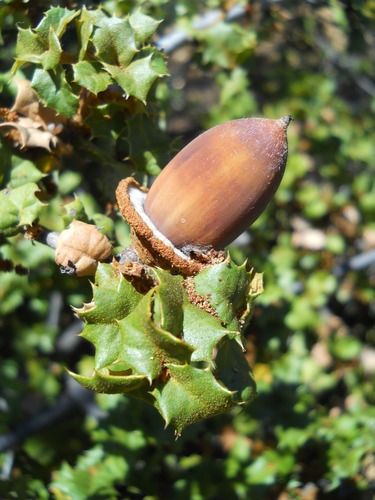
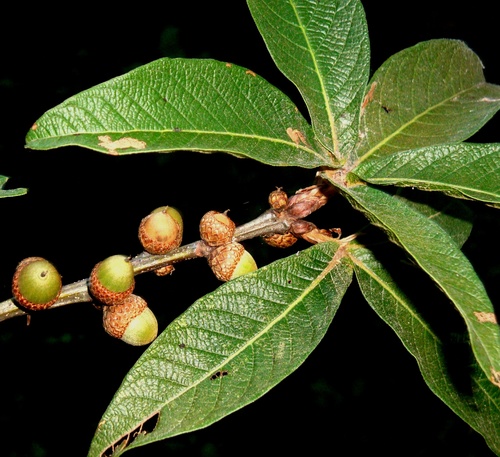
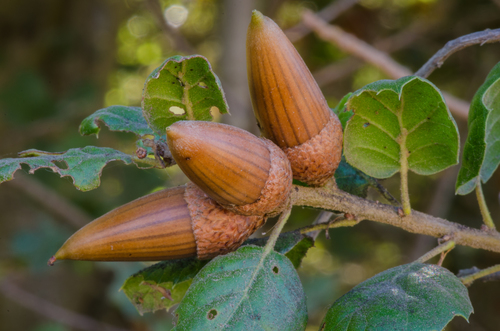
Coast live oak, scientifically named Quercus agrifolia Née, typically grows a much-branched trunk and reaches a mature height of 10 to 25 meters (33 to 82 feet). Some individual trees can live to be more than 1,000 years old; documented examples include the Grand Oak of Cherry Valley, California, the Pechanga Great Oak, and the Encino Oak Tree, which died in the 1990s and has had part of its stump preserved. This species is extremely drought-tolerant. For older individuals in particular, the trunk may be highly contorted, massive, and gnarled. Its crown is broadly rounded and dense, especially when the tree is between 20 and 70 years old. In later life, the trunk and branches become more distinct, and leaf density decreases. The oldest specimens can have a trunk circumference exceeding 6 meters (20 feet) and a height of up to 30 meters (100 feet). Its leaves are dark green, oval, and often convex in shape, measuring 2 to 7 centimeters (3⁄4 to 2+3⁄4 inches) long and 1 to 4 centimeters (1⁄2 to 1+1⁄2 inches) wide. Leaf margins are spiny-toothed (spinose), with sharp thistly fibers extending from the lateral leaf veins. Outer layers of leaves are structured for maximum solar absorption, containing two to three layers of photosynthetic cells. These outer leaves are small in size to more efficiently re-radiate heat absorbed from sunlight. Shaded leaves are generally broader and thinner, with only a single layer of photosynthetic cells. The convex leaf shape may benefit interior leaves, which rely on capturing reflected light scattered randomly from the outer canopy. This shape may also act as a condensation surface for dew and mist, allowing the tree to survive through years with limited rainfall. Coast live oak produces flowers in early to mid spring. Male flowers grow as pendulous catkins 5 to 10 centimeters (2 to 4 inches) long, while female flowers are inconspicuous, less than 0.5 centimeters (1⁄4 inch) long, and clustered in groups of 1 to 3. The fruit is a slender reddish brown acorn that measures 2 to 3.5 centimeters (3⁄4 to 1+1⁄2 inches) long and 1 to 1.5 centimeters (3⁄8 to 5⁄8 inches) wide, with the basal quarter of the acorn enclosed in a cupule. Unusually for red oaks, its acorns mature around 7 to 8 months after pollination; most other red oak acorns take 18 months to mature. Coast live oak is most often found within 100 kilometers (62 miles) of the Pacific Ocean, growing on coastal hills and plains. It prefers well-drained soil and proximity to perennial streams, and often grows in communities with other native oaks, and sometimes in mixed evergreen forests. It generally grows at elevations below 700 meters (2,300 feet), but can be found at elevations as high as 1,500 meters (4,900 feet) in some locations. This oak is adapted to near-coastal climates, and has a higher-than-average tolerance for airborne salinity, which allows coastal fog to offset low rainfall through much of the year. Coast live oaks are the dominant tree species in their woodland habitat. This habitat commonly hosts other shrubs and vines, including toyon, California coffeeberry, California man-root, bitter gooseberry, California wild rose, Hummingbird sage, blue elderberry, and poison-oak. The caterpillars of the California oak moth (Phryganidia californica) feed exclusively on living and fallen coast live oak leaves. In 8 to 10 year cycles, the caterpillars can become abundant enough to completely strip healthy trees of their foliage. The trees recover, and botanists hypothesize that the two species provide mutual benefit, possibly with the moth providing fertilizer for the oak. Coast live oak is also the only known food plant for caterpillars of the moth Chionodes vanduzeei. Along with other western oaks, live oak trees support acorn woodpeckers, which store their acorns in tree trunks and retrieve them to eat later.