About Pystira ephippigera (Simon, 1885)
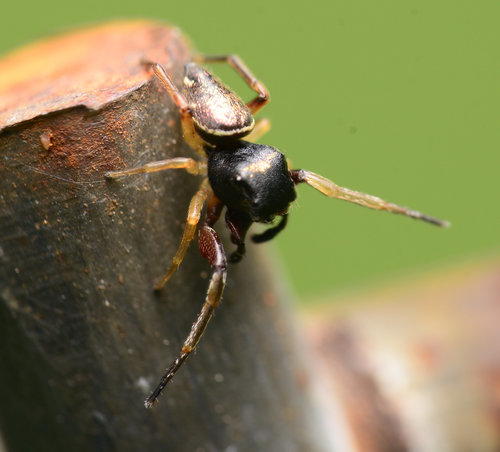
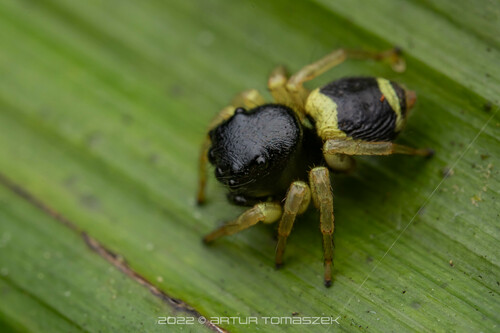
This description of Pystira ephippigera is based on Simon's original 1885 account. The female of the species has a thick, convex, blackish cephalothorax, which is very sparsely hairy, appearing almost hairless with a shiny, somewhat leathery texture. The female's opisthosoma is short and depressed; its front edge is blunt, and its back is strongly pointed, with an overall whitish-opaque color. In the center of the dorsal surface of the opisthosoma sits a very broad, transverse, saddle-shaped marking that takes up more than half the total length of the dorsum. This marking is followed by a shorter transverse stripe that is much narrower than the blackish ornamentation above it. Lower down, both sides of the opisthosoma are blackish with testaceous areas. The legs, pedipalps, chelicerae, and sternum are black, and all coxae are a faint, unclear brownish. The legs are pale yellow, short and robust. For the first and second legs, the tibiae have two terminal spines, excluding the blunt tibiae, and the first and second metatarsi have two pairs of short spines on their underside. Pystira ephippigera was originally described from Sumatra, Indonesia. The type specimen was collected on Sumatra, and is presumed to be held at the Muséum National d'Histoire Naturelle in Paris, France, the institution where most of Simon's type material is housed. The species has also been recorded in Thailand, Cambodia, and peninsular Malaysia.