About Pyrus syriaca Boiss.
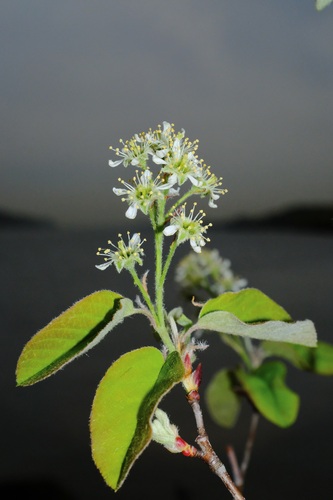
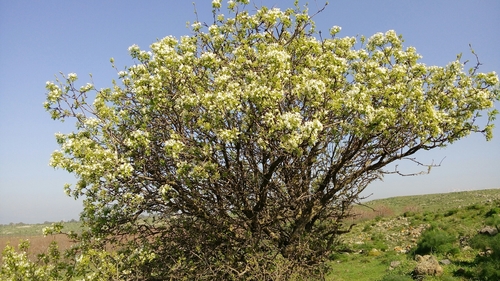
Pyrus syriaca Boiss. is a deciduous tree that grows up to 13 metres (43 ft) tall, and has a broad, sometimes irregular crown. Its branches are reddish‑brown to grey, marked by small, lens‑shaped openings called lenticels. The tree's buds are broadly oval, 3–7 mm long, and are initially covered in soft hairs that wear away over time. Young shoots have a dense, silky covering of hairs called sericeous pubescence, which becomes completely hairless (glabrous) as the shoots age. Leaves range in shape from long‑elliptic to ovate or lanceolate, and are rarely oblanceolate; they measure 1–10 cm long and 0.8–4 cm wide, with their broadest point typically at or just below the middle of the leaf blade. Leaf margins are toothed, ranging from crenate to serrate, with each tooth ending in a small, deciduous callous. The upper leaf surface is glossy and hairless, while the lower leaf surface has sparse, short hairs that usually disappear as the leaf matures. Flowering takes place from late April to early May, with blossoms produced in loose clusters called corymbs that hold 7–20 flowers each. Individual flowers measure 1.5–3 cm across. Each flower has five white, orbicular to obovate petals that are 8–14 mm long and 6–12 mm wide; petals attach via a short stalk (claw) to a cup‑shaped hypanthium that is densely covered in hairs. Sepals are triangular to linear, 4–7 mm long, with an acute tip, and are covered in dense, matted hairs (tomentose) on both surfaces. The flower cup typically holds up to five styles that reach 8 mm long, and 20–35 stamens arranged in one or two concentric rings. Mature fruits of Pyrus syriaca are pomes, ranging in shape from nearly spherical to broadly pear‑shaped, and measure 1.5–3.5 cm by 1.5–3.5 cm. Ripe fruits are greenish‑yellow, with persistent sepals that remain pressed flat against the fruit surface. Each pome grows on a thickened stalk (pedicel) that often widens just below the fruit to provide extra support. Fruits mature from late August through October. Pyrus syriaca grows in dry, well‑drained habitats across the eastern Mediterranean and adjacent regions. Its native range extends from southern Turkey and the southern Transcaucasus through Cyprus, western Syria, northeastern Iraq, Lebanon and western Jordan, and reaches into southwestern Iran. In Iran, it is the most widespread pear species. It grows on dry slopes in open forests of the Zagros Mountains, where it grows alongside other pear species and oaks. In the Arasbaran area of northeastern Iran, it grows in denser woodland with other pears, oaks, hornbeam and elm.