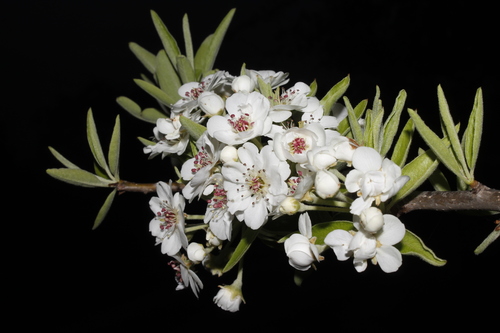
About Pyrus spinosa Forssk.
Pyrus spinosa Forssk. is a spiny shrub or small tree that grows up to around 6 meters tall. Young twigs start out covered in dense, white woolly hairs (a trait called villous), but become smooth and completely hairless (glabrous) as they age. Its leaves are narrow and variable in shape, ranging from lance-shaped (lanceolate) or oval (elliptic) to egg-shaped with the broader end at the tip (obovate). They typically measure 2.5 to 5.0 centimeters long, occasionally reaching 7 centimeters, and 1 to 2 centimeters wide, occasionally reaching 3 centimeters. The leaf margin is usually smooth (entire), but may have shallow, rounded teeth (crenations) near the leaf tip. Leaves may attach directly to the twig (sessile) or grow on short stalks called petioles that are up to 2 centimeters long. When young, the lower surface of each leaf is covered in white villous hairs; as the leaf matures, both sides become smooth. In spring, Pyrus spinosa produces many-flowered clusters called corymbs, whose stalks and bracts are covered in greyish, matted hairs (a trait called tomentose). Individual flowers are 2.0 to 2.5 centimeters across, with five white petals surrounding a cup-shaped hypanthium. By mid to late summer, the plant produces small pear-like fruits called pomes that are 2 to 3 centimeters in diameter. The fruit is nearly spherical (subglobose), yellowish-brown when ripe, and keeps its calyx lobes at the tip. Each fruit grows singly on a stout, stiff stalk called a pedicel that is 2 to 3 centimeters long. Pyrus spinosa is native to the Mediterranean region, with a core distribution stretching from southern Europe into western Anatolia. It most often grows in dry open forests and scrublands on well-drained rocky slopes and at woodland edges. It favours elevations between 1,000 and 2,000 m (3,300–6,600 ft), where it frequently grows alongside oaks and other drought-tolerant shrubs. While it is primarily recorded from Europe and Anatolia, herbarium collections from two sites in western Iran, located near the Turkish border in the Zagros Mountains, confirm the species grows there, extending its known range eastward.