About Pyrus calleryana Decne.
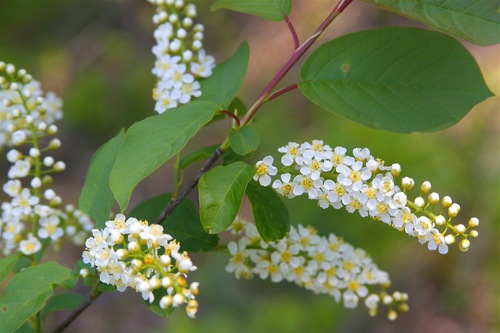
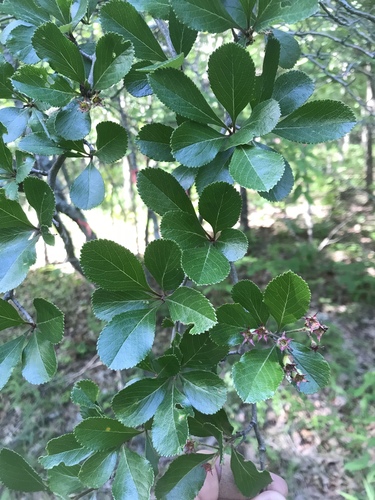
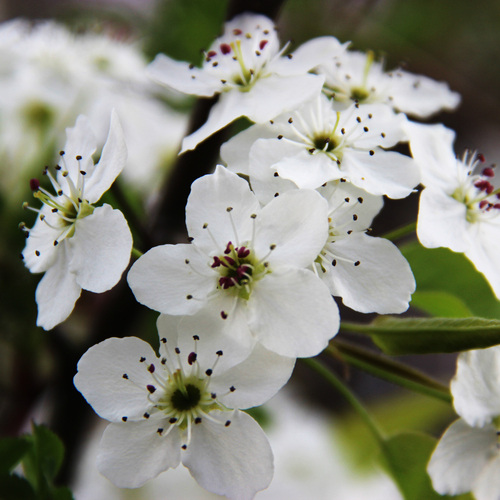
Pyrus calleryana Decne., commonly known as Callery pear, is a deciduous tree that grows 5 to 8 m (16 to 26 ft) tall, and typically has a conical to rounded crown. Its leaves are oval, 4 to 8 cm (1+1⁄2 to 3 in) long, with glossy dark green upper surfaces and pale lower surfaces. The leaves have long petioles and are alternately arranged on branches. The tree produces abundant white, five-petaled flowers that measure around 2 to 2.5 cm (3⁄4 to 1 in) in diameter. These flowers bloom in early spring, before leaves have fully expanded. Callery pear fruits are small, with diameters under 1 centimeter (3⁄8 in), and are hard and nearly woody until they soften after frost. The fruits are often considered inedible because their abundant seeds contain cyanide. Once softened by frost, the fruits are readily eaten by birds, which disperse the tree's seeds through their droppings. In summer, Callery pear foliage is dark green, shiny, and very smooth. In autumn, leaves commonly turn bright colors, ranging from yellow and orange to more common shades of red, pink, purple, and bronze. However, because this color change often occurs very late in autumn, leaves may be killed by a hard frost before they can develop full autumn color. Callery pears are remarkably resistant to disease and fireblight. However, some cultivars such as 'Bradford' are particularly susceptible to storm damage. These cultivars are regularly disfigured or killed by strong winds, winter weather, or limb loss, due to their naturally rapid growth rate and steep vertical branching pattern.
Callery pear is native to mainland China, Japan, the Korean Peninsula, and Taiwan. It has been reported as an introduced species in the United States, Canada, Iraq, and the Western Himalayas region of India.
Numerous cultivars of Callery pear are sold commercially, including 'Aristocrat', 'Autumn Blaze', 'Bradford', 'Capital', 'Chanticleer' (also known as 'Cleveland Select'), 'New Bradford', 'Redspire', and 'Whitehouse'.
Pear wood from any pear species, including this one, has one of the finest textures of all fruitwoods. It is prized for making woodwind instruments, and pear veneer is used to make fine furniture. Pear wood is also one of the preferred materials for preparing printing woodcuts; end-grained pear wood is used for small works, while side-grained pear wood is used for larger works. Callery pear has been used as rootstock for grafting edible pear cultivars including Comice, Bosc, Seckel, and especially Nashi. Pyrus calleryana was first introduced into the United States in 1909 and 1916, largely through the dedicated research of Frank N. Meyer, a plant explorer for the US Department of Agriculture who is commonly known for discovering the Meyer lemon. The species was originally introduced for agricultural experimentation; its potential as an ornamental plant was not recognized until the 1950s.