About Pyrrhulomyces astragalinus (Fr.) E.J.Tian & Matheny
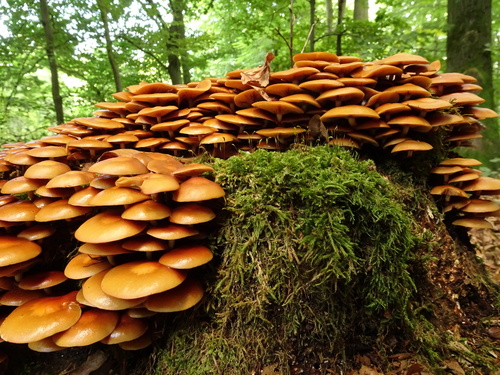
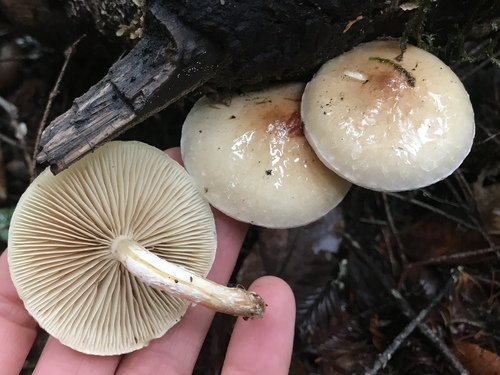
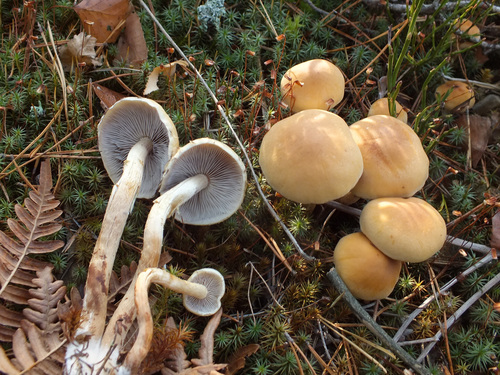
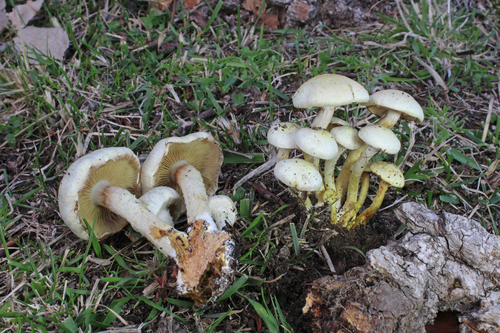
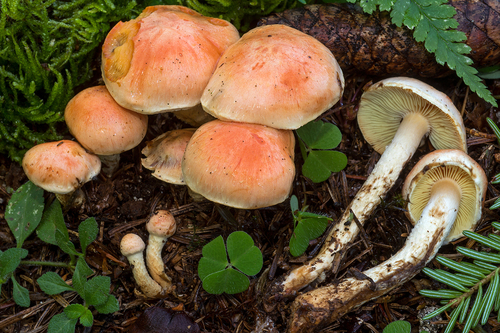
Pyrrhulomyces astragalinus (Fr.) E.J.Tian & Matheny has a cap 2–6 cm (3⁄4–2+1⁄4 in) broad, which is hemispheric to convex with a blunt umbo. The cap surface is viscid when moist, colored brilliant pink-orange to salmon, fading and blackening as the mushroom ages. The cap margin is fibrillose, and often bears fleeting veil remnants. The gills are adnexed to adnate, closely spaced, yellowish-brown, with paler, fimbriate edges. The stipe measures 4–12 cm long and 4–8 mm thick, and is cylindrical, flexuous, and fibrillose or scaly. Young specimens often have a cobwebby annulus on the stipe. The flesh is orange, stains black when exposed to air, and has a mild odor and bitter taste. The spore print of this species is reddish-brown to cinnamon. Under microscopic examination, basidiospores measure 6–8 by 4–5 μm (with intermediate ranges 6.8– and 4.4–), are ellipsoid to somewhat ovate, thin-walled, lack a germ pore, appear pale yellowish-brown in KOH, and brown in spore deposit. Basidia are narrowly club-shaped (clavate), measuring 20–28 by 7–8 μm, and are four-spored. Pleurocystidia are chrysocystidia, fusiform-ventricose to clavate with golden inclusions, and measure 42–55 by 12–18 μm. Cheilocystidia are narrow, with a long neck and an obtuse apex. The pileipellis is an ixocutis made of gelatinous hyphae, and clamp connections are present. While it is not poisonous, Pyrrhulomyces astragalinus is considered inedible. DNA sequencing may be needed to distinguish this species from the related P. amariceps. This species is saprotrophic, growing on decaying conifer wood, most often on late-decay logs and stumps. Mushrooms fruit singly or in small clusters, from late summer through autumn, and can continue into winter in mild coastal climates. Pyrrhulomyces astragalinus is widespread across temperate regions of the Northern Hemisphere. It has been recorded in Europe (including Italy, Sweden, and Switzerland), East Asia (Jilin and Jiangxi provinces in China), and North America. In North America, it occurs from Alaska, British Columbia, Washington, and Idaho east to Newfoundland and Maine, and south along the Pacific coast and in high-elevation conifer forests of the southern Appalachians in North Carolina and Tennessee.