About Pyrrhula murina Godman, 1866
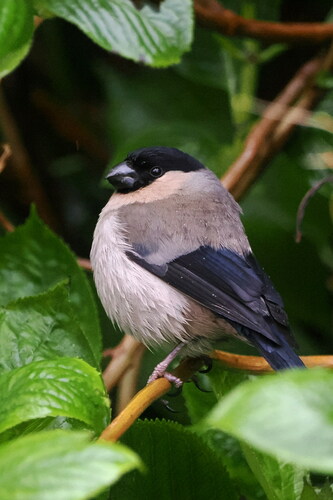
The Azores bullfinch (Pyrrhula murina Godman, 1866) measures 15–17 cm (5.9–6.7 in) in length and weighs approximately 30 g (1.1 oz), with males slightly larger than females. Compared to most other finches in its family, it has a plump build, shorter wings, and a longer tail. Its plumage pattern matches that of the Eurasian bullfinch, but its coloration is more sombre and lacks the Eurasian bullfinch's bright pink underparts. It has a black cap, face, wings, and tail, with the rest of its plumage being greyish or pale grey-brown. Males and females look nearly identical, though males may show a faint pinkish tint on the belly and flanks. Its contact call is a distinctive short, flute-like, melancholic whistle. Currently, the Azores bullfinch is mostly restricted to a small area of around 580 hectares (1,400 acres) of native laurisilva forest at the eastern end of São Miguel, between 300–800 m (980–2,620 ft) above sea level. Its range is mainly centered on Pico da Vara in the Serra da Tronqueira range, but it also occurs seasonally from September to December around Salto do Cavalo, further west in the same range. The population at Salto do Cavalo is likely made up of juveniles that have dispersed after fledging. This species has never been recorded from the western end of São Miguel. Restoration of the species' suitable ecological habitats in the northern Macaronesia archipelago is required for the Azores bullfinch's population recovery. The population decline affecting this species, which is also experienced by many other endemic Azorean plants, is worsened by the spread of invasive alien plants. Current projects focused on conserving the Azores bullfinch include restoring the original laurel forest habitat in the eastern monteverde of São Miguel.