About Pyrrhomyias cinnamomeus (Orbigny & Lafresnaye, 1837)
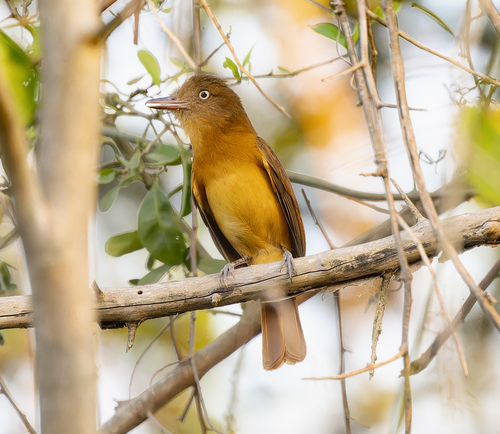
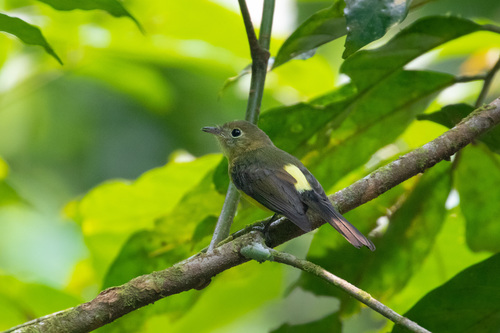
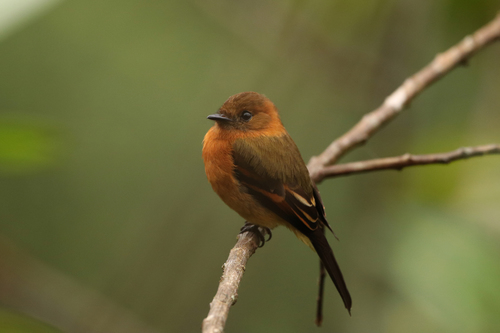
Scientific name: Pyrrhomyias cinnamomeus (Orbigny & Lafresnaye, 1837), commonly called the cinnamon flycatcher. This species measures 11 to 13 cm (4.3 to 5.1 in) in length and weighs about 11 g (0.39 oz). Males and females have identical plumage. Adults of the nominate subspecies P. c. cinnamomeus have a dark brownish crown with a partially hidden yellow central patch. They have a faint buffy eye-ring and a small patch above the lores, olive-brown cheeks and nape, and cinnamon-rufous sides of the neck. Their upperparts are olive-brown, with a thin, often hidden cinnamon-orange band on the rump. Their wings are black, with wide rufous edges on the flight feathers and wide rufous tips on the coverts that form two distinct wing bars. Their tail is blackish. Their throat and underparts are cinnamon-rufous, with the belly a lighter shade than the rest of the underparts. They have a dark iris, a wide black bill, and blackish legs and feet. Juveniles are browner than adults, with ochraceous tips on the lower back and tail feathers, and lack the yellow crown patch. Other subspecies differ from the nominate and from each other as follows: P. c. assimilis has a reddish brown crown, orange-rufous back, a thin olive band on the upper rump above an orange-buff band, rufous tail feathers with a dark brown band near the tip, and more rufous on the flight feathers than the nominate. P. c. vieillotioides, P. c. spadix, and P. c. pariae all share a reddish-brown crown, a rufescent-brown back that fades to olive on the upper rump, a large amount of rufous on the tail feathers, and a slightly paler or duller breast than the nominate. P. c. pyrrhopterus has an olive tinge to the crown, an olive back, and a brighter orange-yellow rump band than the nominate. Each subspecies has a distinct distribution: P. c. assimilis is found only in the isolated Sierra Nevada de Santa Marta in northern Colombia. P. c. vieillotioides occurs in the Andes of Venezuela from northern Táchira to Lara, and in the Venezuelan Coastal Range from Yaracuy and Carabobo to Miranda. P. c. spadix lives in the Venezuelan Coastal Range in Anzoátegui, western and southern Sucre, and northern Monagas. P. c. pariae is restricted to cerros Humo and Azul on the Paria Peninsula in northeastern Venezuela. P. c. pyrrhopterus ranges from the Andes of southern Táchira in western Venezuela and Serranía del Perijá on the Venezuela-Colombia border, south through the Colombian Andes, along both slopes of the Ecuadoran Andes, and into the Peruvian Andes as far as Cajamarca Department on the western slope and San Martín Department on the eastern slope. The nominate subspecies P. c. cinnamomeus is found on the eastern slope of the Andes from San Martín Department in Peru, south through Bolivia into northwestern Argentina as far as Tucumán Province. The cinnamon flycatcher inhabits foothill and montane forest in the subtropical and temperate zones. Within this habitat, it favors brushy clearings and edges, both natural and along roads. At least in Colombia, it is often found near rock faces. Its elevation range varies by country: between 700 and 2,900 m (2,300 and 9,500 ft) in Venezuela, 1,500 and 3,000 m (4,900 and 9,800 ft) in Colombia, 1,200 and 3,000 m (3,900 and 9,800 ft) in Ecuador, and 900 and 3,400 m (3,000 and 11,200 ft) in Peru.