About Pyrrhocorax graculus (Linnaeus, 1766)
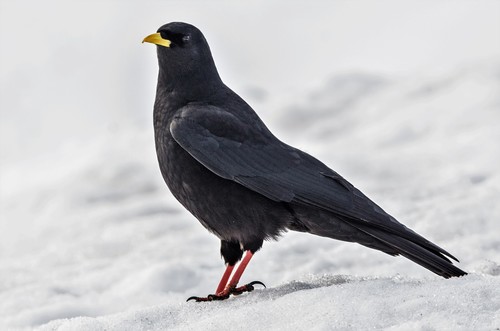
This bird species is the Alpine chough, with the binomial name Pyrrhocorax graculus (Linnaeus, 1766). Adults of the nominate subspecies have glossy black plumage, a short yellow bill, dark brown irises, and red legs. This subspecies measures 37–39 centimetres (15–15 inches) in total length, with a 12–14 cm (4.7–5.5 in) tail and a 75–85 cm (30–33 in) wingspan. It is slightly smaller than the red-billed chough, but has a proportionally longer tail and shorter wings, while sharing a similar buoyant, easy flight. Males and females look identical, though males average slightly larger than females. Juveniles are duller than adults, with a dull yellow bill and brownish legs. The Alpine chough is rarely confused with other co-occurring species: the jackdaw, which shares its range, is smaller and has non-glossy grey plumage, while the red-billed chough has a long red bill. The subspecies P. g. digitatus averages slightly larger than the nominate P. g. graculus; P. g. digitatus weighs 191–244 g (6.7–8.6 oz), while the nominate subspecies weighs 188–252 g (6.6–8.9 oz), and P. g. digitatus also has stronger feet. This size pattern aligns with Bergmann's rule, which predicts larger body sizes in birds found at higher elevations or in colder, more arid regions. In warmer areas, the extremities (the bill and tarsus) are longer, which matches Allen's rule. Temperature appears to be the most important driver of body size variation in this species. Alpine chough flight is swift and acrobatic, with loose, deep wing beats. It achieves high manoeuvrability by fanning its tail, folding its wings, and soaring in updrafts along cliff faces. Even in flight, it can be told apart from the red-billed chough by its less rectangular wings and longer, less square-ended tail. Its calls are a rippling preep and a whistled sweeeooo, which are quite different from the typical crow-like chee-ow vocalizations of jackdaws and red-billed choughs. It also has a rolling churr alarm call, plus a range of quiet warbles and squeaks produced by resting or feeding birds. A study of chough calls across the Palearctic region found that call frequency in Alpine chough has an inverse relationship with body size: smaller-bodied populations produce higher-pitched calls. The Alpine chough breeds in mountain ranges from Spain eastward through southern Europe and the Alps, across Central Asia and the Himalayas to western China. It also has separate populations in Morocco, Corsica and Crete. It is a non-migratory resident across its entire range, though Moroccan birds have established a small new colony near Málaga in southern Spain, and wandering individuals have been recorded in Czechoslovakia, Gibraltar, Hungary and Cyprus. This is a high-altitude species: it normally breeds between 1,260–2,880 metres (4,130–9,450 ft) in Europe, 2,880–3,900 m (9,450–12,800 ft) in Morocco, and 3,500–5,000 m (11,500–16,400 ft) in the Himalayas. It has nested at 6,500 m (21,300 ft), a higher elevation than any other bird species recorded, surpassing even the red-billed chough, whose diet is less well adapted to the highest altitudes. It has been observed following mountaineers ascending Mount Everest at an altitude of 8,200 m (26,900 ft). It usually nests in cavities and fissures on inaccessible rock faces, though in some local areas it will use gaps between rocks in open fields. It forages in open habitats such as alpine meadows and scree slopes down to the tree line or lower. In winter, it will often gather around human settlements, ski resorts, hotels and other tourist facilities. Its habit of waiting near hotel windows to get food is popular with tourists, but less popular with hotel owners.