About Pyrrharctia isabella J.E.Smith, 1797
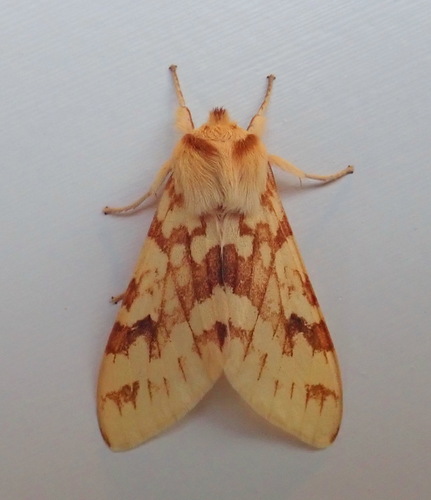
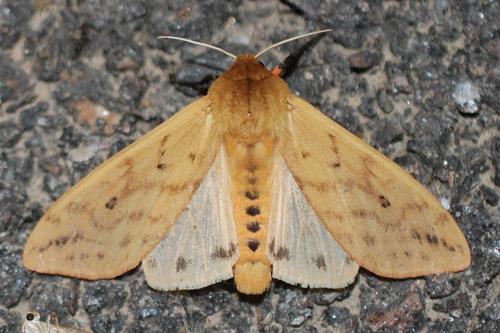
This species, Pyrrharctia isabella, is the Isabella tiger moth. Its larvae have thirteen body segments. These larvae are usually covered with brown hair on their mid-regions, and black hair on their anterior and posterior regions. The brown hair appears bright reddish brown when viewed in direct sunlight. The setae, or hairs, are all uniform in length, which distinguishes this species from other similarly appearing tiger moth larvae. Adult Isabella tiger moths are generally dull yellowish to orangish in color. They have robust, scaly thoraces, small heads, and bright reddish-orange forelegs. Their wings have sparse black spotting, and each of their abdominal segments holds three black dots. The Isabella tiger moth occurs across many cold and temperate regions. The banded woolly bear larva of this species hatches from its egg in the fall, and overwinters in the caterpillar life stage. It allows most of its body mass to freeze solid to survive the winter: first its heart stops beating, then its gut freezes, followed by its blood, and finally the rest of the body. It survives this freezing process by producing a cryoprotectant in its tissues. Freezing only occurs outside of the body's cells, and does not happen inside cells. In spring, the frozen caterpillar thaws out. The larval setae do not inject venom, are not urticant, and do not typically cause irritation, injury, inflammation, or swelling. Even so, handling these larvae is discouraged, because their sharp, spiny hairs can cause dermatitis in some people.