About Pyronota festiva (Fabricius, 1775)
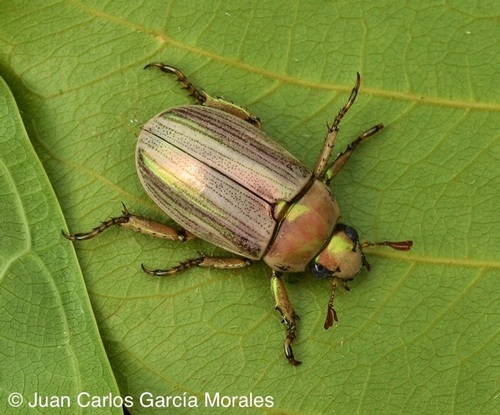
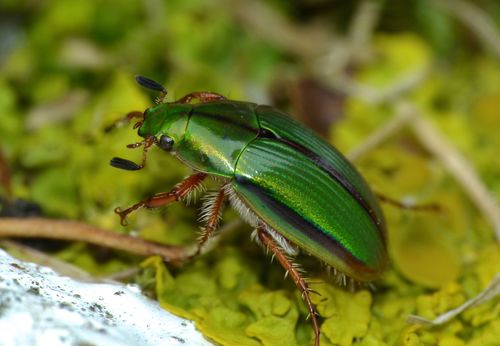
The mānuka beetle, with the scientific name Pyronota festiva (Fabricius, 1775), is bright green with blue and yellow shades on areas of its back. A dark longitudinal stripe running down the back of its hard wing case is often brown or yellow. Its body length varies between 3 and 25mm, with 9mm being the most common size. It belongs to the superfamily Scarabaeoidea, and is characterized by a modified prothorax and large coxae. It has a lamellate antennal club on its antennae, and a head with anterior margins that are either semicircular or emarginate; its mesocoxae are strongly oblique. The species is part of the subfamily Melolonthinae, which is defined by a stout body, a glossy exterior, and the presence of either labrums or mandibles. The antenna segments are either elongated or form oval lobes that can be folded tightly together to create compact, asymmetrical clubs. The elbowed antennal clubs have between 8 and 10 segments. The mānuka beetle has spindly legs covered in light-coloured hairs; the legs are heavily modified for digging, with teeth, spines and/or bristles. Its abdomen has 6 ventrites, and the hind wing has a spring mechanism that allows it to fold. Larvae (grubs) grow into a C-shape. The mānuka beetle is endemic to New Zealand, and there is no compelling evidence that it is found anywhere else in the world. It is closely related to other Scarabaeidae beetles such as chafers, dung beetles, and grass grubs, which occur in other parts of the world. An old journal article held by a museum in London records mānuka beetles found in sheep's wool imported from New Zealand. The species has a widespread range across New Zealand, with little information available about its impacts on land outside of New Zealand. Because endemic New Zealand species are often closely related to Australian species, it has been assumed that mānuka beetles may also occur in Australia. Within New Zealand, the mānuka beetle is very common and found in large numbers throughout the country. It inhabits grass and vegetation habitats, which make up most of New Zealand's landscape. It is so common that it has become a pasture pest for agricultural grasslands. The species has been recorded in Egmont National Park, Taranaki, North Island, where it was found in pastures near native bush containing mānuka trees. A 5 km belt surrounding the park shows clear evidence of damage from mānuka beetle larvae feeding on plant roots. Research using traps placed 20m and 50m away from mānuka bush recorded the beetles' flight activity, and found that more beetles were present further from the bush than close to it. Of all members of the Melolonthidae family, mānuka beetles have the widest ecological tolerance for different habitats, though they prefer woody vegetation. They tend to occur in tussock and pastures that have been developed for 2 to 3 years after conversion from native vegetation or bush regrowth. However, as its common name suggests, the mānuka beetle prefers to live in and around the soil of mānuka trees (Leptospermum). Adult beetles have been observed swarming over the small white flowers that cover mānuka during the summer flowering season. Most experimentation on Pyronota species has taken place in the Otago region. At Macraes Flat, Otago, Stewart (1987) found that a Pyronota beetle species follows an approximately two-year life cycle: the beetles spend two winters as larvae, and mature into adult beetles the following summer, between November and January. General observation of the species' habitat preferences confirms that warmer temperatures attract mānuka beetles to an area, which leads to significant population increases; Stewart (1987) also observed that adults are more active on sunny days than on overcast days or at night. This finding is notable because Otago has more sunless days than Taranaki. The two-year life cycle includes three larval stages. Eggs are laid in January; first or second instar larvae survive their first winter, and third instar larvae survive their second winter. When conditions meet most of the species' needs, individuals are more likely to complete their full two-year life cycle. When conditions do not meet their needs, development can take place over a shorter time period, sometimes within just one year. Immature larvae are considered a minor pest. After hatching, larvae develop into pupae and feed on the roots of plants that grow in pasture soils. As they grow, they retain a C-shape. In early summer of their third year, fully grown beetles emerge from tunnels or cracks in the soil to feed on the foliage of mānuka plants. Damage from pupal root-feeding becomes visible during autumn and winter of this third stage. Adult beetles are present for a few weeks each year during late spring and early summer. They fly during the day in warm conditions. Females lay their eggs in pasture soil at depths of up to 10 cm, and each female can lay up to 30 or 40 eggs at one time. When populations reach 350 beetles per square metre, they cause significant damage to pastures, which appears as yellow, dried-out patches of grass. The mānuka beetle's life cycle differs slightly from that of its relatives, which include other Scarabaeidae members: chafers, dung beetles and grass grub beetles. Mānuka beetle eggs are laid in soil, and after hatching into larvae, they undergo a reasonably long period of development underground. Adult beetles die very shortly after mating, and their dead bodies often form drifts or mounds around mud or tree roots. There are multiple records of mānuka beetles being used by indigenous Māori tribes across New Zealand. Piles of dead adult beetle bodies that form in and around shallow water, mud and vegetation were often collected and eaten by Māori as a delicacy. Another record notes that when Māori tribes first settled in New Zealand, mānuka beetles were among the insects they ate occasionally. Māori also used mānuka beetles for their antiseptic qualities, to reduce fevers and treat stomachaches. More fleshy insects such as the larvae of the cerambycid huhu grub (and adult huhu beetles) were more widely eaten than mānuka beetles. Along with Puriri moths, mānuka beetles were also used for medicinal purposes. New Zealand Fishing (1998) notes that mānuka beetles are most active during daylight hours in November and December. Heavy winds often blow them onto the surface of the water, where trout wait to feed on them. The presence of mānuka beetles in the intestines of trout from Lake Tikitapu confirms this feeding interaction. Fishermen have also created a trout fishing fly patterned after the mānuka beetle, called the 'green beetle', which is designed specifically to catch trout during the summer months.